
What OEKO-TEX's 2026 Update Means for Swimwear Sourcing
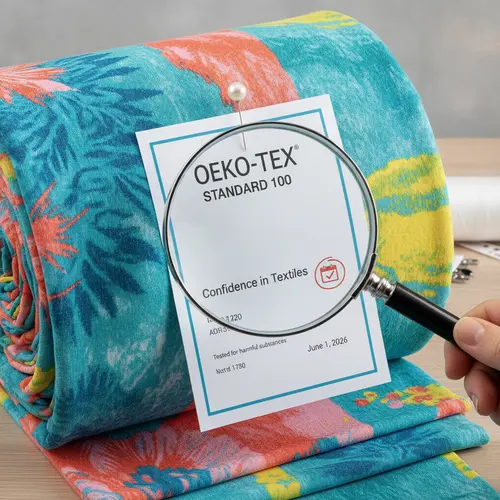
OEKO-TEX's STANDARD 100 certification changed in a real, dated way this year. New limit values and requirements took effect June 1, 2026 after a three-month transition period, and the update is more substantial than the yearly refreshes OEKO-TEX has typically made in past years. If you're sourcing swimwear fabric and a supplier hands you an OEKO-TEX certificate, here's what that certificate now actually covers — and what it doesn't yet require.
What Actually Changed
Three changes matter most for anyone buying swimwear fabric:
Change | What It Means in Practice |
|---|---|
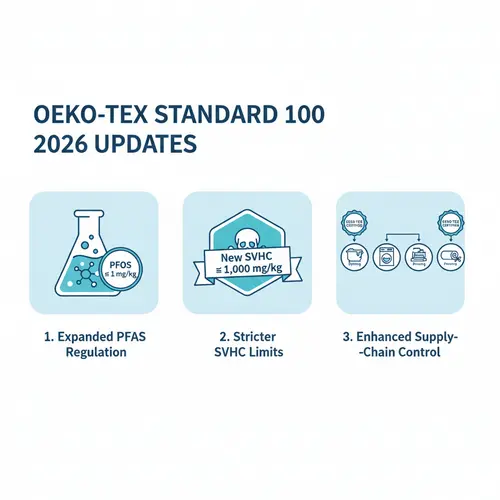
**PFOS limit tightened to 1 mg/kg** | Applies to both STANDARD 100 and ORGANIC COTTON certification. This is a significant tightening from prior limits, aimed at PFAS-family chemicals used in some water-repellent and stain-resistant finishes. |
**New Substances of Very High Concern (SVHC) added** | Two additional restricted substances were added to STANDARD 100 at a 1,000 mg/kg limit — mainly relevant to fabrics using antimicrobial, flame-retardant, or UV-protective finishing treatments. |
**Full wet-processing traceability required** | This is the biggest structural change. Renewed STANDARD 100 and ORGANIC COTTON certificates will require every wet-processing supplier in the chain — dyeing, washing, printing, and finishing — to hold their own certification, not just the final fabric mill. A transition window runs through June 2027, during which existing (tier-2) certificates are still accepted for renewals. |
That last point is worth sitting with. Historically, a fabric mill could hold an OEKO-TEX certificate that effectively vouched for the finished fabric, without every individual dye house or finishing facility further upstream being separately certified. The 2026 update moves STANDARD 100 and ORGANIC COTTON toward requiring certification at each processing step. Separately, but in the same direction, OEKO-TEX has partnered with TextileGenesis specifically on its ORGANIC COTTON certification — using token-based digital tracking to replace paper transaction certificates for organic cotton supply chains. It's a narrower initiative than the full wet-processing traceability rule, but it signals the same broader shift: OEKO-TEX is moving from document-based trust toward chain-of-custody verification.
What This Doesn't Change (Yet)
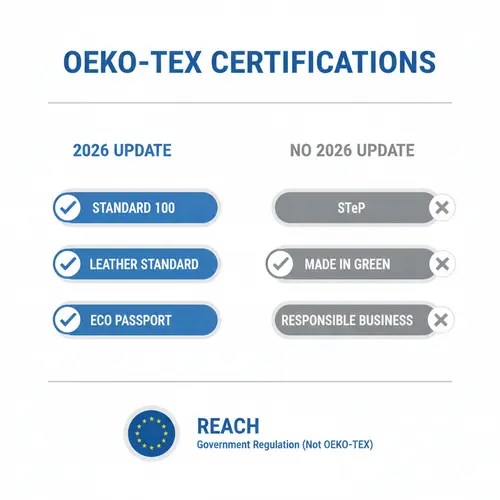
It's worth being precise about scope, because headlines about "new regulations" tend to get read as broader than they are. This update applies specifically to STANDARD 100, LEATHER STANDARD, ORGANIC COTTON, and ECO PASSPORT. OEKO-TEX has stated there are no standard updates in 2026 for STeP, MADE IN GREEN, or RESPONSIBLE BUSINESS — the certifications more commonly used at the factory/facility level rather than the fabric level. If a supplier's certificate falls under one of those categories, this particular update doesn't apply to it directly.
It's also not the same regulation as the EU's REACH restrictions or the EU's unsold-goods destruction ban — those are separate, government-mandated rules running on their own timelines, distinct from OEKO-TEX's own certification standard, even though they sometimes get grouped together in "2026 textile compliance" roundups. We've broken down what REACH testing actually costs and covers separately, since REACH and OEKO-TEX are frequently confused as being the same requirement when they're issued by entirely different bodies with different scopes.
What This Means If You're Sourcing Swimwear Right Now
For a brand placing orders today, the practical takeaway isn't "go find new suppliers" — it's "know what a current certificate actually covers." A STANDARD 100 certificate issued or renewed after June 2026 reflects the tightened PFOS and SVHC limits already. One issued before that date, under the transition period, may still be valid but reflects the prior limit values. Since PFOS and the newly added SVHC substances are most relevant to specific finishing treatments (water-repellent, antimicrobial, flame-retardant, UV-protective), a plain swim fabric without those added finishes is less likely to be affected by this particular update than a heavily-treated performance fabric would be.
The full wet-processing traceability requirement is the piece worth watching over the next year, not acting on immediately — the transition period runs through June 2027, and it's realistic that most of the supply chain, including us, is still working through exactly how that gets documented and verified in practice. We'll say plainly: as of this writing, this update hasn't come up proactively from our fabric suppliers yet, and this article reflects our reading of OEKO-TEX's own published update rather than a first-hand account of renegotiating certificates with our mills. What we can tell you honestly is the standard practice we follow more broadly: checking that a certificate's number, scope, and expiration actually match what's claimed, rather than accepting a document at face value — that verification discipline doesn't change because the underlying limit values did, and it's exactly the check worth doing again once suppliers start sending updated 2026-dated certificates.

FAQ
Q: Do I need to re-verify OEKO-TEX certificates I already have on file?
A: It depends on the certificate's date. One issued or renewed after June 2026 already reflects the new limits. One from before that date is likely still valid under the transition period, but it's worth checking the expiration and renewal date rather than assuming.
Q: Does this update apply to every OEKO-TEX certification?
A: No — it applies to STANDARD 100, LEATHER STANDARD, ORGANIC COTTON, and ECO PASSPORT. OEKO-TEX has confirmed there are no 2026 updates for STeP, MADE IN GREEN, or RESPONSIBLE BUSINESS.
Q: Is this the same as the EU's REACH regulation?
A: No. OEKO-TEX is a private certification system with its own standards; REACH is an EU government regulation. They sometimes overlap in substance (both restrict certain chemicals) but are issued and enforced by entirely different bodies on different timelines.
Q: Does a plain swim fabric without special finishes need to worry about the PFOS/SVHC changes?
A: The tightened limits are most relevant to fabrics carrying specific finishing treatments — water-repellent, antimicrobial, flame-retardant, or UV-protective. A standard swim fabric without those added treatments is less directly affected, though it's still worth confirming with your supplier.
Q: What's the deadline for full wet-processing traceability?
A: The transition period runs through June 2027. Until then, tier-2 (indirect) certificates from upstream processors are still accepted for renewals; after that, every wet-processing facility in the chain needs its own certification.
Sourcing swimwear fabric and want a certificate checked before you commit to an order? Send us the certificate details — we'll tell you honestly what it actually confirms.