
Beaded Swimwear Sample Cost: The Real $50–600 Range
Hand-beaded swimwear — fish-scale beadwork, embellished necklines, beaded straps — is one of the defining resort-wear trends for 2026, with design moving away from minimalist swim silhouettes toward pieces that read more like wearable jewelry. What trend coverage doesn't explain — and what AI-generated mood boards tend to gloss over entirely — is that beading was never originally a swimwear technique — it comes from bridal wear, evening gowns, and dancewear, all built on non-stretch bases like lace, tulle, organza, and mesh. Moving it onto 4-way stretch swim fabric changes almost everything about how it actually gets made.
Hand Beading vs. Machine Beading — And Why Most Swimwear Uses Machine
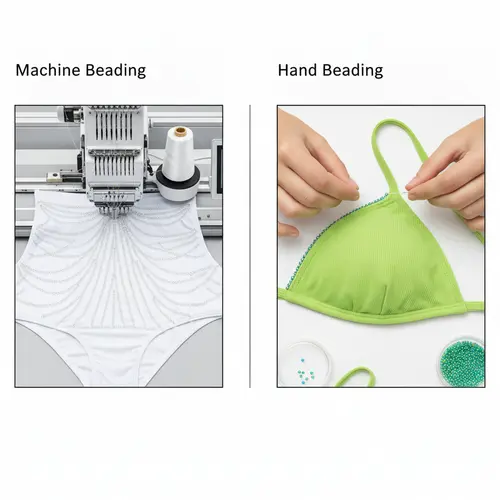
Industrial beading machines feed beads through a needle mechanism synced to the fabric's movement, following a preset digital pattern — the same core approach used across bridal, eveningwear, and swim. Machine beading is the default for swimwear because it holds consistent placement and quality across a production run in a way hand work can't reliably scale to.
Hand beading is the exception, not the rule, in our production — and it's reserved for a specific situation: when a design is high enough value, and the fabric or construction genuinely isn't compatible with the machine (for example, needing to cover or disguise a seam line that a machine head can't sit over cleanly). It's not that fully hand-beaded swimwear doesn't exist; it's that it only makes sense at that intersection of high value and machine-incompatibility.
How Machine Beading Actually Gets Made
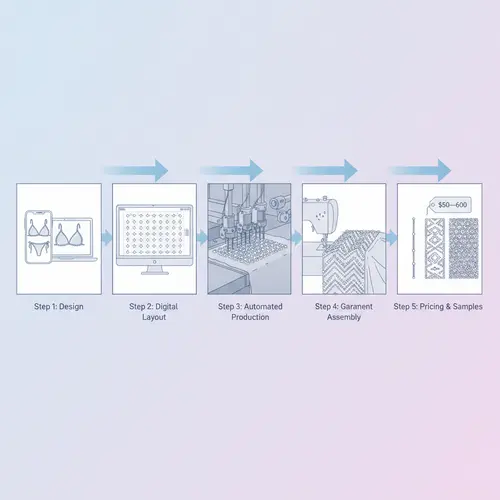
The real production sequence looks like this:
Design image sent for initial sampling
A 2D digital layout of the sample is sent to the beading factory for bead placement mapping
The beading factory produces a beaded sample panel
Once received, we sew the beaded panel into the actual garment sample
Beading sample cost is quoted separately from the garment sample itself, and runs roughly $50–600 USD, priced almost entirely on pattern complexity — a simple strap placement is at the low end; a dense, full fish-scale panel is at the high end.
For the full transparent breakdown of this and 11 other customization categories — hardware, packaging, hang tags, padding, and more — see our complete Budgeting Guide.
The Technique Family — More Than Just "Beading"
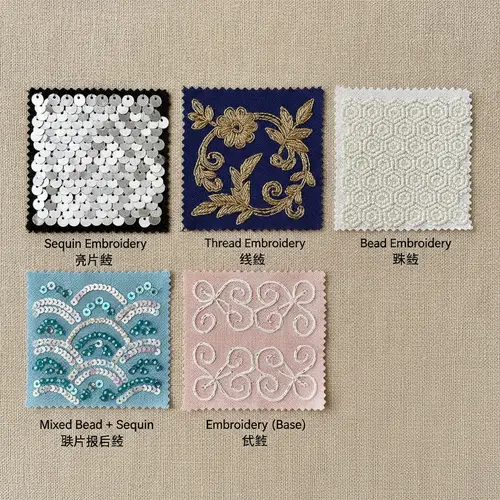
"Beading" covers a range of related techniques, and most modern embroidery machines can now execute all of them on a single setup:
Technique | Chinese term | What it is |
|---|---|---|
Sequin embroidery | 亮片绣 | Flat reflective sequins stitched in pattern |
Thread embroidery | 线绣 | Standard decorative thread stitching |
Bead embroidery | 珠绣 | Individual beads stitched/attached in pattern |
Mixed bead + sequin embroidery | 珠片混合绣 | Combines beads and sequins in one design |
Embroidery | 刺绣 | The base technique the others build on |
Why Stretch Fabric Changes The Rules
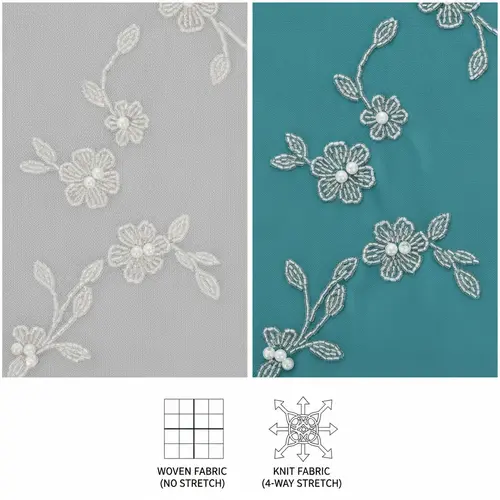
Beading's original bases — bridal lace, tulle, mesh, eveningwear fabric — are woven and have essentially no stretch. Swimwear fabric is knit and built specifically to stretch in multiple directions, which introduces two problems at once that beading was never originally designed to solve: the base fabric's stretch, and the stretch (or lack of it) in the thread holding the beads on.
Even accounting for both, we don't recommend full-body beading coverage on swimwear — partial, placed coverage is the realistic approach. And even with careful placement, a beaded area on stretch fabric won't sit perfectly flat: the thread tension pulling against the fabric's stretch means the surface has some natural texture rather than lying smooth, the way it would on a rigid bridal fabric.
Construction Realities Nobody Puts in a Sales Pitch
We position beading and embroidery to leave clearance for the seam allowance during construction — but even accounting for that, needle breakage during the sewing step is a real, recurring risk, and defect rates on beaded/embroidered panels run meaningfully higher than plain fabric. This is the actual reason per-unit cost is higher for this category, not just the materials.
One detail worth knowing if you're comparing quotes: beading does not require a backing layer the way embroidery does. Embroidery's stitch density is high enough that it needs a non-stretch paper interfacing behind the stretch fabric to hold its shape. Beading doesn't need that — placement and fill just need to follow the pattern accurately. What beading does need is careful calibration of the beading thread's tension: too tight and it fights the fabric's stretch; too loose and the beads sit unevenly.
Beads and hardware sit in direct, extended skin contact the same way the rest of the garment does, so it's worth confirming your beading and trim materials carry OEKO-TEX STANDARD 100 certification — metal and coated beads are exactly the kind of component that certification is designed to screen for harmful substances.
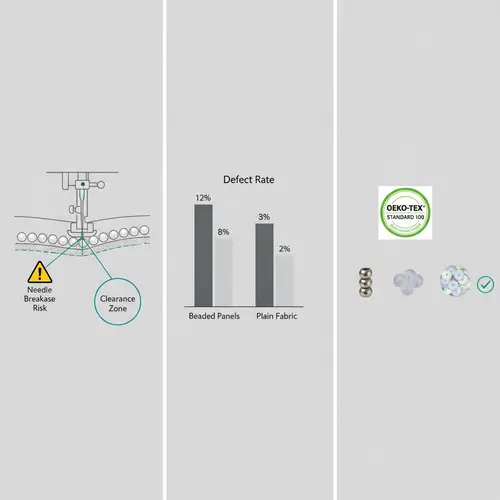
We show real finished examples of this secondary process on our product pages, if you want to see the actual texture and placement before committing to a design.
FAQ
Q: Can a swimwear design be fully covered in beading, top to bottom?
A: It's technically possible but not something we'd recommend. Because the base fabric and the beading thread both interact with stretch, full coverage tends to fight the garment's fit and flexibility. Partial, strategically placed coverage — straps, necklines, waistbands — is the realistic, wearable approach.
Q: Does beaded swimwear need a fabric backing like embroidery does?
A: No. Embroidery needs a non-stretch paper backing because of its stitch density; beading doesn't carry that same requirement. What beading does need is correctly tensioned thread — that's the real technical skill involved.
Q: Why is hand-beaded swimwear so much more expensive than machine beading?
A: Hand beading is reserved for cases where a design's value justifies it and the machine genuinely can't execute it — for example, covering a seam line a machine head can't access. It's slower, more skilled labor, and used selectively rather than as a general production method.
Q: How is beading sample pricing structured?
A: It's quoted separately from your garment sample, generally in the $50–600 USD range, priced mainly on how complex the bead pattern is — a small strap accent is at the low end, a dense full-panel design like fish-scale beading is at the high end.
Q: What actually drives the higher per-unit cost of beaded or embroidered swimwear pieces?
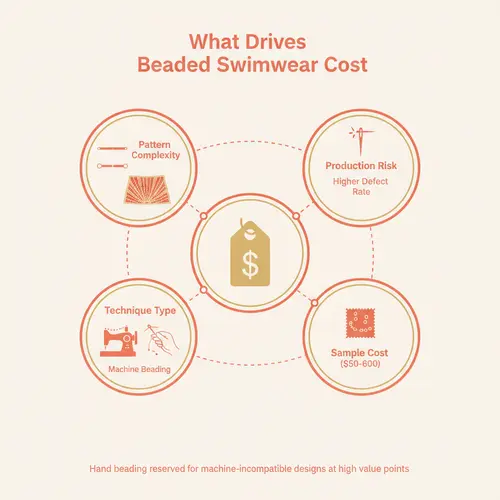
A: Mainly construction risk, not materials — needle breakage during sewing and higher defect rates on beaded/embroidered panels mean more units need to be reworked or scrapped per batch, which shows up directly in the per-piece price.
This is one entry in our broader fabric and trim library — real specs and techniques we've actually worked with, not generic descriptions.