
Real Fabric & Trim Library: Specs You Can Actually Verify
Most swimwear sourcing content describes fabric the way a menu describes food — "luxurious," "premium," "silky." None of that tells you whether a fabric will hold its shape after twenty washes, what it costs to customize, or whether it can actually take the print or embroidery you're planning. We built our fabric and trim library to answer those questions with real numbers, not adjectives — and this page is the map to everything in it.
At a Glance
Topic | The Real Data Point | Full Breakdown |
|---|---|---|
Ribbed "channel" fabric | CX8900: 60% polyester/40% covered spandex, 285gsm, 125cm width, 30 colorways | |
Beading and embroidery | Real sample cost range: $50–600 depending on pattern complexity | |
Swim-to-street crossover fabric | Standard swim fabric pills fast under all-day dry wear | |
Fabric certificate verification | A real story: independently-tested fabric didn't match its certificate | |
OEKO-TEX 2026 update | PFOS limit tightened to 1mg/kg; wet-processing traceability required by 2027 | |
Colorfastness and fading | Chlorine/seawater, light, and crocking fastness are 3 separate tests | |
Chlorine-resistant fabric | Real vs. claimed chlorine-resistant fabric costs ~$0.25 more per bikini | |
Stretch recovery | 85% is an immediate-recovery number — rested fabric often recovers to 98%+ | |
Men's swim trunks fabric | Woven fabric is still the default, not stretch knit | |
Hardware plating | Rack vs. barrel plating; zinc alloy usually beats stainless steel on real economics | |
EU packaging rules (PPWR) | New rules started Aug 12; here's what actually applies to swim | |
Crinkle texture | Two structurally different production methods, same visual trend | |
Seam construction | Flatlock, coverstitch, and bonded seams fail differently — "seamless" rarely means literally seamless | |
Recycled elastane | Real MOQ ~1 metric ton, ~$8/kg at 25% elastane content | |
PFAS bans | 2026 bans target chemistry in technical wovens, not high-stretch swim knits | |
Neon/fluorescent color (SS2027) | High-saturation color and true fluorescent color are two different production problems |
Spandex vs. Lycra sourcing | Branded Lycra runs ¥30–50/kg more than generic elastane — same fiber, different licensing/QC standard |
|---|
Custom hardware mold fee & no-MOQ logic | ~$80-100 mold fee is a one-time cost — that's why there's no fixed MOQ, only tiered per-unit pricing |
|---|
Care and composition labels | No-MOQ heat transfer vs. sewn labels from about 2,000 pieces, with real per-piece costs |
|---|
Strap construction | Elastic-core straps expose the white core when trimmed; coreless fabric-tube straps can be cut to length by the customer | |
|---|---|---|
Sample-to-bulk consistency | Two swimwear-specific risks: stretch-fabric cutting and molded-cup batches | |
Fabric roll yield and loose-cut pricing | One 20 kg roll (about 70–80 m) makes roughly 44–265 pieces by style; under one roll is cut at about ¥20/m | |
Sample lead time | Real range: 2 days at the fastest to 30 days for a project with custom hardware and packaging | |
Care and composition labels | Heat transfer has no MOQ, about $0.5/label on small runs; sewn labels start around 2,000 pieces at $0.1–0.5/label | |
Tan-through / UV-permeable fabric | Real mesh construction, but usually sold without a lab-verified UV transmission number — ours included | |
Nylon printing process | Direct-injection print-dye penetrates the yarn; check the fabric's back — color through means penetration, white means surface print | |
Construction terminology | A glossary of the terms buyers actually ask about — gusset, underwire, hardware, seams — each linked to its full real-data breakdown |
Why a Real Materials Database Matters More Than It Used To
AI-generated tech packs and mood boards have made it easier than ever to produce something that looks production-ready without actually specifying anything a factory can build from. A rendered image doesn't carry a GSM, a stretch percentage, or a composition breakdown — and increasingly, that's the gap that turns into a failed sample. Real material data is the layer that's missing from most sourcing conversations, and it's the thing we've built this entire library around.
For the next step, our AI swimwear tech pack workflow explains how material references fit into an editable file and which details still need human confirmation before sampling.
What's Actually in the Library
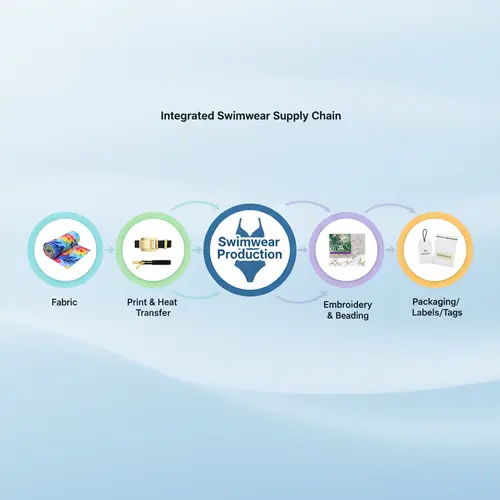
Our materials library is organized into the same categories that drive real production decisions — and every category below is browsable directly in our live materials database, not just described here in article form:
Category | What It Covers | Browse Real Examples |
|---|---|---|
Fabric | Composition, GSM, width, stretch/recovery, colorways — the base data every tech pack needs | |
Trims | Hardware, buckles, adjusters — sizing and compatibility with different fabric weights | |
Embroidery & beading | Machine vs. hand technique, backing requirements, thread tension, real sample cost ranges | |
Print & heat transfer | Technique compatibility with different fabric structures and textures | |
Patterns | Printed and woven-in pattern options across fabric bases | |
Packaging, labels, and tags | Customization options and MOQ structure | Browse packaging → · Browse hangtags → · Browse care labels → |
Other functional components | Everything else that doesn't fit a standard category |
Each category page lets you filter by real attributes — material, elasticity, feature (including Chlorine Resistant, if you're specifically vetting pool-durability), and craftsmanship — the same specs referenced throughout the articles below.
Swimwear Fabric Spec Cheat Sheet: Six Real References
Most swimwear fabric is a stretch knit built on nylon or polyester with spandex, and the real differences come down to fiber ratio, weight, stretch, and surface. To show what that looks like in practice, here are six fabrics from our own fabric reference database, with the specs exactly as listed on each page.
Reference fabric | Composition | Weight (as listed) | Elasticity | Listed features |
|---|---|---|---|---|
Nylon 80%, spandex 20% | 190 | High | Quick dry, sun protection, chlorine resistant | |
Polyester 85%, spandex 15% | 210 | Medium | Quick dry, chlorine resistant | |
Nylon 80%, spandex 20% | 195 | High | Sun protection, quick dry, chlorine resistant | |
Nylon 85%, spandex 15% | 170 | Medium | None listed | |
Polyester 99%, spandex 1% | 260 | Medium | Quick dry | |
Nylon 80%, polyester 20% | 85 | High | Quick dry |
Three things stand out.
Weight covers a huge range:
These six run from 85 to 260, and the weight changes how the fabric behaves. Fabric below about 200 GSM is where opacity when wet needs checking, and the ribbed knit at 170 sits in that zone; the reason 200 is the line is in why 200 GSM is the real threshold. The mesh at 85 is a special case: it is normally used as an outer layer over a lining, not on its own.
The fiber ratio changes the stretch:
The two nylon-spandex fabrics carry 20% spandex and are listed as high elasticity. The polyester-spandex one carries 15% and is listed as medium. The jacquard knit has only 1% spandex and gets its stretch from its knit structure instead. For what those stretch numbers mean once the fabric is worn wet, see what 85% stretch recovery actually means.
"Chlorine resistant" is a starting point, not a test result:
It is a feature tag in the listing. The development notes on the eco fabric recommend a chlorine resistance test, and the polyester fabric's notes recommend an anti-chlorine treatment. For what actually makes a fabric hold up, see what makes swimwear fabric chlorine-resistant and what actually wears out in nylon vs. polyester.
The nylon-spandex listing also shows what can be customized: color, composition, and fabric weight. Stock fabric is sold by the roll, about 70–80 m for a 20 kg roll at 158 cm wide, and orders under one roll are cut loose by the meter; the full breakdown is in how many suits one roll makes. You can filter the database by texture, elasticity, and features, including chlorine resistance, sun protection, and quick dry.
A Few Real Examples From the Library
Rather than describe this abstractly, here's what it actually looks like in practice, pulled from our own content:
Ribbed "channel" fabric — a real example with documented width, GSM, and composition data (CX8900: 60% polyester / 40% covered spandex, 285gsm, 125cm width, 30 colorways), including the technical reason ribs form the way they do and what determines fabric weight and width.
Crossover fabric for swim-to-street pieces — why standard swim fabric isn't built for all-day wear, and what fiber and finish choices actually solve it.
What makes swimwear fabric actually chlorine-resistant — why chlorine resistance is a baseline configuration rather than a premium spec, the real cost gap between claimed and verified chlorine-resistant fabric, and an honest account of what we've tested formally versus what we've only observed.
Why swimwear fades, and why fabric vetting matters more than dye chemistry alone — the real testing standards behind colorfastness, and an honest account of where our expertise ends and a dye house's begins.
Men's swim trunks: the real fabric divide, explained — why men's trunks use woven fabric while women's swimwear uses stretch knit, and where that line is actually starting to blur.
Swimwear stretch recovery: what 85% actually means — why an 85% immediate-recovery number isn't the full picture, the real drivers of recovery performance, and the under-discussed way high-heat printing can damage it.
Crinkle swimwear isn't one fabric — it's two techniques — why the 2026 crinkle trend actually splits into two structurally different real production methods (elastic thread ruching vs. knit-structure texture), with very different cost implications.
Recycled elastane is real now — what sourcing it actually looks like — real MOQ (~1 metric ton) and pricing mechanics (~$8/kg at 25% elastane content), and the polyester-versus-nylon gap most sustainability coverage skips entirely.
Spandex vs. Lycra: where the premium actually comes from — spandex, elastane, and Lycra are the same fiber; the real cost gap (¥30–50/kg) is licensing and QC standards, not import logistics, and a decision framework for when paying it is actually worth it.
Why recycled fabric needs a different printing approach — digital printing, sublimation, and heat transfer compared, and why recycled elastane's heat sensitivity makes digital the lower-risk default for recycled-content collections.
2026 PFAS bans are real — swimwear fabric is mostly exempt — why the PFAS chemistry targeted by 2026 apparel bans is built into outdoor technical wovens, not high-stretch swim knits, and how we handle real buyer questions on this.
Neon swimwear for SS2027: what's actually achievable — why high-saturation color and true fluorescent color are two different production problems, and what it actually takes to get a custom, trend-matched Pantone color made.
How cut-out swimwear is actually reinforced at the edge — the real bias-binding and internal-elastic techniques documented in the library for stabilizing an open or raw edge without it curling or distorting.
Swimwear hygiene stickers vs. the real gusset lining — two small, frequently confused components documented in the library, including the real cost gap between an adhesive sticker and disposable try-on underwear.
Underwire poke-through: the real cause isn't the wire — why genuine stainless steel underwire barely varies in price, and the real construction and QC factors documented in the library that actually prevent poke-through.
Heat-transfer vs. sewn care labels: MOQ, label price, and labor for each method.
How many suits one roll of swimwear fabric really makes — real roll length (about 70–80 m for a 20 kg roll), pieces per roll by garment type, the ¥20/m loose-cut price for small orders, and what custom fabric sampling and dye fees cost.
Tan-through swimwear: real fabric science or marketing concept? — the honest mechanism behind UV-permeable mesh, why we don't have a lab-verified transmission number, and the double-layer construction that actually keeps it wearable.
Trims, Hardware & Construction Technique
What REACH compliance testing actually costs for swimwear — a real, itemized breakdown of 8 REACH-related test items relevant to swimwear exports, with real prices and lead times.
Swimwear hardware: why the plating method matters more than the design — rack vs. barrel plating, why zinc alloy usually beats stainless steel on real production economics, and the testing hardware actually needs to pass.
Swimwear seam construction: what "seamless" actually means — flatlock vs. coverstitch vs. bonded construction, and why "seamless" on a product page almost never means what it sounds like.
Nylon direct-injection print-dye vs. digital printing: the backside test — the real 4-step process (inject, dry, wash, dry), why nylon needs its own dye chemistry, and the one-second test that tells you which process you actually got.
Certification & Compliance
How to verify a fabric certificate — because a real materials library isn't just about having data, it's about knowing which data is actually trustworthy.Includes a real story about independently-tested fabric that didn't match its certificate.
What OEKO-TEX's 2026 update means for swimwear sourcing — the real chemical-limit and traceability changes behind a certificate you might already be holding, and what's still just a transition-period grace window.
Beading and embroidery techniques — real production workflow, real sample cost ranges ($50–600 depending on pattern complexity), and the construction reality of applying rigid-fabric techniques to stretch swimwear.
Packaging & Labels
New EU packaging rules start Aug 12 — what applies to swim — what PPWR actually requires, and an honest account of where our own recycled-packaging transition stands.
Swimwear care labels: heat transfer vs. sewn, real costs — heat-transfer labels have no MOQ and cost about $0.5 each on small runs; sewn labels start around 2,000 pieces at $0.1–0.5, and each method adds its own labor.
How We Keep This Data Real, Not Marketing Copy
Every material in this library comes from something we've actually handled — a real fabric roll, a real sample run, a real supplier relationship — not a generic spec sheet copied from elsewhere. When a fabric's real-world behavior differs from what a spec sheet implies (slower drying, pilling under certain conditions, compatibility issues with specific techniques), we say so, because that's exactly the information that gets left out of AI-generated sourcing content and generic marketplace listings.
Functional descriptions need the same evidence check. Our guide to antimicrobial swimwear liningseparates a supplier’s material description from a tested antibacterial result and explains what to confirm for the specific lining.
FAQ
Q: Is this library available for browsing, or is it something you reference during a project?
A: Both — the categories and real examples above give you a sense of what's documented, and once we're working on a specific design, we reference the exact specs relevant to your project directly.
Q: Do you only work with the fabrics already documented here, or can new materials be added?
A: New materials get added regularly as we source and test them — this library grows with every real project, not on a fixed schedule.
Q: Why does fabric-level documentation matter if I'm just sending a design idea?
A: Because the fabric choice is often what determines whether a design is actually buildable. Real spec data lets us tell you that upfront, before you commit to a direction that won't hold up in production.
Have a specific fabric or trim question? Reach out with your design or reference photos, or browse our live materials database directly — we'll tell you what's actually feasible from real material data, not a guess.