
6 Ways AI Swimwear Designs Mislead Before Sampling
AI-generated swimwear renders look finished. That's exactly the problem. A model shot generated in seconds can look more polished than a real sample — which means it's the first thing that misleads a brand, not the last. The gap shows up in six specific places: color, fabric texture, structure, the tech pack itself, hardware proportions, and sizing. Here's what we actually see when a design moves from an AI render to a real production line.
An incomplete or inaccurate tech pack is already one of the most common causes of sample rejection industry-wide, with rework from a single miscommunicated spec running anywhere from roughly $500 to over $50,000 depending on the scale of the error. This is consistent with the broader picture in McKinsey's State of Fashion 2026 report, which flags AI adoption and stronger technical/data foundations as a defining pressure point for the industry this year. AI-generated renders and tech packs add a layer on top of that risk, because they look complete in ways that are specifically hard to verify before cutting fabric.
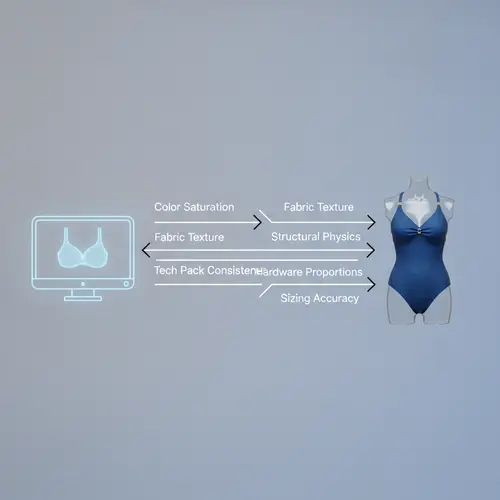
1. Color: AI's Saturation Isn't Free to Reproduce
The first thing anyone notices in an AI render is color — and it's usually the first thing that's misleading. Standard swimwear printing uses digital (sublimation) printing, which struggles to reproduce the high-saturation colors AI renders default to. Matching that saturation in real production generally means switching to direct-injection reactive printing, which solves most of the saturation gap — but not all of it. Fluorescent colors specifically remain difficult to adjust even with this technique, and most brands don't realize that going in.
There's a real trade-off most brands never hear explained: direct-injection dyeing runs through a "wash, steam, dye, heat-set, dry" process, and every one of those steps — and the environment around them — introduces some variation in bulk-order color consistency, even with tight control on our end. Digital printing, by comparison, keeps the ink and the base fabric constant through the process, so it stays far more stable batch to batch. The underlying principle: the more dyeing steps involved, the more variables there are to manage. Matching an AI render's exact saturation and keeping perfect batch-to-batch consistency at scale are, in practice, two goals in some tension with each other.
This same saturation gap shows up outside of AI renders too, most recently with SS2027's neon and fluorescent color trend — see what's actually achievable with true fluorescent swimwear color versus standard high-saturation dyeing.
2. Texture: Real Weaves and Knits Don't Photograph the Way AI Renders Them
Ribbed ("channel") fabric, jacquard, rib knit, mesh — these textures each come from a distinct weaving or knitting process, and AI rendering struggles to reproduce any of them faithfully. The same gap shows up with applied decoration like hand or machine beading, where an AI render can show a dense beaded pattern that simply isn't structurally possible on a stretch base.It shows up just as clearly with crinkle texture — a render can show a plausible gathered surface without indicating whether it implies elastic-thread ruching or a knitted-in crinkle fabric, two methods with very different real costs behind the same visual effect. In practice, this is usually solvable: an experienced factory can identify the intended texture quickly and recommend the closest real equivalent, then work through the difference directly with the brand. The exception is a brand that's genuinely new to swimwear and unfamiliar with fabric behavior — those conversations are harder, which is why we ask for real reference photos rather than relying on an AI-generated texture alone, and guide the sourcing conversation from there.
3. Structure: AI Doesn't Understand Where Fabric Actually Pulls
Take something as simple as a drawstring bikini top. AI has a hard time even generating the gathered, rippled fabric effect that a pulled drawstring naturally creates — and more importantly, even when it does generate something plausible-looking, it doesn't understand where the real physical tension in that structure will pull the fabric once it's worn. A real sample will show structural behavior — where the fabric stretches, where it gathers, where stress concentrates — that has no equivalent in the AI-rendered version, because that behavior comes from physics, not from image generation.
4. Tech Packs: When the Three Views Don't Even Agree With Each Other
One recurring issue we've seen directly: the front, back, and side views within the same AI-generated tech pack sometimes describe a structurally inconsistent garment. A front view might clearly show a halter neckline, while the back view shows an adjustable buckle closure that doesn't match a halter construction — and the side view often fails to show where a seam or panel line should actually sit. We can't speak to which specific overseas tool generated any given tech pack we've seen this in; we're only describing the pattern. As AI tools continue to improve, we expect this specific problem to get solved — and it's one we're actively working on solving accurately ourselves.
5. Hardware Proportions
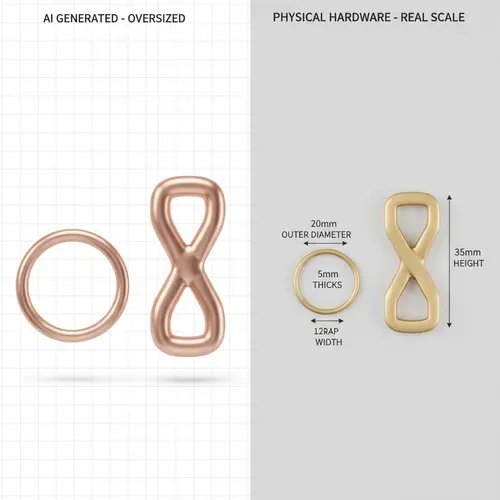
AI-generated hardware — adjuster rings, slider ("figure-8") buckles, and similar findings — frequently comes out at a size or proportion that doesn't match what's physically available or practical. This one is usually the easiest to fix: we flag it directly with the brand, and it's a straightforward point of negotiation once it's on the table.
6. Sizing: Where We Draw a Hard Line
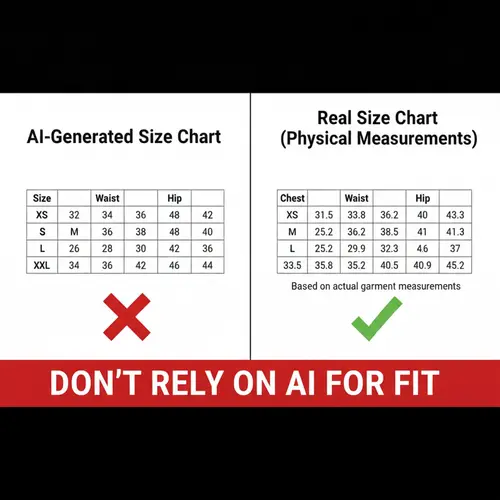
This is the one place we'd push back hard on using AI at all. An AI-generated size chart is not something we'd recommend relying on — the entire point of a size chart is that it fits real human bodies, and that's not something we believe AI genuinely understands yet. Our recommendation instead: reference actual size charts from established marketplaces like Amazon, or better, purchase and physically measure real garments in the target category to establish a baseline. Alternatively, we can build a baseline sample together using our own production experience, test it once it arrives, and revise before committing to bulk production.
Why This Doesn't End in Rework, In Our Experience
In our own service process, we don't have rework-or-scrap cases from these issues — every step gets a confirmation pass, and we deliberately spend the most time on communication before cutting anything. The exception is genuinely avant-garde, highly creative swimwear designs, where rework can still happen — but we can't go into specifics on those cases, since brand protection agreements prevent us from discussing them.
The same principle extends past AI-generated tech packs: even for clients who can't write any technical spec at all, we don't ask them to — see why a swimwear factory shouldn't need a full tech pack to hit an accurate first sample.
FAQ
Q: Does this mean I shouldn't use AI tools at all for swimwear design?
A: Not at all — AI is genuinely useful for generating initial creative direction and communicating a concept quickly. The issue is treating an AI render or AI-built tech pack as production-ready without a factory-side review across color, texture, structure, tech pack consistency, hardware, and sizing.
Q: How much does a tech pack or design mismatch typically cost to fix?
A: Industry estimates put the cost of a single miscommunicated spec anywhere from around $500 to over $50,000, depending on how far into production the error is caught and how much material and labor has already gone into the affected batch.
Q: What's the single most common issue you actually see?
A: Color is usually the first and most persistent one. Brands come in expecting AI-render-level saturation, and matching that in real bulk production — while keeping colors consistent order to order — involves a genuine technical trade-off that most brands haven't been told about before working with us.
Q: Can a factory catch these issues before sampling, or only after?
A: Most of them — color approach, texture matching, hardware proportions — can be flagged from the design or reference photos alone, before cutting a single sample. Structural issues and tech pack inconsistencies typically surface during our confirmation process, which is why we build in time for that step rather than rushing straight to cutting.