
Why Swim Fabric Fails as Everyday "Beyond the Pool" Wear
Swimwear that doubles as streetwear — a bikini top worn as a crop top, a one-piece styled as athleticwear — has moved from a styling trick to a real product category. There are now over 400 direct-to-consumer swimwear brands operating globally, with their combined website traffic doubling over the past 24 months, and Victoria's Secret has already taken a minority stake in Frankies Bikinis specifically to buy into this crossover demand. The commercial case is proven. What's less discussed is that most of this crossover fails at the fabric level, not the design level.

The Real Bottleneck Isn't Design — It's Fabric
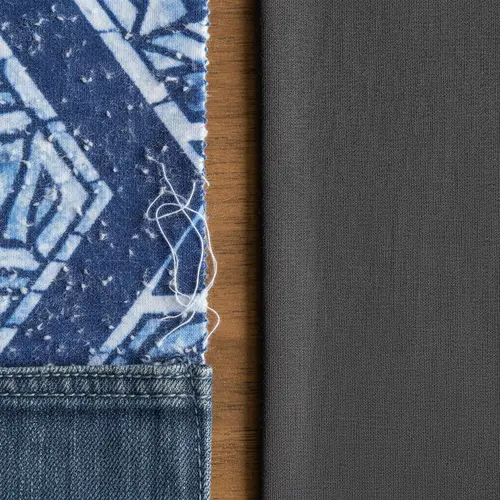
The instinct when building a "beyond the pool" piece is to focus on structure: does the top need reinforced support to survive a full day of wear instead of an hour in the water? In practice, that's not where these garments actually fail. The failure point is comfort and fabric character — specifically, that standard swim fabric was never engineered for extended dry wear in the first place.
Swim-specific spandex (elastane) yarns are chosen and finished primarily to resist chlorine, UV exposure, and repeated wet-dry cycling — that's the performance profile a fabric needs to survive actual swimming. Everyday apparel fabric is optimized differently, for a completely different kind of stress: sustained, repeated mechanical friction against jeans, bag straps, car seats, and chair backs over a full day of wear rather than a wet, chlorinated environment. Those are two different engineering problems, and a fabric tuned for one doesn't automatically perform well at the other.
The visible result is one every swimwear producer has seen: after enough dry-wear friction, the spandex yarn in standard swim fabric starts to pill and, eventually, the elastic thread itself breaks down — not because the fabric is low quality, but because it's being used outside the stress conditions it was actually engineered for. This lines up with how spandex behaves generally: bare spandex yarn is rarely used alone in apparel because it's prone to sticking, breaking during processing, and difficulty dyeing, which is why it's conventionally covered with a fiber like nylon for its superior abrasion resistance, as described in a U.S. textile fiber patent on covered spandex yarn construction — but which covering fiber and finishing process makes sense depends entirely on what kind of friction the fabric is being built to survive.
The Fix: Apparel-Grade Knit, Not Standard Swim Fabric
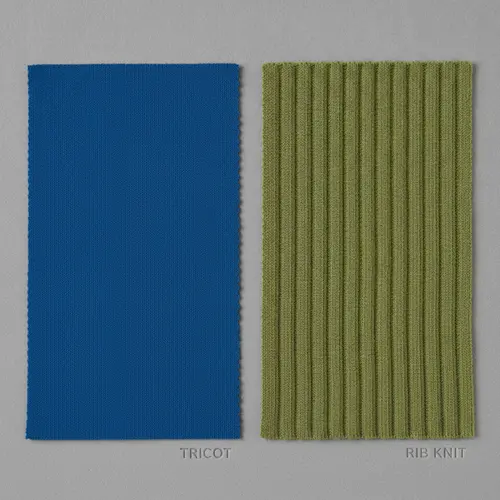
The practical solution isn't reinforcing the swim fabric's structure — it's sourcing a genuinely different fabric for the job. A true "beyond the pool" piece needs fabric that leans closer to general apparel knit than to competition-grade swimwear fabric, with one non-negotiable constraint: it still has to be knit fabric, not woven — the garment still needs the stretch and recovery that only a knit construction provides, since it's still functioning as swimwear part of the time. What changes is the yarn and finishing choice within that knit construction, prioritizing dry-wear durability alongside the usual swim performance requirements, rather than defaulting to whatever fabric is already on hand for standard swim production.
Visual Crossover Matters As Much As Comfort
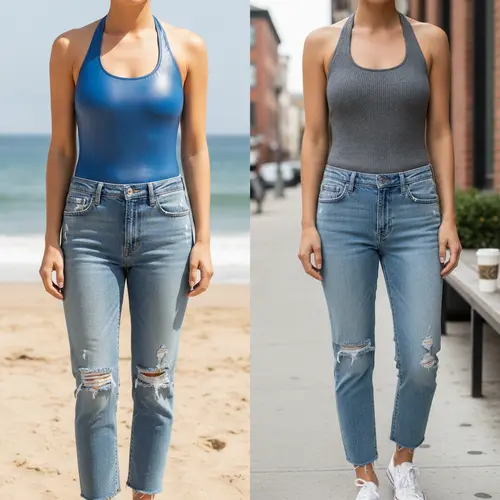
The other half of "beyond the pool" success is how the fabric reads outside a pool setting. A high-shine, competition-style swim finish signals "swimwear" the moment it's worn as a top with jeans; a more matte, textured knit reads as apparel first. This is the same logic behind why textured knits — like the channel rib fabric we've covered separately — have been gaining ground in resort and crossover pieces: the texture and finish photograph and wear convincingly in both a beach setting and a street setting, which is exactly the visual flexibility a "beyond the pool" piece is being asked to deliver.
What This Means for Sourcing
Treating a "beyond the pool" line as "take a swim style, cut it in swim fabric" undersells the category. The real product decision is a fabric decision made upfront — choosing a knit construction and yarn finish built to survive a full day of ordinary wear-and-tear, not just a swim session, while still holding the stretch and recovery the garment needs to function as swimwear when it's actually in the water.
Even within standard swim fabric that never leaves the water, chlorine resistance itself isn't a single fixed property — fiber choice, elastane type, and knit structure all move the needle, which is a separate question from the dry-wear durability covered here; see what actually makes swimwear fabric chlorine-resistant for that breakdown.
This crossover category is one entry in the full real construction guide organized by swimwear type — worth a look if you're sourcing across more than just this one silhouette.
FAQ
Q: Can standard swimwear fabric be used for a "beyond the pool" crossover piece?
A: It can, but it tends to show wear quickly — pilling and elastic breakdown from everyday friction (denim, bag straps, seating) that swim fabric isn't engineered to resist. It's built for chlorine and UV resistance, not sustained dry-wear abrasion.
Q: Does a crossover piece need a woven fabric instead of knit?
A: No — it still needs to be knit fabric for the stretch and recovery swimwear function requires. The fix is a different yarn and finish within a knit construction, not a switch to woven fabric.
Q: What actually causes swim fabric to pill after regular wear?
A: Repeated mechanical friction against everyday surfaces causes fiber entanglement at the surface of the yarn — this is a normal pilling mechanism for stretch fibers, but it happens faster when the fabric's finishing was optimized for water and chemical resistance rather than dry abrasion resistance.
Q: Is a "beyond the pool" piece more expensive to produce than standard swimwear?
A: It can be, depending on the specific yarn and finish sourced — but the driver is fabric selection, not extra construction steps. It's a sourcing decision made at the fabric stage, not a manufacturing complexity issue.
Q: How do I know if a fabric will photograph and wear well outside a beach setting?
A: Finish is the biggest signal — a high-shine, competition-swim finish reads as "swimwear only," while a matte or textured knit finish reads as apparel first, which is what makes it convincing worn away from water.
Building a swim-to-street crossover line and not sure which fabric actually holds up to daily wear? Send us the use case — we'll recommend a real fabric, not just whatever's already in stock.