
The Real Swimwear Construction Guide, by Garment Type
Most swimwear sourcing content is organized around vague adjectives — "supportive," "compressive," "seamless." That doesn't help much when you're trying to figure out whether a specific style is actually buildable, what construction choices go into it, and where the real quality risks sit. This page organizes what we've written by what you're actually trying to build: a specific garment type, with a specific construction challenge, and a real answer about how it's actually made.
This isn't new content — it's a map to real construction breakdowns we've already published, organized the way a buyer actually thinks about sourcing: by product, not by marketing term.
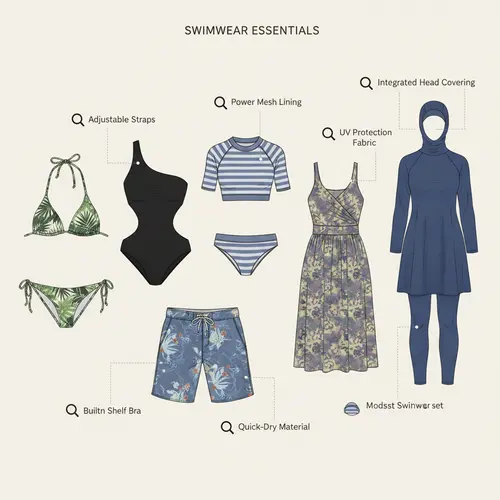
Start Here: The Basic Categories
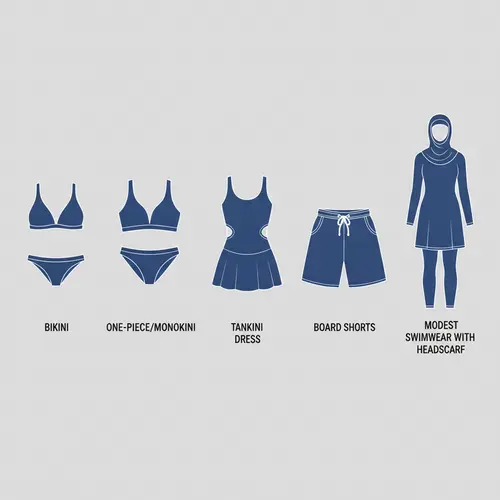
If you're new to swimwear terminology, start here before diving into construction details. The basic garment categories:
Category | What It Is |
|---|---|
Bikini | Two separate pieces — a top and a bottom, sold and fit independently |
One-Piece / Monokini | A single connected garment covering the torso in one piece |
Tankini | A looser, tank-top-style top paired with a separate bottom — more coverage than a fitted bikini top, without the full connection of a one-piece |
Swim Dress | A one-piece base with a skirt-like overlay for additional coverage |
Board Shorts / Trunks | The men's swimwear category — typically woven fabric rather than stretch knit; see the real construction differences |
Modest Swimwear | Long sleeves and long bottoms, often with a matching headscarf, built for higher coverage; see the real construction challenges |
Within bikinis specifically, tops and bottoms each break down further into their own subtypes — see the real construction differences across 10 bikini bottom styles as one example of how deep this goes once you move past the basic category.
At a Glance
Type | The Real Construction Signal | Best For | Full Breakdown |
|---|---|---|---|
Men's swim trunks | Woven fabric is still the default, not stretch knit | Board shorts, casual swim trunks | |
Training vs. race suits | The two get confused, but use different fabric compositions entirely | Competitive swimmers, team orders | |
Layered swimsuits | Looks like one garment, is actually built as two | Resort and statement styles | |
Cut-out swimwear | Edges need real reinforcement or they stretch out within weeks | Trend-led, fashion-forward drops | |
Swim-to-street crossover | Standard swim fabric pills fast under all-day dry wear — needs a different yarn/finish | "Beyond the pool" crossover lines | |
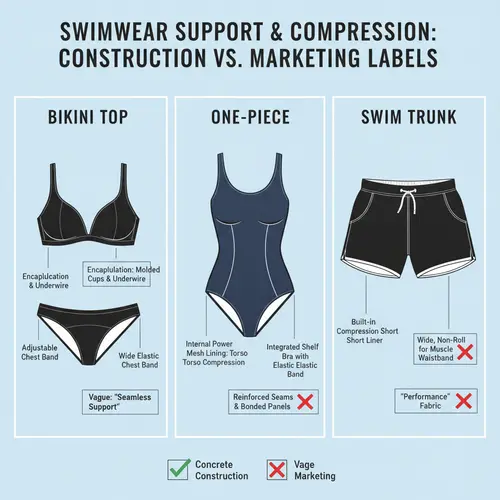
Tummy control | Real control comes from layered panels, not just tighter fabric | Shapewear-adjacent swim lines | |
Bust support | Genuine support is a structural build choice, not a label claim | Fuller-bust swimwear lines | |
Graduated compression | Compression is engineered through lamination, not just fabric tension | Post-partum, shaping, athletic lines | |
Underwire styles | Poke-through is usually a bar-tack/quality-control failure, not a wire defect | Underwire bikini tops, one-pieces | |
Period-proof swimwear | Leakproof needs a real seam construction, not just an absorbent layer | Period-proof, medical-adjacent lines | |
Nursing swimwear | Access points are a structural design choice, not a simple cut-out | Maternity and nursing lines | |
Hygiene liners | A ¥0.04 disposable sticker and a sewn ~120g gusset are not the same thing | Any style with a crotch lining | |
Crinkle texture | Two structurally different builds produce the same visual effect | Textured, trend-forward fabric lines | |
Seam construction | Flatlock, coverstitch, and bonded seams fail differently — "seamless" rarely means literally seamless | Any style, since every garment has seams | |
Modular/detachable straps | The strap itself is standard bikini-tie construction — the innovation is the SKU model, not the fabrication | Small-batch, customization-led brands | |
Mesh splicing | Standard seams join mesh and solid fabric fine — no special technique or default extra lining needed | Sheer-panel and mesh-trend styles | |
Neoprene bikinis | Laminated fabric loses stretch, which is why this category is almost always bikini, not one-piece | Scuba/neoprene-style lines | |
Stretch recovery | 85% is an immediate-recovery number — rested fabric often recovers to 98%+ | Any style making a recovery/shape-retention claim | |
Chlorine resistance | Real vs. claimed chlorine-resistant fabric costs about $0.25 more per bikini | Any style marketed as pool-durable | |
Bikini bottom types | Cost ranks by hardware + panel count, not by coverage — one-piece cut is cheapest despite more fabric waste | Anyone specifying bottom style across a line | |
Bikini top types | Underwire and convertible tops cost the most — cutting complexity doesn't drive cost at all | Anyone specifying top style across a line | |
One-piece vs. bikini | The "harder to build" claim is overstated — real difference is fabric quantity, not difficulty | Anyone comparing one-piece and bikini pricing | |
Modest swimwear | Real difficulty is the underarm, not the coverage amount | Modest/burkini lines, headscarf sets |
Every number in this table comes from a full breakdown we've already published — click through for the construction detail, testing standard, or real cost behind it.
For definitions of the construction terms used throughout this guide — gusset, underwire, seam types, hardware — see our swimwear construction glossary.
How Much Fabric Each Garment Type Uses
Garment type decides how much fabric a single piece consumes, and that decides how far one roll goes. These are the figures we work with, using a 20 kg roll of 158 cm-wide, 190–200 GSM fabric (about 70–80 m), cut with sizes S to XL laid out in a 1:1 ratio.
Garment type | Fabric per piece | Pieces per roll |
|---|---|---|
Bikini set | 0.3–0.5 m | About 140–265 |
0.5–0.7 m | About 100–160 | |
Skirted two-piece | 0.7–1.2 m | About 58–114 |
1.2–1.6 m | About 44–66 |
The more coverage a style has, the more fabric it uses and the fewer pieces one roll makes. That is why a modest set and a bikini with the same fabric can have very different unit costs. If your order is smaller than one roll, the fabric is cut loose by the meter at about ¥20/m. The full breakdown, including custom fabric sampling and dye fees, is in how many suits one roll of swimwear fabric really makes.
See Real Examples
Reading about a construction detail is one thing — seeing it is another. A few starting points in our own catalog:
Browse men's swimwear examples alongside the trunks construction breakdown above.
Browse our fabric library and filter by "Chlorine Resistant" to see real chlorine-resistant fabric options.
Browse hardware and trims referenced in the underwire construction breakdown above.
Everyday Silhouettes
These are the styles that live and die on fabric choice and cut, not on added features — the construction question here is almost always "woven or knit" and "how is this edge finished," not "what special technology does this need."
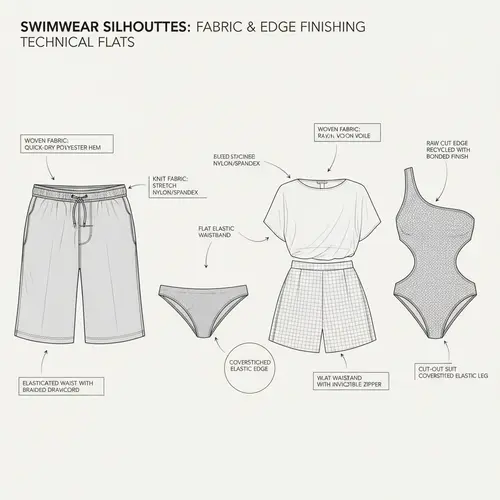
Men's swim trunks: the real fabric divide, explained — why men's trunks typically use woven fabric while women's swimwear uses stretch knit, and where that line is starting to blur.
Training swimwear vs. race suits: the real fabric difference — two categories that get confused constantly, and what actually separates them at the construction level.
Layered swimsuits: how the trend is actually constructed — the real build behind a style that looks simple and isn't.
Cut-out swimwear: how the edges are actually reinforced — the reinforcement techniques that keep cut-out styles from stretching out of shape, and where the real limits are.
Crossover fabric for swim-to-street pieces — why standard swim fabric isn't built for all-day wear away from the pool, and what construction choices actually solve it.
Types of bikini bottoms: the real construction differences — 10 bottom styles ranked by real cost and quality risk, not styling advice.
Types of bikini tops: what actually drives the cost — 8 top styles, and why underwire and convertible construction cost the most while cutting complexity doesn't matter at all.
One-piece vs. bikini: is it actually harder to build? — a common industry claim, honestly reconsidered: the real difference is fabric quantity, not construction difficulty.
Why swim brands sell sets, not separates — it isn't production — the real reason is margin and shipping economics, not manufacturing difficulty; most of our own clients actually order tops and bottoms separately.
Crochet swimwear: who actually makes it, and what it costs — production runs through outsourced knitwear factories and artisans, not an in-house swim line, with real sample pricing based on color count and coverage.
Tankini swimwear: the real construction and who it's for — construction is close to an elongated bikini top, but built-in support is the real default difference, and the core customer base is verifiably older women, not "anyone wanting more coverage."
Functional & Shapewear-Adjacent Types
These styles make a specific performance claim — control, support, compression — and the real question is always the same: is that claim backed by an actual structural build, or just tighter fabric and a label?
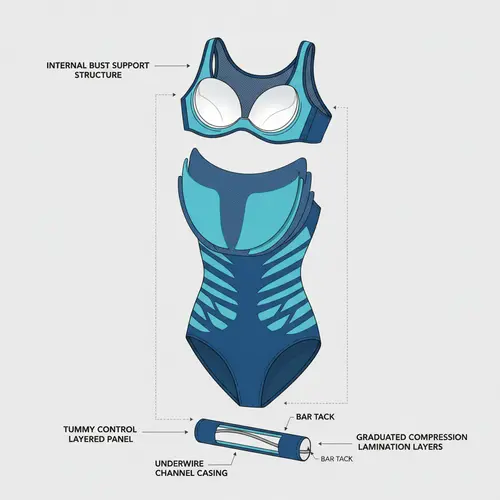
Tummy control swimwear: what the construction actually involves — the real layering and panel construction behind a "control" claim.
Real bust support in swimwear: how it's actually built — what separates genuine structural support from a marketing claim.
Graduated compression swimwear: the real lamination construction — how compression is actually engineered into a garment, not just claimed on a label.
Underwire poke-through: the real cause isn't the wire — the construction and quality-control details that actually determine whether underwire stays where it should.
Life-Stage & Special-Use Types
These are the styles where getting the construction wrong isn't just a quality complaint — it's the entire reason the product exists. A period-proof suit that leaks or a nursing suit with the wrong access point has failed at its one job.
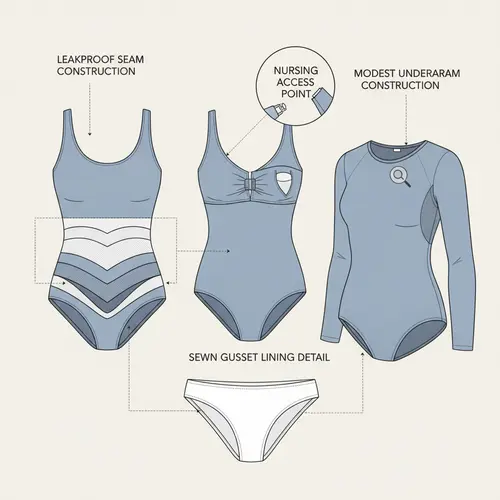
Period-proof swimwear: the real leakproof seam construction — what a genuine leakproof construction actually requires, beyond an absorbent layer.
Nursing swimwear: the real access construction — how nursing access points are actually built without compromising the garment's structure.
Swimwear hygiene stickers vs. the real gusset lining — the real difference between a disposable liner and genuine gusset construction.
Modest swimwear construction: real fabric and fit challenges — why the underarm, not the coverage amount, is the real technical difficulty, plus real headscarf fabric specs.
Techniques That Apply Across Multiple Types
Some construction questions aren't about a garment shape at all — they're about a fabric or finishing technique that shows up across many different styles, and the real answer usually splits into "it depends which method" rather than one clean answer.
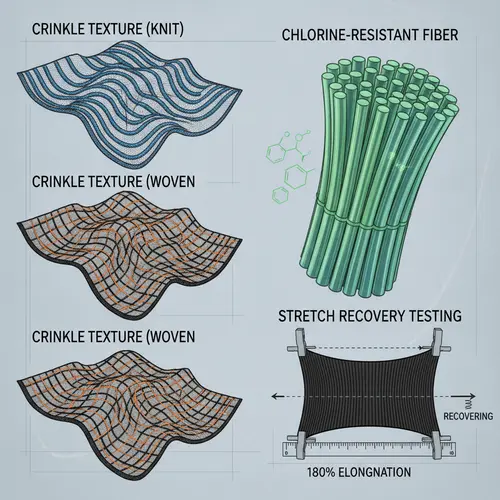
Crinkle swimwear isn't one fabric — it's two techniques — two structurally different real production methods behind the same visual trend.
Swimwear seam construction: what "seamless" actually means — flatlock vs. coverstitch vs. bonded construction, and why "seamless" rarely means what it sounds like.
How detachable, modular bikini straps are actually built — real construction behind a growing request: panels with finished channels instead of sewn-on straps, and straps sold separately, extra-long, for customers to trim themselves.
Mesh splicing in swimwear: what actually requires care — standard seams handle the mesh-to-solid join fine, and sheer areas don't automatically need extra lining or support.
Neoprene bikinis: the real construction behind the look — laminated fabric, binding-based finishing, and why the material's reduced stretch keeps this category almost entirely to bikinis.
Ruffle swimwear construction: gathered vs. sewn-on strip — two genuinely different real construction methods chosen per style, and the real edge-evenness quality check that catches issues before they ship.
What makes swimwear fabric actually chlorine-resistant — why chlorine resistance is a baseline configuration, not a premium spec, and what real vs. claimed resistance actually costs.
Swimwear stretch recovery: what 85% actually means — why an 85% immediate-recovery number isn't the full picture, and what actually determines whether a suit keeps its shape.
Why We Organize It This Way
A lot of sourcing content is written around a feature ("moisture-wicking," "compressive," "seamless") without acknowledging that the same feature gets built completely differently depending on the garment it's going into. Bust support in a bikini top isn't built the same way as bust support in a one-piece; a leakproof seam in period-proof swimwear takes a different approach than a seam in a standard bikini bottom. Organizing by type, rather than by isolated feature, is closer to how an actual production decision gets made — you're not choosing "compression" in the abstract, you're choosing how to build compression into a specific garment.
FAQ
Q: Is this a separate content section from your fabric library?
A: They're related but different. Our fabric and trim library is organized by material — what a specific fabric, trim, or technique actually is. This page is organized by finished garment type — what it actually takes to build a specific style.
Q: Do you only produce the types listed here?
A: No — this reflects what we've written about so far, not the limits of what we produce. If you have a style that isn't covered here, that doesn't mean we can't build it; ask us directly.
Q: How do I know if my design idea maps to one of these types?
A: If your design combines features from multiple types listed here (for example, a cut-out design with built-in compression), that's normal — most real garments aren't a single pure category. Send us the design and we'll tell you which construction considerations actually apply.
Q: How much fabric does one swimsuit use?
A:It depends on the style: about 0.3–0.5 m for a bikini set, 0.5–0.7 m for a one-piece, 0.7–1.2 m for a skirted two-piece, and 1.2–1.6 m for a modest long-sleeve and long-pants set. See how many suits one roll really makes for the full breakdown.
Have a specific swimwear style you're trying to build and want to know what the real construction requires? Send us your design or reference photos — we'll walk you through what's actually involved.