
The EU Unsold-Clothing Ban: Why Most Swim Brands Are Exempt
The EU's ban on destroying unsold apparel, clothing accessories, and footwear took effect on July 19, 2026, and it's been covered widely enough that it's worth answering plainly: does this actually apply to an early-stage or growing swim brand? For the overwhelming majority of our clients, the honest answer is no. Not one client has asked us about this regulation, and once you understand who it's actually built for, it's clear why.
Who the ban actually covers
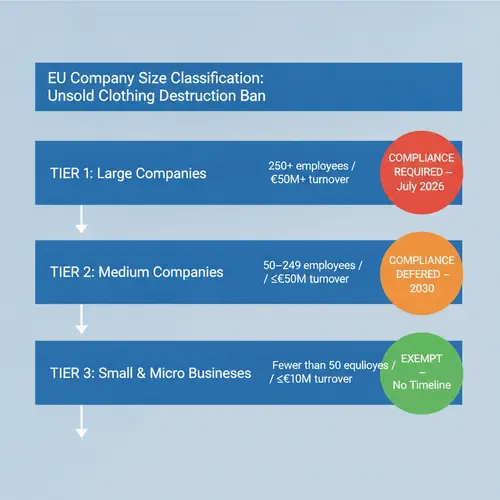
The rule, adopted under the EU's Ecodesign for Sustainable Products Regulation (ESPR), prohibits destroying unsold clothing, accessories, and footwear rather than reselling, donating, repairing, or recycling it. But the size thresholds matter more than the headline: large companies — generally 250+ employees or turnover above roughly €50 million — are in scope now. Medium-sized companies (50–249 employees, turnover up to €50 million) don't have to comply until 2030. Small and micro businesses are exempt from the ban entirely, with no current timeline for that to change.
That's a policy lever aimed squarely at the top of the market — large retailers, fast-fashion platforms, and major brands sitting on unsold inventory at a scale that generates real, measurable waste. Estimates cited in the regulation's own impact assessment put unsold-textile destruction at roughly 4–9% of goods across the EU market, generating emissions on the order of a mid-sized country's annual output. That's the problem this rule is built to solve, and it's a large-company problem by design.
It's also worth noting where this rule sits within a broader pattern of EU textile regulation aimed at large-scale operators. The destruction ban isn't an isolated measure — it followed earlier reporting on major platforms and retailers destroying large volumes of as-new returned goods because reprocessing cost more than disposal, a practice that drew enough public attention in individual EU member states that national rules (France notably passed its own destruction ban years earlier) became the template the EU-wide ESPR rule was built on. That history matters for understanding scope: this rule was designed in direct response to high-volume, large-scale destruction practices, not the kind of inventory management an emerging brand doing small production runs typically deals with.
Our honest read on it
Our own judgment on this, without any client having raised it directly: this is environmental policy aimed at pushing large companies toward genuinely sustainable inventory and sales management — not a compliance burden meant to reach small or emerging brands. None of our clients come close to the size thresholds that trigger the ban. The one scenario where it could touch our supply chain indirectly is if we're producing as a supplier feeding into a large platform's own inventory — something like SHEIN or TikTok Shop's owned-brand lines — but even there, the legal obligation not to destroy unsold stock sits with the company that owns and discards it, not with the factory that manufactured it. That's the same distinction we've drawn before between who's legally on the hook for a regulation and what a factory's actual role is.
Our client base is deliberately broad and mostly at the early or growth stage — that's the whole premise of what we do. Working with startup and small brands at low or no minimum order quantity means the customers this regulation is actually targeting simply aren't who we're building for.
A model that predates the regulation, not a response to it
It would be easy to frame our low-MOQ, frequent-reorder approach as a deliberate answer to unsold-inventory regulation, but that wouldn't be accurate, and we'd rather be precise than sound impressive. Small-batch production, rapid reorder cycles, and even pre-sale models weren't invented by any factory, including us — they emerged from a broader shift in how people shop: rising demand for individualized, differentiated products, and brands responding by testing smaller runs before committing to bulk, rather than betting on a single large forecast months in advance. That consumer-driven shift toward personalization and differentiation is what produced trial-order and pre-sale models across the industry, well before this specific EU rule existed.
What's true, as a side effect rather than a design goal, is that a brand ordering in smaller, demand-responsive batches naturally carries less risk of ending up with the kind of built-up unsold inventory this regulation is trying to eliminate in the first place. That's a genuine byproduct of how smaller-batch sourcing works — not a compliance strategy we're marketing, and not something we'd claim credit for solving on purpose.
This distinction matters for how a brand should actually think about the two things together. A brand chasing personalization and testing smaller runs before scaling isn't doing that because of EU inventory regulation — it's responding to the same consumer shift toward differentiated, individualized products that's reshaped a lot of retail over the past several years. The regulation and the small-batch trend share a root cause (overproduction being increasingly unsustainable, financially and environmentally) without one having caused the other. Conflating "we do small batches" with "we're compliance-ready for unsold-goods rules" would overstate what the model was actually built to solve.
Where this fits alongside other EU rules we've covered
This isn't the first EU regulation we've broken down for swim brands, and it won't be the last. We've written previously about the EU's PPWR packaging rules, and the same discipline applies here that we try to apply to any regulatory question a brand brings to us: read the actual thresholds and scope before assuming a headline regulation applies to a business your size, and say plainly when it doesn't.
FAQ
Q: Does the EU's unsold-clothing destruction ban apply to my early-stage swim brand? A: Almost certainly not. The ban currently applies only to large companies (roughly 250+ employees or over €50 million in turnover). Small and micro businesses are exempt entirely, and medium-sized companies have until 2030 to comply.
Q: What counts as a "large company" under this rule? A: The EU's size thresholds generally define a large company as one exceeding at least two of: 250+ employees, over €50 million in annual turnover, or over €43 million in total balance sheet assets. Most early-stage and growing DTC swim brands fall well below these thresholds.
Q: If I supply products that end up sold through a large platform, does the ban affect me as a manufacturer? A: The legal obligation not to destroy unsold stock falls on the company that owns and discards the goods — typically the brand or platform, not the factory that produced them. If you're working with a platform large enough to fall under this rule, that's a question for their compliance team, not something that changes how we produce your order.
Q: Is your no-MOQ, small-batch model a response to this regulation? A: No, and we want to be accurate about that rather than overstate it. Small-batch and reorder-based production predates this specific rule by years and comes from a broader shift toward personalized, differentiated products, not from unsold-inventory regulation. It does happen to reduce exposure to the kind of built-up unsold stock this rule targets, but that's a byproduct, not the reason the model exists.
Q: Should I expect similar EU rules to expand to smaller companies eventually? A: The regulation itself allows the European Commission to extend scope to additional product categories and, over time, to medium-sized companies by 2030. It's reasonable to expect the regulatory direction to keep moving toward broader coverage, even if today's rule doesn't reach most early-stage brands.