
No-MOQ Swimwear Manufacturing: How It Actually Works
Most swimwear manufacturers require 200+ pieces per style per color before they'll even discuss production. We don't have a minimum. But "no MOQ" doesn't mean "no consequences" — smaller orders take longer and cost more per unit, for reasons that are almost never explained clearly to buyers. Here's the actual mechanics behind MOQ, and how we price around it instead of just refusing small orders.
The short version: if you can accept the price, any quantity can be produced.
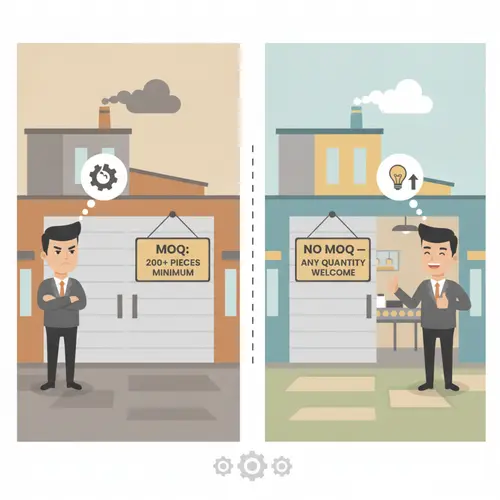
Why MOQ Exists At All
MOQ isn't one rule — it comes from two different places, depending on whether you're working with an existing style or building something fully custom.
Ready-Stock Model: The Garment Itself Has No MOQ — But Customization Does
If you're ordering an existing style with no changes, there genuinely is no minimum — one piece or a thousand, it doesn't matter. MOQ enters the picture the moment you want ODM-level customization: custom hang tags, custom packaging, sewn-in care labels, or swapped hardware/trims. (Heat-transfer care labels have no MOQ; see heat transfer vs. sewn care labels.)
Here's why: these customizations require tooling. A custom hang tag mold, for example, typically costs around $50 USD — and most suppliers include a batch of a few dozen finished samples with that mold cost. If you're ordering a small quantity, you simply pay the mold fee and get your samples with it. If you're ordering 100+ pieces, we have two options: either place a separate order that meets that trim supplier's own MOQ (with the surplus held at our facility for your next order), or fold the tooling cost directly into the garment price — usually adding only $2–3 USD per piece.
To choose between sourcing an existing style, private labeling, custom print and original development, see our four ready-stock and development paths.
Fully Custom Samples: Two Real Constraints Drive the MOQ
For a completely custom design, MOQ is shaped by two production realities that have nothing to do with arbitrary factory policy:
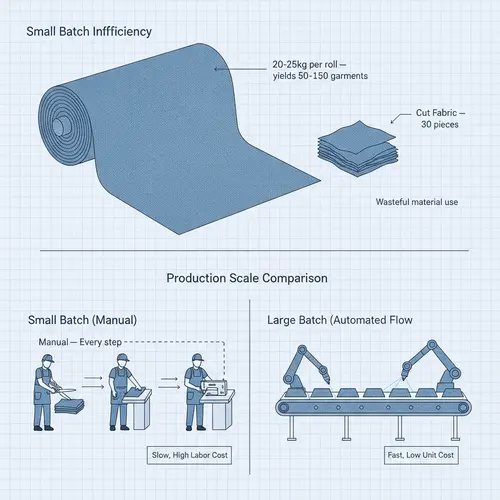
A single fabric roll weighs roughly 20–25kg. A 20 kg roll of 158 cm-wide, 190–200 GSM fabric runs about 70–80 m and yields roughly 44 to 265 pieces depending on the style see how many suits one roll really makes.
Production line efficiency. Making 30 pieces takes almost as long as making 100, because at low volume, nothing can be automated or run through a streamlined batch process — every step stays manual. This is the real reason lower quantities mean higher unit price and longer lead time, not a policy designed to discourage small orders.
 Before comparing supplier quotes, check whether MOQ applies per style, color or size; the way a minimum is scoped can change the quantity you actually need to order.
The Hidden Lever Most Factories Never Mention: Shipping Weight Brackets
This is the part of the cost conversation that almost never gets discussed openly, and it's worth understanding before you finalize any order size.
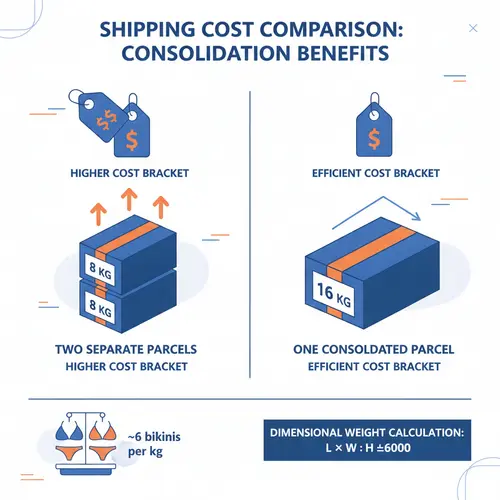
International couriers (DHL, FedEx, etc.) price shipments in weight brackets — the per-kg cost of a 10kg parcel and a 20kg parcel is often nearly identical on the same lane, because you're paying more for hitting the next bracket than for the extra kilos themselves. At a typical express rate of roughly $13 USD/kg, and roughly 6 bikinis or 3 one-piece suits per kilogram (before dimensional weight is even factored in), the shipping cost you save by consolidating into the next weight bracket can be worth more than a dozen "free" garments.
Separately, most air and express couriers also charge based on chargeable weight — the higher of actual weight or volumetric (dimensional) weight, calculated from the shipment's dimensions rather than the scale alone. This is a standard method air carriers use, applying volumetric weight, dimensional weight, or actual weight, with the volumetric rate generally calculated by dividing the shipment's volume in cubic centimeters by 6000. Bulky, lightweight packaging can quietly push your shipment into a heavier bracket than your product weight alone would suggest.
Most manufacturers don't walk customers through this because it feels like negotiating against their own service — but if you're deciding between placing one consolidated order versus two smaller ones, this is often the single biggest lever on your landed cost, bigger than most per-unit fabric or labor negotiations.
This same weight-bracket logic is also the real reason most swim brands default to selling fixed top-and-bottom sets rather than offering mix-and-match sizing — it's a margin and shipping decision, not a production limitation. Splitting an order into separate pieces doesn't reduce the shipping cost, since the shipment usually lands in the same weight bracket either way — but it does reduce the order's revenue.
Our Actual Quantity-Based Pricing
This is the part that usually stays vague industry-wide. Here's the real structure:
Quantity | Price vs. Standard MOQ Price | Example (per set) |
|---|---|---|
1–10 pieces | 50% of the standard sample fee | Sample-fee based |
10–30 pieces (5 per size) | 2× standard MOQ price | $20/set (vs. $10 baseline) |
30–60 pieces | 1.5× standard MOQ price | $15/set |
60+ (our standard batch: 3–5 sizes, 1 color) | Standard pricing | $10/set |
One detail worth calling out: we price and quote bikinis as a complete set (top + bottom together), not split into separate top and bottom line items the way some factories do. Splitting the price across two components can make per-unit cost look lower than it actually is — we consider that misleading, so we don't do it.
If you are choosing a launch quantity rather than comparing unit prices, our first swimwear order quantity guide uses supplier cases to explain how demand evidence and stock exposure affect that decision.
Sample Development Costs by Style
Style | Typical Sample Cost |
|---|---|
Bikini | $80 USD |
One-piece | $100 USD |
Two-piece set | $100 USD |
4–5 piece set | $200 USD |
Fully custom fabric development runs above these figures — price depends directly on how many customization layers are involved (fabric, trims, hardware, packaging), since each additional layer adds cost and time. Sample time is not a fixed number. It varies with the materials, the print method, and whether the client confirms a sample first, from 2 days for a basic style in stock fabric to 30 days for a project with custom hardware and packaging see how long a swimwear sample really takes, and we confirm a firm timeline once the details are settled and payment is made. Fully custom fabric builds are scoped individually once we've seen the actual design or tech pack.
Before requesting a design-specific sample quotation, use our AI swimwear tech pack and review guideto organize reference images, confirmed specifications and questions that still need technical confirmation.
The numbers above cover sampling specifically. For the full picture — hardware mold fees, packaging, hang tags, woven labels, hygiene liners, padding, beach towels, and fabric customization, all 12 categories with real pricing — see our complete Budgeting Guide, which is the same transparent-pricing philosophy behind this article applied to every customization category we offer, not just sampling.
For the full order-to-delivery picture beyond just sampling — including bulk production and shipping — see our real timeline breakdown for startup brands, including why we don't recommend the industry-standard 6-9 month planning window for most early-stage clients.
It's also worth knowing that a low or no-MOQ order carries its own real hidden costs — fabric procurement, cutting minimums, labor, and shipping brackets all work differently at small quantity. See the full breakdown of what low MOQ actually costs before you commit to a test order.
What "We'll Incubate With You" Actually Means
"No MOQ" is the foundation, but it's not the only thing that matters for a brand trying to launch or grow. Here's the full picture at a glance:
Support | What It Actually Means |
|---|---|
Volume rebates | Once cumulative orders cross 300 sets, a portion (sometimes all) of certain customization fees gets refunded |
AI-assisted visual/video support | For brands without in-house photography or short-form video capability |
Design development | Bring the concept, we handle technical execution — most brands never need to write a formal tech pack |
Warehousing & fulfillment | China and overseas (US, UK, EU, Japan/Korea), for stock and custom goods |
Co-branded distribution | For proven-sales brands: we handle inventory/fulfillment/routing on a revenue-share basis |
Lower unsold-inventory risk | A real, secondary benefit of small-batch ordering — not something we'd claim the model was built specifically to solve |
Niche category support | Period-proof, nursing, and modest swimwear — technically demanding categories we take on under the same no-MOQ logic |
Tariff-resistant pricing | We didn't follow the industry trend toward higher MOQs in 2026 — see why |
In practice, that support looks like this in more detail:
No MOQ, plus volume rebates — once cumulative orders cross 300 sets, a portion of certain customization fees (in some cases, the full fee) is refunded. Our order tracking system makes cumulative volume easy to monitor on both sides.
AI-assisted visual and video production support — for brands that need product photography or short-form video content but don't have that capability in-house.
Design development support — our design capability, enhanced by AI-assisted workflow, means you bring the concept and direction; we handle the technical execution. That extends to sampling itself — most brands never need to write a technical spec at all; see how first samples get built accurately without one.
Warehousing and fulfillment, China and overseas — for both stock and custom goods, with fulfillment to essentially any destination worldwide at negotiated freight rates.
Co-branded distribution partnerships — for brands with proven sales capability, we can structure an agreement where you focus entirely on sales while our supply chain network (with warehousing across the US, UK, EU, and Japan/Korea) handles inventory, fulfillment, and routing, on a revenue-share basis.
It's also worth being direct about something we don't market as a feature but that's genuinely true: ordering in small, demand-responsive batches through this model naturally carries less risk of ending up with unsold inventory than betting on a single large forecast — a real, if secondary, benefit of no-MOQ sourcing that we've written about honestly elsewhere, including why we wouldn't claim this model was built specifically to solve that problem.
For a full breakdown of what a real quote actually contains — sample fees, hardware molds, packaging MOQs, fabric minimums — see our line-by-line look at what's actually in a swimwear factory sample quote.
This no-MOQ model also extends to technically demanding niche categories — see how we handle the real construction behind leak-proof, period-proof swimwear.
The same no-MOQ logic applies to nursing swimwear — a technically demanding category we're still building real production expertise in. See our honest breakdown of the construction challenge.
The same model also supports modest swimwear — a genuinely growing category, not a marginal request. We work from a standardized modest swimwear pattern base, which is exactly what makes a small first order in this category lower-risk. See the real construction details, including headscarf fabric requirements.
This same flexible structure is exactly what made it possible to quote a real modular bikini order — separate finished straps, sold and priced independently from the panels themselves — at a 10-piece-per-size-per-color floor rather than turning the brand away for being "too small." See the real construction and pricing behind detachable, modular bikini straps.
Tariff pressure in 2026 has pushed a lot of factories toward higher minimums— see why our own numbers didn't justify following that trend
This project-by-project evaluation approach is exactly how we price crochet swimwear too — real sample cost depends on color count and coverage area, not a flat rate, since crochet production runs through outsourced knitwear factories and artisans rather than a standardized in-house process.
Three more real cost categories worth knowing as you plan your full budget: custom hang tags run a $50 mold fee, custom padding molds run $400 per size with a full rebate at 20,000 units, and woven-pattern beach towels run $800 with a 200-piece MOQ — all part of the complete Budgeting Guide.
The same no-MOQ logic extends to fully custom decorative hardware, too — a real mold fee (around $80-100 USD) is a one-time cost, which is why there's no fixed piece-count minimum for custom hardware the way there might be for a full garment run. See the real mold-development process and pricing logic behind custom swimwear hardware, including when the tooling investment is actually worth making.
Swimwear Care Labels: Heat Transfer vs. Sewn, Real Costs — why heat-transfer labels have no MOQ while sewn labels start around 2,000 pieces, and what each adds per piece.
The fabric side of MOQ works differently from the sewing side.** A roll of stock fabric is bought per color, and orders under one roll are cut loose by the meter at about ¥20/m, which is why unit prices rise on very small runs. See how many suits one roll really makes, including custom fabric sampling and dye fees.
Sample time has no fixed number either.** The fastest sample we have made took 2 days and the slowest project took 30, depending on materials, print method, custom accessories, and confirmation rounds. See the two real cases side by side.
Care labels are a no-MOQ item if you choose heat transfer.** Heat-transfer labels cost about $0.5 each on small runs with no minimum, while sewn labels start around 2,000 pieces. See the real per-piece costs of both methods.
Not every fabric claim comes with a lab report, and we'd rather say so than pretend otherwise. Tan-through swimwear is a real mesh construction, but the UV-transmission number behind it is usually unverified — ours included. See the honest breakdown of what's real and what isn't.
If you're testing through dropshipping before committing to bulk, shipping is its own real cost line — and it prices differently than bulk freight. A single 200–300g piece ships for about $10–20 with no company info on the package, in about 12 working days. See the real single-parcel shipping cost and blind-ship packaging details.
One revision is free — what costs extra is reshipping it, not the revision itself. If you approve a revised sample from a photo, you go straight to bulk at no added cost. See the full 4-step process and what actually triggers a second cost.
Case Study: From a Lingerie Brand to 20,000+ Units a Month in Swimwear
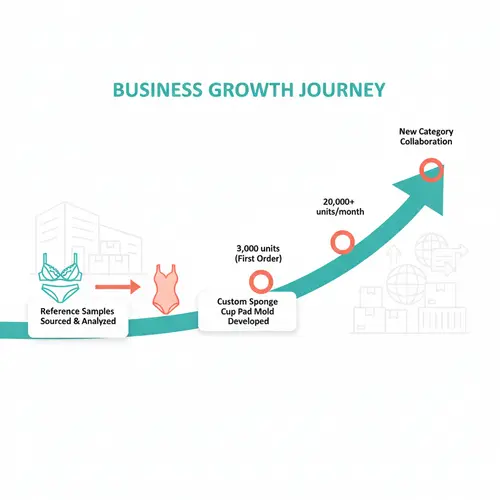
A lingerie brand looking to expand into swimwear came to us without an existing swim product line — a real example of why factory responsiveness matters more than a fast "yes". We started by analyzing their market position and identifying direct competitors, then sent that analysis back to them. Given their priority on speed to market, we suggested they source a few benchmark products from other brands already in that space and send them to us directly.
Once those reference samples arrived, we broke them down component by component and sourced matching suppliers for each part in parallel — including developing a fully custom sponge cup pad mold from scratch, a genuinely significant undertaking that we completed in a short timeframe. Samples went out fast enough that the client was able to shoot their campaign and launch on schedule, and they were clear that our response speed and service were a deciding factor in continuing to work with us.
Their first order came in at over 3,000 units. A reorder followed quickly, and the brand's monthly volume has since stabilized at more than 20,000 units a month.We're now planning a China-direct shipping model with them for later this year, moving them toward a no-inventory sales structure. The trust built over that relationship has led to discussions about an entirely new project together — interestingly, in an apparel category outside swimwear, which is where our working relationship with them originally could have started. What's made that possible is the same infrastructure behind everything in this article: multiple coordinated warehouses, an in-house supply chain system, and full transparency into cutting quantities, production start/completion dates, and shipping routing.
FAQ
Q: Is there really no minimum order quantity?
A: Yes — any quantity can be produced, from a single piece up. What changes with smaller quantities is price and lead time, not feasibility. The trade-off is transparent and quoted upfront before you commit.
Q: How is sample pricing actually determined?
A: It's based on style complexity and the number of customization layers involved. A standard bikini sample runs around $80, a one-piece or two-piece set around $100, and a 4–5 piece set around $200 — fully custom fabric or trim development can run higher, priced individually once we've reviewed your design or tech pack.
Q: What if I need custom packaging, tags, or hardware for a small order?
A: These typically involve a one-time tooling/mold fee (around $50 for a custom tag mold, for example), which usually includes a batch of finished samples. For larger orders, the tooling cost is either handled as a separate order at the trim supplier's own MOQ, or folded into your per-unit garment price at a small added cost.
Q: Do smaller orders get lower quality or less attention than bulk orders?
A: No — it's the same production team and the same process either way. The price difference for smaller quantities reflects the extra labor time of manual, non-batch production, not a difference in materials or craftsmanship.
Q: Does the 300-set volume rebate apply per style, or across all my orders?
A: It's tracked cumulatively across your order history with us, not reset per individual style — our order system makes the running total visible to both sides, so it's clear when a rebate threshold has been reached.
Q: Can I combine multiple customizations — like tags, packaging, and hardware — into a single order to reduce tooling costs?
A: Yes. Since tooling/mold fees are largely a one-time cost per customization type, consolidating several customizations into one order spreads that fixed cost more efficiently than ordering them separately over time. It also helps you hit shipping weight brackets sooner, which compounds the savings.
Q: How does order quantity affect sample lead time?
A: Quantity is not what sets sample time; materials and process are. Our fastest sample took 2 days (stock fabric, a basic style, digital printing) and our slowest project took 30 (custom packaging, hang tags, hardware, a gift box, and a peak-season print queue), and we confirm a firm timeline once the details are settled and payment is made. See how long a swimwear sample really takes for both cases side by side.
Q: Is ocean freight subject to the same weight-based pricing logic as air or courier shipping?
A: Not exactly. The dimensional/volumetric weight math discussed above applies specifically to air freight and express couriers. Ocean freight (relevant mainly for larger bulk orders) is typically priced by volume in cubic meters (CBM) rather than a weight-based dimensional formula — a different calculation, but the same underlying principle: how efficiently you use the space you're paying for affects your real cost per unit.