
2026 PFAS Bans Are Real — Swimwear Fabric Is Mostly Exempt
PFAS bans on apparel are real and arriving on a specific timeline this year: France's ban on PFAS in clothing is already in force, the EU's PFHxA restriction under REACH reaches consumer textiles in October 2026, and multiple U.S. states — including New York, California, and Minnesota — have their own restrictions taking effect through 2026. What most coverage of this trend skips is a distinction that actually matters for swimwear sourcing: the PFAS chemistry these bans target is built primarily into technical outdoor wovens — rain shells, windbreakers, hiking gear — not high-stretch knit swimwear fabric. Here's the real, specific reason why, and what it means if you're sourcing swim fabric right now.
What PFAS Actually Does — And Why That Matters for Swimwear Specifically
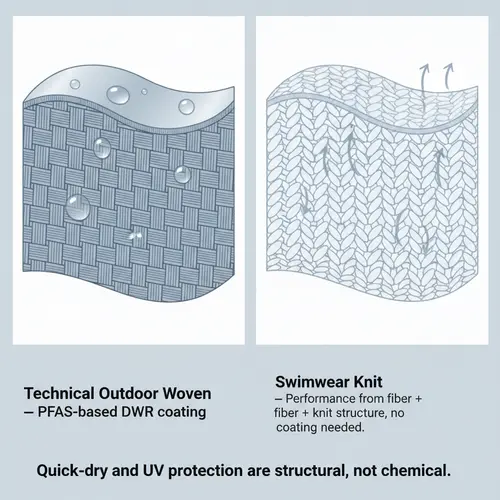
PFAS in textiles exists almost entirely to create durable water repellent (DWR) coatings — the finish that makes a rain jacket bead water instead of soaking it through. That's a real, useful property for outdoor technical apparel worn in prolonged wet-weather conditions where staying dry matters. It's simply not a property swimwear fabric is built around, or needs to be.
Swimwear fabric's defining performance traits — quick-dry behavior and UV protection — come from a completely different source: fiber composition, knit structure, and the weaving/knitting and dye-finishing process itself, not a chemical water-repellent coating applied afterward. This is the same underlying principle behind why texture in trending fabrics like ribbed and crinkle knits comes from the knitting process rather than a printed or coated surface — swim fabric performance is largely a structural and process decision, not an added-chemical one.
Why This Distinction Gets Lost in PFAS Coverage
Most PFAS reporting understandably starts from the apparel category where the chemistry is most entrenched — technical outerwear — and extends the alarm to "clothing" broadly without separating out categories where the underlying chemistry was never functionally necessary. Swimwear gets swept into that broader narrative even though the mechanism driving PFAS use in a rain shell simply doesn't apply the same way to a stretch knit bikini or one-piece.
Our own fabric sourcing has been explicitly fluorine-free from the start — not as a reaction to the 2026 regulatory wave, but because a DWR-style coating was never part of how we built quick-dry or UV-resistant performance into swim fabric in the first place.
How Real Buyer Questions on This Actually Get Handled
We've had direct customer inquiries asking whether our fabric is PFAS-free, and we answer honestly every time. In practice, that's meant passing along the fabric supplier's own certificates — fluorine-free status, chlorine resistance, UPF rating — directly to the customer as documentation.
Worth being precise about what that does and doesn't prove: a supplier certificate is a starting point, not independent verification — a lesson we've written about before in a different context, where a signed contract and a certificate weren't enough to stop a supplier from later denying their own fabric's origin. On PFAS specifically, no customer to date has requested independent sample testing beyond the supplier certificate — every inquiry has been satisfied by the documentation itself. That may simply reflect that PFAS concern in swimwear sourcing is still a relatively new question for most buyers, rather than evidence that a certificate alone is always sufficient.
What Independent Testing Actually Costs, If You Want More Than a Certificate
PFAS is short for per- and polyfluoroalkyl substances — a broad chemical family, not a single compound. When we looked into what independent lab testing would actually involve beyond a supplier certificate, a testing agency we consulted confirmed two things directly, on their own initiative rather than in response to a leading question: swimwear as a product category is generally exempt from this specific testing requirement, and this type of product typically doesn't contain PFAS to begin with. That's an independent confirmation of the same conclusion we'd already reached from the fabric-construction side.
Full-panel testing — screening for the broad range of PFAS variants — comes at a real cost premium, and most buyers don't need it. In practice, labs typically offer a few tiers depending on how many PFAS compounds are screened:
Testing scope | Compounds covered | Cost |
|---|---|---|
Targeted (PFOS + PFOA) | The two most established, heavily regulated legacy compounds | \\\~¥400 RMB per material |
Mid-range panel | 292 PFAS compounds | \\\~¥1,500 RMB per material |
Full panel | 711 PFAS compounds | \\\~¥2,000 RMB per material |
For most swim fabric sourcing conversations, the targeted PFOS/PFOA test is the practical starting point — it covers the compounds regulators have historically focused on, at a fraction of the cost of a full 711-compound panel that's built more for categories where PFAS use is actually widespread, like technical outdoor wovens.
The One Question We're Not Going to Answer With False Confidence
A natural follow-up question is what it would cost, performance-wise, to move to a PFAS-free water-repellent finish if one were ever needed. We're not going to answer that with a number, because in our own experience, swimwear fabric doesn't require a water-repellent finish process at all — the fabric doesn't need to shed water the way a rain shell does, since it's designed to be worn wet. That's our own understanding based on the swim fabric we actually work with, not a claim about how every swimwear manufacturer or every fabric type in the broader industry operates. If a specific swim fabric construction elsewhere in the industry does rely on a water-repellent finish for some other reason, that's outside what we can speak to directly.
What This Means If You're Sourcing Swim Fabric in 2026
If you're sourcing... | What PFAS regulation means for you |
|---|---|
Outdoor/technical wovens (rain shells, windbreakers) | Direct, material impact — reformulation of DWR coatings is likely already underway or required by specific 2026 deadlines |
High-stretch knit swimwear fabric | Minimal direct impact — quick-dry and UV performance don't typically depend on PFAS-based coatings to begin with |
Either category, regardless of category-specific risk | Still worth requesting fluorine-free confirmation and relevant certificates from your fabric supplier — sourcing chains and specific finishing processes vary, and a certificate costs nothing to ask for |
PFAS isn't the only 2026 compliance question that gets more alarming in headlines than it turns out to be in practice for most swim brands. The same "read the actual scope before reacting" approach applies to children's product certification requirements, the EU's unsold-clothing destruction ban, and SS2027's neon and fluorescent color trend — three more 2026 topics where the specific scope matters more than the headline.
If PFAS testing isn't the real cost concern, the other REACH-related tests are — see a real, itemized breakdown of what REACH compliance testing actually costs for swimwear, including which items are exempt and which one dominates the total.
FAQ
Q: Are the 2026 PFAS bans on apparel real, or is this overstated in media coverage?
A: The regulations themselves are real and dated: France's PFAS clothing ban is already in force, the EU's PFHxA restriction under REACH reaches consumer textiles in October 2026, and several U.S. states have their own 2026 effective dates. What's often overstated is how directly those bans apply to every apparel category — the chemistry primarily targeted is functional water-repellent coatings, which aren't standard in most swimwear fabric construction.
Q: Does swimwear fabric ever use PFAS-based treatments?
A: It's not something we use or have needed to use — quick-dry and UV-resistant performance in the swim fabric we source comes from fiber composition and knit/dye-finishing processes rather than an applied water-repellent coating. We can't speak definitively to every fabric construction across the broader industry.
Q: How can I verify a swim fabric supplier's PFAS-free claim?
A: Ask for the supplier's certificate directly, the same way you would for chlorine resistance or UPF rating. A certificate is real documentation, but it's worth treating it as a starting point rather than the final word — the same caution that applies to any fabric certification claim.
Q: Should I be worried about PFAS in the swimwear I'm currently sourcing?
A: If your fabric doesn't carry a water-repellent or stain-resistant finish — which most standard stretch swim knits don't — PFAS exposure risk from that specific pathway is low. It's still reasonable to request fluorine-free confirmation from your supplier, since finishing processes and supply chains vary by source.
Q: If I want independent PFAS testing instead of relying on a certificate, what does that actually cost?
A: It depends on scope. A targeted test for PFOS and PFOA (the two most established, heavily regulated compounds) runs around ¥400 RMB per material. Broader panels exist too — a 292-compound panel runs around ¥1,500 RMB, and a full 711-compound panel around ¥2,000 RMB per material — but for swim fabric, the targeted test is usually the practical starting point. Worth noting: when we inquired about this ourselves, the testing agency independently confirmed that swimwear as a category is typically exempt from this testing requirement in the first place.
This is one more example of the manufacturing feasibility and honest compliance judgment we try to bring to every sourcing conversation — including telling a brand when a regulatory concern doesn't apply to their category the way headlines suggest.
The same approach applies to CPSC eFiling and kids' swimwear certification: we've laid out plainly who actually needs a CPC/GCC certificate versus who doesn't, rather than assuming every regulatory headline applies equally to every brand.
It also shows up in a very different context — color: the same structural-vs-surface-treatment reasoning explains why true fluorescent swimwear color carries different compliance and durability considerations than standard high-saturation dyeing.
And it applies to the EU's newer unsold-clothing destruction ban too: most early-stage swim brands fall well outside that regulation's scope, the same way most fall outside PFAS testing requirements for swim fabric specifically.