
Layered Swimsuit Trend: Real vs. Fake Bikini Construction
Layered swimwear is one of the standout trends of summer 2026 — bikinis designed to look like two suits worn together, often in polka dot prints against the season's muted chocolate-brown and bicolor palettes. What most trend coverage doesn't explain is the part that actually matters if you're sourcing it: a layered swimsuit is one garment, engineered to look like two. How well that illusion holds up — and what it actually costs to build — comes down to construction decisions most brands never think to ask about.
The Trend, Briefly
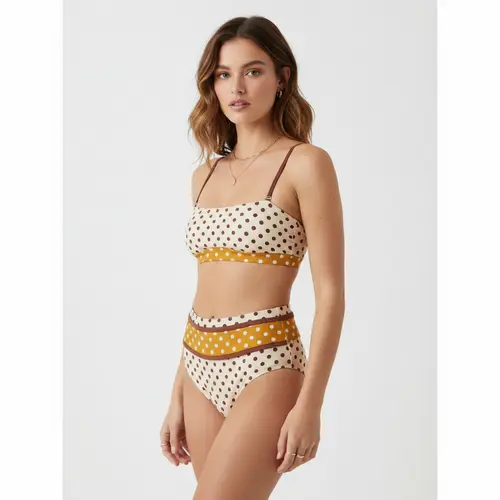
The look took off through repeated celebrity styling over the past two seasons and has since moved from a styling trick into garments built with the layered effect sewn in from the start, appearing on brands from Skims to smaller contemporary labels. A common construction pattern echoes what's become the template for the category: an inner cup construction that ties at the neck, sitting underneath a more structured outer layer with adjustable straps — visually reading as two separate tops, functionally built as one. Bottoms follow the same logic, typically combining a regular waistband with a second, tied waistband layered over it. Color-wise, the trend has leaned hard into polka dot prints, shifting this season toward muted, bicolor combinations — chocolate brown paired with mustard, cream, or sky blue — rather than the high-contrast red-and-white prints the look started with.This look also gets searched under a few other names — "stacked bikini" and "double-layer swimsuit" both describe the same construction, just different shopper phrasing for the same trend.
How the Top Is Actually Built
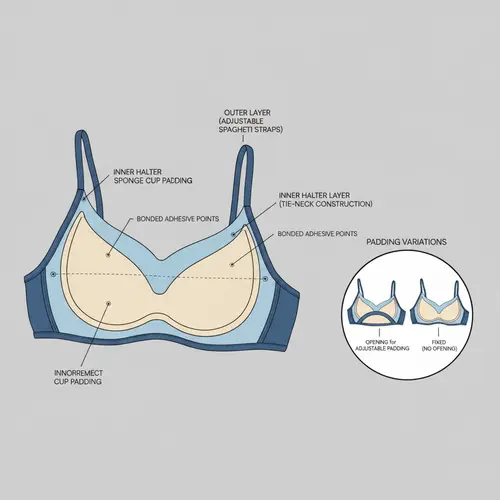
The inner piece is typically a halter/tie-neck construction; the outer, "mis-layered" piece is built with adjustable spaghetti straps — that pairing is what creates the visual read of two different tops stacked together.
Structurally, this is usually built using a four-layer bonded construction technique (sometimes called a "pull-edge" method): four fabric layers are bonded together to form the finished panel. The innermost layer is where the sponge cup padding gets inserted — when brands build in an opening for that layer, the padding can be adjusted or replaced. A significant number of brands skip that opening entirely, which keeps construction simpler but means the padding is fixed in place for the life of the garment. That's a real trade-off worth asking your manufacturer about directly, because it's invisible from a finished-product photo.
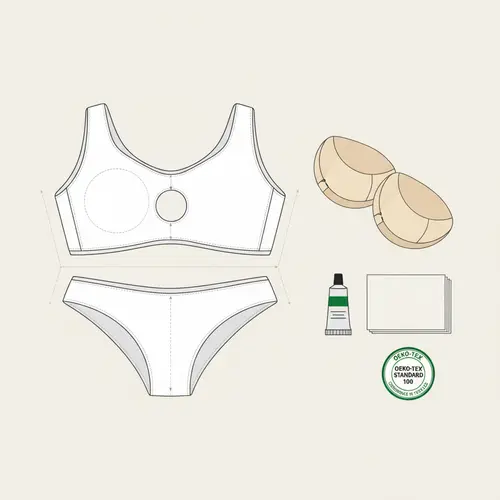
Since this construction involves bonding rather than only stitching, it's worth confirming with your supplier that any bonding adhesives used are covered under OEKO-TEX STANDARD 100 certification — bonding agents are exactly the kind of production input that certification is designed to screen.
Where "Real" and "Fake" Layered Bottoms Actually Diverge
This is the part worth knowing if you're comparing suppliers or trying to understand why two visually similar products are priced completely differently.
The fast-fashion shortcut — common on platforms like SHEIN and TikTok Shop sellers — builds the "layered" look by stitching a single contrast-color fabric block onto the top edge of an otherwise standard bottom. It reads as layered in a product photo. It is not actually two layers of anything.
Genuine layered bottoms are built differently from the ground up: two fully separate fabric layers, joined only at the gusset (crotch seam) and left independent everywhere else. The two layers move somewhat independently on the body rather than behaving as one bonded piece, which is what makes the layered effect hold up in motion rather than just in a static photo.
Why the Real Version Costs More
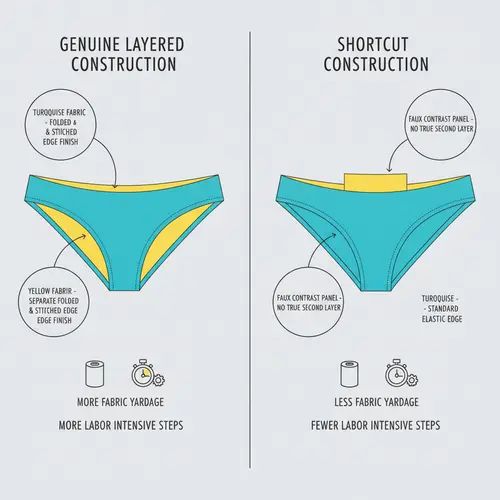
The fake version adds one small trim piece to an otherwise standard bottom — minimal extra fabric, minimal extra labor. The genuine version effectively requires cutting and finishing two nearly complete fabric layers instead of one: each layer needs its own edge treatment, and because the two layers are only connected at the gusset, the pattern has to be engineered precisely enough that both layers sit correctly and move together rather than twisting independently during wear. That's meaningfully more fabric, more finishing steps, and more pattern-engineering precision than the shortcut version — which is exactly why the price difference between a "layered-look" bottom and a genuinely layered one is real, not just markup.
This is the same logic behind why our sample pricing scales with construction complexity rather than being a flat rate — a technique like this sits toward the higher end of that range because of the extra layers and steps involved, not because of the fabric itself.
It's the same principle behind another 2026 texture trend, crinkle swimwear: a visual effect that looks like one thing in a product photo but is actually built through one of two structurally different (and very differently priced) real construction methods underneath.
What Doesn't Change: Pattern-Making Is Standard Process, Just More Complex
Cutting and pattern-making for a layered design follows the same overall workflow as any other style — tech pack, pattern draft, sample cut, sew. It's simply a more complex version of that same process, with more pieces and more precise alignment between layers. Interestingly, that added complexity doesn't change the sample development fee itself in most cases — it's priced within our standard range based on overall construction difficulty, the same way any multi-step customization is.
Comfort: Heavier, But Not Hotter
A layered construction is objectively heavier than a single-layer suit, simply because there's more fabric. In practice, that doesn't translate to feeling stuffy or overheated while worn — swimwear spends most of its wear-time either in water (already wet, regardless of layer count) or drying in open air afterward, and the difference in dry time between a layered and single-layer suit is smaller than people expect, since both are already soaked through during actual swimming and dry at a broadly similar rate once you're out of the water and resting.
FAQ
Q: Is a layered swimsuit actually two separate garments?
A: No — it's built and sold as a single garment engineered to visually read as two. The inner and outer sections are usually different construction types (commonly a tied inner piece and an adjustable-strap outer piece) to sell the illusion.
Q: How can I tell if a layered bikini bottom is genuinely layered or just styled to look that way?
A: Check where the layers connect. A genuine layered bottom joins the two layers only at the gusset, with both layers otherwise independent. A shortcut version is usually a single standard bottom with one extra fabric block stitched onto the top edge — no true second layer underneath.
Q: Is a "stacked bikini" the same thing as a layered swimsuit?
A: Yes — "stacked bikini," "double-layer swimsuit," and "layered swimsuit" all describe the same trend and the same construction question: whether the two visual layers are genuinely separate fabric pieces or a styling shortcut on a standard suit.
Q: Does the padding in a layered bikini top stay in place, or can it be adjusted?
A: It depends on construction. Some manufacturers leave an opening in the innermost bonded layer for the padding to be inserted or swapped; others skip that opening for simpler construction, which means the padding is fixed permanently. Ask your supplier directly — it's not visible in a finished-product photo.
Q: Does a layered swimsuit take longer to dry than a regular one?
A: Not meaningfully, in practice. Swimwear stays wet throughout actual swimming regardless of layer count, and dry time afterward is broadly similar once you're out of the water — the extra fabric adds weight, not a noticeably longer dry time.
Q: Why does genuine layered construction cost more than a "layered-look" style?
A: It requires cutting and finishing close to two complete fabric layers instead of one, with precise pattern engineering so both layers move together correctly. A shortcut version only adds a small trim piece to a standard bottom — far less fabric and labor.
This is one example of the manufacturing feasibility questions worth asking before you commit to a trend-driven design.