
Manufacturing Feasibility: What's Actually Buildable
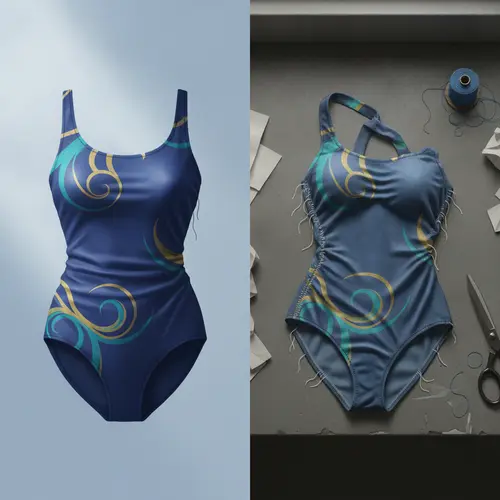
A design can look finished — rendered, styled, photographed — without being buildable. That gap between what looks right and what a factory can actually construct is where most sampling failures happen, and it's rarely about creativity. It's about physical constraints most brands never get told about until a sample comes back wrong. This page is where we lay out those constraints honestly, category by category.
Why "Looks Right" and "Builds Right" Are Different Problems
Design tools — AI-generated or not — are optimized to produce something visually convincing. They're not optimized to know what stitch types hold up under stretch, where fabric tension will pull once a garment is worn, or which construction techniques are physically compatible with each other. That knowledge comes from having actually built the thing, not from rendering an image of it. Feasibility isn't a creativity constraint — it's information a designer usually doesn't have access to until they ask a factory directly.

Where Feasibility Gaps Actually Show Up
Based on what we've documented in real projects, the same handful of categories keep causing sampling problems:
Area | The Real Constraint |
|---|---|
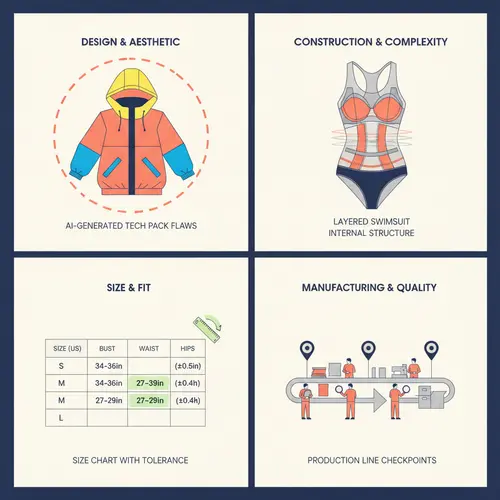
AI-generated designs and tech packs | Color, texture, structural tension, and hardware proportions rendered by AI often don't reflect physical production reality |
Trend-driven construction (layered looks, compression/shaping) | What reads as simple in a photo can require a fundamentally different — and more expensive — build than it appears to |
Return and fit data | Manufacturing tolerance is real and expected, not a defect — understanding it prevents chasing an impossible standard |
Quality control process | A single "perfect" test sample doesn't represent what a full production run actually delivers — ongoing checkpoints matter more |
Feasibility Gap | The Real Finding | Full Breakdown |
|---|---|---|
AI-rendered designs | Color, texture, tension, and hardware proportions often don't reflect production reality | |
"Layered look" construction | A shortcut look and a genuinely engineered layered garment are two different builds | |
Tummy-control claims | Real compression comes from specific shaping methods, not visual camouflage | |
Return rates | Manufacturing tolerance is real and expected — chasing "zero variance" is chasing the wrong standard | |
Bust support claims | Six specific construction elements separate real structural support from a padded shelf bra | |
Kids' swimwear compliance | Real CPC/GCC certification pricing, and a real gap between US and EU drawstring rules | |
Training vs. race suit fabric | An honest account of where our own competitive-swimwear experience actually stops | |
Graduated compression | Real two-layer lamination construction — the same mechanism behind Spanx's three-tier line | |
Full tech packs | Requiring clients to spec stretch ratios shifts judgment onto people unequipped to provide it — 90% first-sample success without one | |
DTC CPC/GCC certification | The real difference between marketplace-enforced and optional, risk-disclosed certification paths | |
Fabric opacity when wet | Real GSM and lining thresholds determine opacity — "dark colors don't show through" is only half true | |
OEM vs. ODM vs. private label | Which service models we actually offer, which we deliberately don't, and what design development really costs | |
Sample-to-bulk consistency | An approved sample only proves one version worked once — stretch fabric cutting and molded cups are where swimwear consistency actually breaks at scale | |
Sample lead time | What takes 2 days with stock fabric and a basic style can take 30 with custom hardware, packaging, and revision rounds — timing is a feasibility question too | |
Tan-through / UV-permeable claims | A real mesh construction with a genuine physical mechanism, but usually sold without any lab-verified transmission number — including ours |
A Few Real Examples From This Work
6 ways AI swimwear designs mislead before sampling — real, specific gaps between AI-rendered designs and physical construction, from print technique to three-view tech pack inconsistencies.
How 2026's layered swimsuit trend is actually built — the real construction difference between a shortcut "layered look" and a genuinely engineered layered garment.
How real tummy-control compression is built — which shaping methods create real compression versus visual camouflage, and why most marketplace "shaping" claims don't hold up.
Why DTC swimwear returns are so high — a full breakdown of manufacturing tolerance, quality checkpoints, and the other factors that actually drive return rate.
Real bust support in swimwear: what actually works — the six construction elements that separate genuine structural support from a padded shelf bra marketed the same way.
Kids' swimwear compliance: drawstrings, UPF, and what certification actually costs — real CPC/GCC certification pricing, the US-EU drawstring regulation gap, and an honest account of what we haven't independently tested.
Training swimwear vs. race suits: where the fabric confusion actually comes from — an honest account of where our own competitive-swimwear experience stops, and the real fabric science behind the two categories.
How graduated compression swimwear is actually built — the real two-layer lamination construction behind Spanx's three-tier compression line, the hidden adhesive-quality variable, and why this is a low-reorder, high-per-unit category rather than mass production.
Why your swimwear factory shouldn't need a full tech pack — why requiring clients to spec stretch ratios and lining construction shifts factory judgment onto people unequipped to provide it, and how a 90% first-sample success rate gets built without it.
Do DTC swimwear brands actually need a CPC/GCC certificate? — the real difference between marketplace-enforced certification and the optional, risk-disclosed path for independent brand sites, plus what certification actually costs in extra samples and lab time.
Why some swimwear turns see-through when wet — and some doesn't — the real GSM and lining thresholds that determine opacity, and why "dark colors don't show through" is only half true.
OEM vs ODM vs private label: where we actually stand — which service models we actually offer, which we deliberately don't, and what real design development costs when you don't have your own tech pack.
Sample success vs. mass production: the real swimwear gap — why an approved sample only proves one version worked once, and the two swimwear-specific places (stretch fabric cutting at volume, molded cup batch drift) where the gap between sample and bulk production actually shows up.
Feasibility also has a time dimension: what takes 2 days with stock fabric can take 30 with custom hardware and packaging, as shown in how long a swimwear sample really takes.
Tan-through swimwear: real fabric science or marketing concept? — the honest mechanism behind UV-permeable mesh, why we don't have a lab-verified transmission number, and the double-layer construction that actually keeps it wearable.
Our Approach: Say What's Actually True, Not What's Easiest to Hear
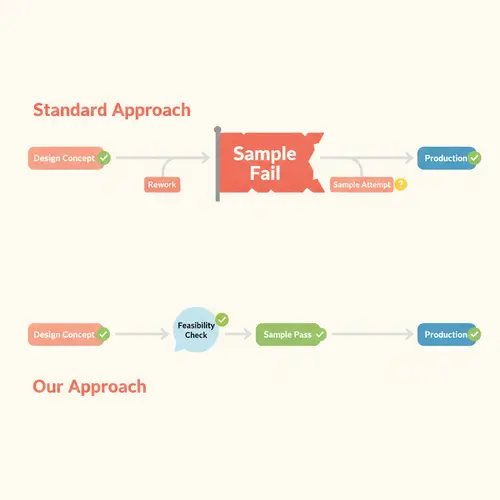
The throughline across everything on this page is the same: we'd rather tell a brand upfront that a design needs to change than let it fail at the sampling stage. That means being specific about trade-offs — cost, comfort, durability — rather than defaulting to "yes, we can do that" on every request. It's a slower first conversation, and it's the reason projects we take on tend not to need expensive rework later.
FAQ
Q: If a design isn't feasible as originally conceived, does that mean it can't be made at all?
A: Almost never — it usually means a specific adjustment (fabric choice, construction method, or technique) makes it work. We'd rather identify that upfront and propose the fix than quote something we already know won't hold up.
Q: How early in the process should feasibility be checked?
A: As early as possible — ideally before a tech pack is finalized. Catching a construction issue at the design stage costs nothing; catching it after a sample is cut costs real time and material.
Q: Does prioritizing feasibility slow down the sampling timeline?
A: It can add a short upfront conversation, but it typically saves time overall by avoiding rework from a design that wasn't buildable as originally specified.
Not sure if your design is production-ready? Send it over — we'll tell you honestly what's feasible and what needs adjusting before you commit to a sample.