
Nylon vs Polyester Swimwear Fabric: What Actually Wears Out
Byoyoyi.ai— written with AI-assisted research, reviewed and fact-checked in-house.
Most nylon-vs-polyester swimwear guides stop at fiber chemistry: polyester resists chlorine and UV better, nylon feels softer and stretches more. That's true, but it's also the easy 20% of the decision. The harder, more useful 80% — composition ratio within a nylon-spandex blend, what a specific weight is actually suited for, what a custom fabric run costs, and why "fading" and "pilling" are two completely different problems with different fixes — is what this guide covers, based on the fabric we actually produce and sell every week.
The Basic Chemistry, Briefly
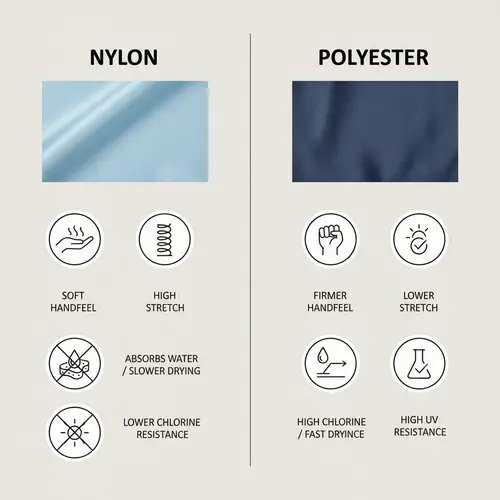
Chlorine degrades nylon faster than polyester because it attacks the amide bonds in nylon's molecular structure more readily than the ester bonds in polyester — this is well established in textile engineering literature, and it's the reason testing data from swimwear brands generally shows polyester suits outlasting comparable nylon suits under heavy chlorinated-pool use. Nylon also fades faster under UV exposure and absorbs more water, meaning nylon garments generally take longer to dry. In exchange, nylon offers a softer handfeel and typically greater stretch elongation than polyester.
That's the part every guide covers. Here's the part most don't.
We Use Both — But Nylon-Spandex Is Our Primary Blend
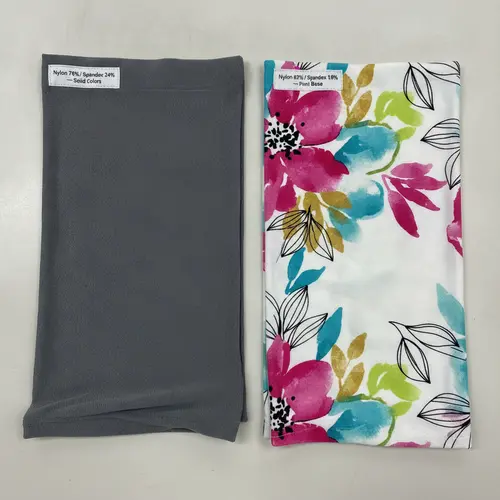
Both fiber families have a place in our production, but nylon-spandex is our default for most swim styles. Within that, composition ratio and weight are where the real sourcing decisions happen — not just "nylon or polyester."
Composition | Available weights | Typical use |
|---|---|---|
Nylon 76% / Spandex 24% | 260gsm / 230gsm / 250gsm / 200gsm / 180gsm | Higher spandex content — generally reserved for solid-color pieces rather than printed designs |
Nylon 82% / Spandex 18% | Multiple weights available | White base for direct-injection (digital) printing; lower weights used for more conservative, fuller-coverage styles |
The practical distinction: higher-spandex blends are generally kept to solid colors, while the lower-spandex, higher-nylon blend is what we run in white for direct-injection printing — a stability trade-off in production, not just an aesthetic choice. If a design needs a bold, saturated print, it's built on the 82/18 base; if it's a solid-color piece where stretch and compression matter more, the 76/24 base is the better fit.
What Custom Fabric Development Actually Costs
This is real pricing, not a "contact us for quote" placeholder: a customer can choose their own composition ratio, weight, and color, and we'll develop it as a custom fabric run. The development fee is $100 USD, with a 60KG minimum order quantity on the custom fabric itself. Beyond composition and color, one-off performance treatments — chlorine resistance, UV resistance — can be added to a custom run for an additional $100 USD, which is essentially the cost of running an extra dye vat cycle dedicated to that treatment.
Beyond Chlorine: The Abrasion-Resistance Request Most Content Skips
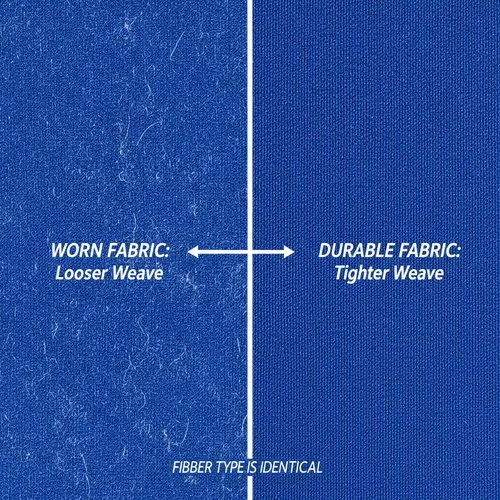
Chlorine resistance dominates the conversation online, but it's not the only durability request we get. A meaningful number of clients — particularly those sourcing for training or competitive use — ask specifically for scratch/abrasion resistance, not just chlorine resistance. This comes from a distinct textile construction technique, separate from the chlorine-resistant spandex treatment, and it addresses a completely different failure mode than chlorine damage does — one that's directly relevant to the next section.
Fading and Pilling Are Not the Same Problem — Here's the Real Difference
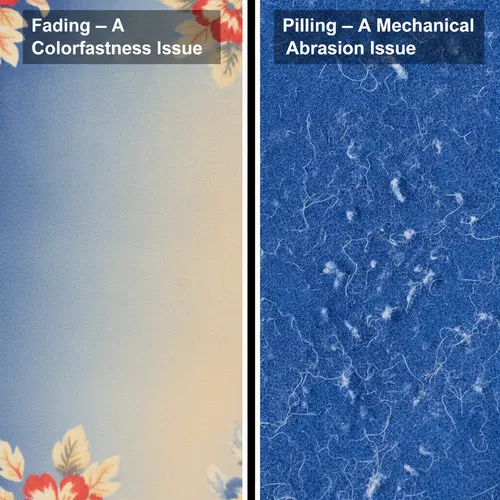
This is the distinction that gets conflated in almost every nylon-vs-polyester guide, and it matters if you're trying to diagnose a real complaint rather than just pick a fiber.
Fading is a colorfastness issue.Chlorine and UV exposure over time will gradually lighten any dyed fabric, and beyond a certain point, this isn't something you engineer your way out of — pushing harder on chemical fixes tends to cost more than the improvement is worth. Fading is expected, gradual, and inherent to prolonged wear.
Pilling is a mechanical problem, not a dye problem. We've received real returns describing "fuzzing" or pilling specifically at the seat and waist areas of training suits — and based on what we've seen, this is spandex filament breakage, not a fiber or dye issue at all. Training use means repeated entry and exit from the water, plus unavoidable contact and friction against pool edges and starting blocks. That repeated mechanical stress breaks down the spandex filaments in the fabric at the exact points where friction concentrates — seat and waist, the areas that make the most repeated contact during training.
These are genuinely different failure modes with different fixes. Fading is addressed (partially) through dye process quality and isn't something you can fully engineer away. Pilling from mechanical abrasion is addressed by moving to a scratch-resistant fabric construction — the technique described above — not by chasing a "better" fiber blend or a stronger dye process, since the root cause isn't color at all.
What We Actually Recommend When This Happens
When a training-focused client reports seat or waist pilling, our real recommendation is to test a scratch-resistant fabric construction on the next order rather than simply changing fiber ratio or color process — because the mechanical cause needs a mechanical solution. This is the kind of diagnosis that's hard to get right from a generic fiber comparison alone; it comes from actually seeing what training-specific wear does to fabric over repeated real use, which is the same kind of real construction distinction we track across our fabric and trims library.
Why This Matters More for Training-Focused Sourcing
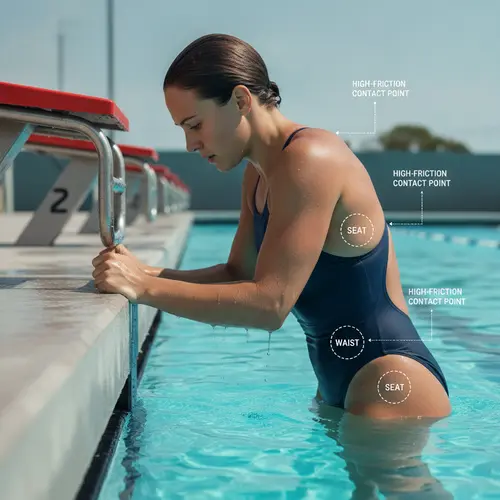
If you're sourcing for training swimwear rather than occasional leisure use, the fiber-level chlorine resistance debate is only half the picture. The other half is mechanical durability under repeated real-world friction — a factor that has nothing to do with whether you chose nylon or polyester, and everything to do with weave/knit construction and whether abrasion resistance was specifically built in.
FAQ
Q: Is polyester always the better choice for swimwear durability?
A: For chlorine resistance and UV stability specifically, yes, generally. But durability against pilling from training-related abrasion depends on textile construction (scratch-resistant weave), not on choosing polyester over nylon — a nylon-spandex blend with an abrasion-resistant construction can outperform a standard polyester blend against that specific failure mode.
Q: Why is higher-spandex-content fabric usually reserved for solid colors rather than prints?
A: In our production, higher spandex content creates more instability for print processes, making it better suited to solid, piece-dyed colors. The lower-spandex, higher-nylon blend we use as a white base holds direct-injection printing more reliably.
Q: What does it cost to develop a custom fabric composition or weight?
A: Our custom fabric development fee is $100 USD, with a 60KG minimum order quantity on the custom fabric itself. Adding a one-off performance treatment like chlorine or UV resistance runs an additional $100 USD, roughly the cost of a dedicated dye vat cycle for that treatment.
Q: My training swimwear is pilling at the seat and waist — is that a defective fabric?
A: Not necessarily a defect — in our experience, this is usually spandex filament breakage from repeated mechanical friction during training (getting in and out of the water, contact with pool edges), not a fabric quality failure. Testing a scratch-resistant fabric construction on your next order is the practical fix.
Q: Is fading in a training suit something I should expect to happen eventually?
A: Yes, to some degree — colorfastness naturally declines with prolonged chlorine and UV exposure, and this is a separate issue from pilling. See our dedicated breakdown of colorfastness and fading for what's realistic to expect and what actually helps.
Sourcing swim fabric and not sure which composition or weight actually fits your use case? Tell us the application — training, leisure, print, or solid color — and we'll recommend the real blend and weight for it, not a generic answer.