
Training vs. Race Suit Fabric: The Real 200-Hour Benchmark
Byoyoyi.ai— written with AI-assisted research, reviewed and fact-checked in-house.
When a buyer asks for "competitive" swimwear, they're often describing two genuinely different products without realizing it — and the fabric requirements for each are not interchangeable. We produce pool/gym-level training swimwear regularly; we don't have experience with officially certified major-competition racing suits, and we want to be upfront about that distinction, because understanding it is exactly what clears up most of the fabric confusion in the first place.
Two Different Jobs, Two Different Fabrics
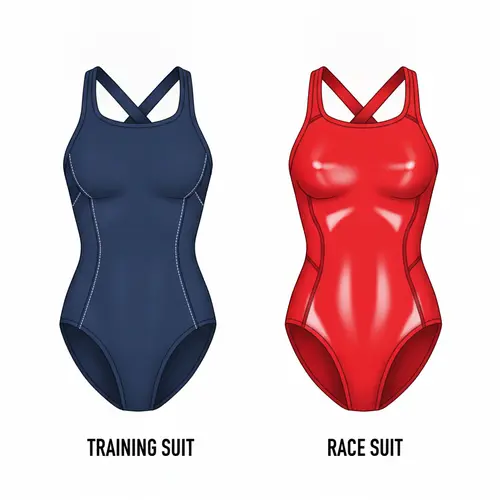
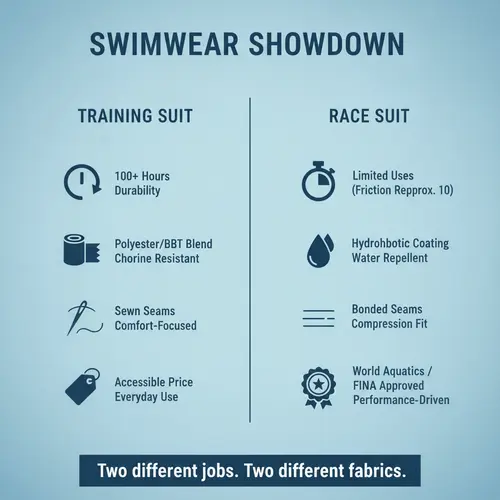
Training suits are built for durability under near-constant chlorine exposure — swum in for hours, multiple times a week, for months at a time. Race suits ("tech suits") are built for a completely different, narrower job: minimizing drag for a small number of high-stakes competition swims, at the cost of durability and price. A coach's common advice — save the tech suit for race day, train in something built to survive the daily grind — reflects a real, practical product distinction, not just a budget one.
The fabric choice follows directly from the job. Training swimwear is overwhelmingly built from polyester or polyester-PBT (polybutylene terephthalate) blends specifically for chlorine resistance — PBT's molecular structure actively resists chlorine breakdown, which is why it holds color and shape far longer than standard nylon-spandex under heavy pool use. A commonly cited real benchmark: a well-known 53% polyester / 47% PBT training fabric is rated to hold its tension and color for roughly 200 hours of pool time before stretch degradation sets in — a concrete, checkable spec, not a vague durability claim. This is the same PBT fiber family behind the compression panels we've written about in shaping swimwear — PBT's shape-retention property is useful for very different reasons in each application, but it's the same underlying fiber science.
Race suits, by contrast, prioritize hydrodynamics over chlorine endurance: hydrophobic coatings that repel water rather than absorb it, bonded (not sewn) seams to reduce surface drag, and compressive fits engineered to stabilize muscles for a handful of races rather than survive a season of daily practice.
The Two Categories, Side by Side
Factor | Training/Practice Suit | Certified Race Suit |
|---|---|---|
Primary job | Survive months of daily chlorine exposure | Minimize drag for a small number of competition swims |
Typical fabric | Polyester or polyester-PBT blend | Advanced compressive fabrics, often with hydrophobic coatings |
Seam construction | Standard sewn seams | Bonded, not sewn — reduces surface drag |
Durability | Built for hundreds of hours of wear | Fragile by design; not meant for daily training use |
Regulatory status | No governing-body certification required | Requires World Aquatics/FINA-style approval, with fabric swatch testing |
Realistic price point | Accessible, repeat-purchase category | Significant investment, typically reserved for race day |
This isn't a hierarchy of "better" and "worse" — a coach who trains in a durable practice suit and saves a certified race suit for competition day is making the correct call for both garments' actual jobs, not compromising on either.
Why "Competitive" Alone Isn't a Fabric Spec
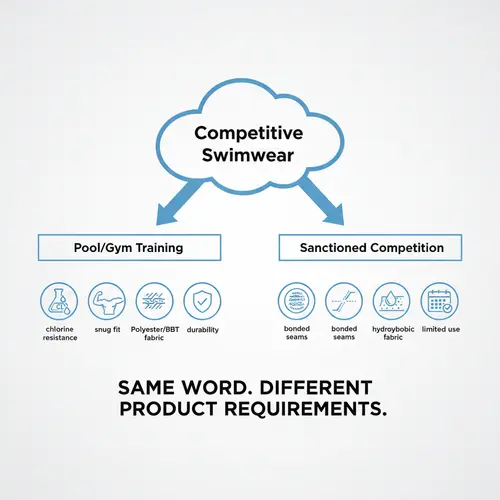
This is where the real confusion sits, and it's exactly the gap in our own experience worth naming plainly: a buyer requesting "competitive-style" swimwear for pool or gym-level use is usually describing something closer to a training suit — durable, chlorine-resistant, snug-fitting — not an officially regulated race suit. True race suits sit inside a formal, narrow regulatory category: World Aquatics (formerly FINA) requires textile-only construction since the 2010 ban on polyurethane "super suits," with strict rules on coverage (waist-to-knee for men, shoulder-to-knee for women) and a certification process where manufacturers submit physical fabric swatches for independent testing before a suit can carry the approval mark. That's a fundamentally different manufacturing and compliance undertaking than producing durable training swimwear — different fabric sourcing, different testing, different certification relationship, and typically a category dominated by a small number of major brands with direct governing-body relationships.
Knowing which of these two categories a buyer actually needs — before specifying fabric — is the single most useful clarifying question in this part of the business. "Competitive" describes a look and a use case; it doesn't describe a fabric composition, a chlorine-resistance rating, or a certification requirement, and treating it as if it does is where mismatched expectations start.
What This Means for Sourcing
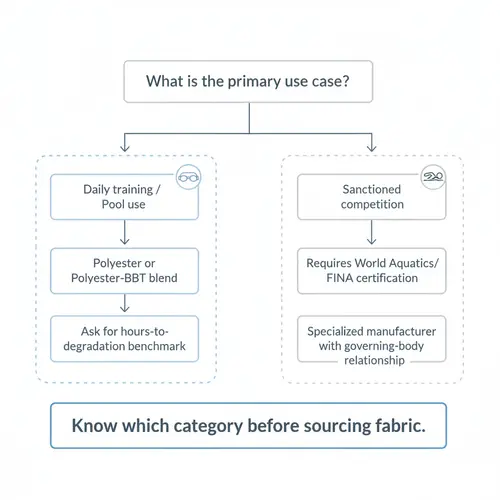
If your swimmers are training daily and durability under chlorine is the priority, a polyester or polyester-PBT blend is the right starting spec, and it's worth asking for a concrete durability benchmark (hours of pool time before degradation) rather than accepting "chlorine-resistant" as a self-explanatory claim. If what's actually needed is an officially sanctioned race-day suit, that's a different, more specialized conversation involving governing-body certification requirements that most training-swimwear manufacturers, including us, don't take on — and it's worth knowing which conversation you're having before fabric gets specified. This is the same manufacturing feasibility judgment that applies across any specialized construction: know which category you're actually asking for before the fabric gets sourced, not after. The fabric-level specifications involved here are exactly the kind of detail we track in our real fabric and trims library rather than treating "chlorine-resistant" as a single, undifferentiated claim.
This category sits alongside men's trunks, layered styles, and other silhouettes in the full real construction guide organized by swimwear type — worth a look if you're sourcing across more than one category.
Being upfront about where our own experience stops — training suits, not certified race suits — is exactly the kind of honest gap worth checking for in any supplier; see how to vet a swimwear factory before you sample.
FAQ
Q: What's the real difference between a training suit and a race suit?
A: Training suits are built for durability under repeated chlorine exposure over months of daily use. Race suits are built to minimize drag for a small number of competition swims, using different, more delicate hydrodynamic fabric and construction that isn't meant to withstand daily training wear.
Q: What fabric should I ask for in a durable pool/training swimsuit?
A: Polyester or polyester-PBT (polybutylene terephthalate) blends are the standard for chlorine resistance and shape retention. Ask for a specific durability benchmark — hours of pool exposure before stretch degradation — rather than accepting a general "chlorine-resistant" claim.
Q: Is a certified race suit the same thing as "competitive-style" swimwear?
A: No, and this is the most common point of confusion. A certified race suit sits inside a formal regulatory category (World Aquatics/FINA approval, with specific fabric and coverage rules), while "competitive-style" swimwear for pool or gym use is generally closer to a durable training suit — a different product with different fabric requirements.
Q: Does every swim team or gym need officially certified racing suits?
A: No — certified race suits are specifically for sanctioned competition. Training, practice, and general pool/gym use call for durable training swimwear, which is a more accessible and less specialized category to source.
Q: Why does PBT show up in both compression shapewear and competitive swimwear?
A: PBT's molecular structure gives it strong shape retention and chemical resistance, which is useful for two different reasons — chlorine endurance in swimwear built for pool use, and structural compression in shapewear-style garments. Same fiber family, different application.
Not sure whether your project needs durable training-level construction or a specialized certified race suit? Tell us the actual use case — we'll tell you honestly which category it falls into and what fabric that actually calls for.