
Why Swimwear Fades — And Why Fabric Vetting Matters More
Byoyoyi.ai— written with AI-assisted research, reviewed and fact-checked in-house.
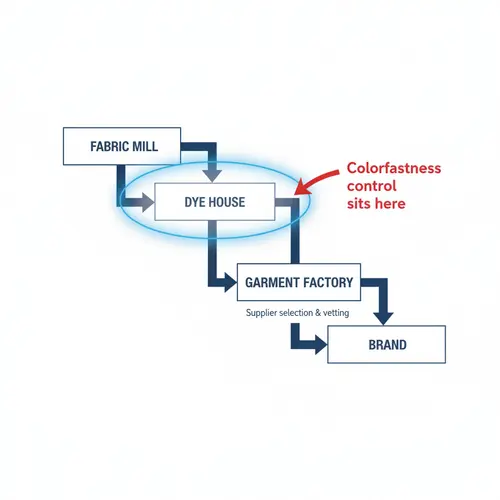
Color fading is the single most common complaint across every swimwear price tier — from $12 fast-fashion pieces to $100+ premium suits, based on 2026 B2B buyer survey data. It's worth being upfront about something before going further: the underlying dye chemistry that determines how well a color holds up is fundamentally the fabric mill's technical domain, not something a garment factory controls directly. What a garment factory can control — and what actually matters most in practice — is which fabric mills and dye houses it chooses to work with in the first place. That's the real subject of this article.
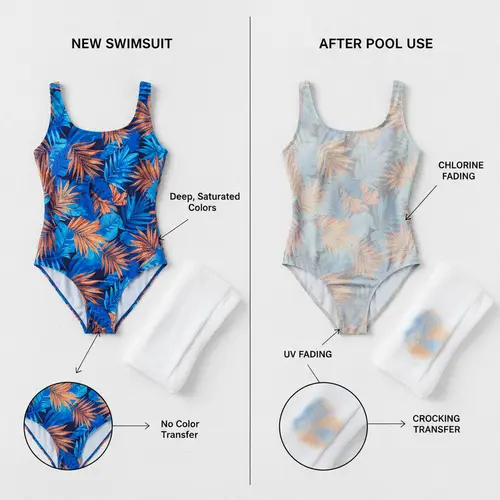
What "Colorfastness" Actually Measures
Colorfastness isn't one property — it's a set of distinct, individually-tested resistances, each with its own established international standard. The tests that matter most for swimwear specifically:
Test | Standard | What It Measures | Real-World Symptom If It Fails |
|---|---|---|---|
Chlorinated water / seawater fastness | ISO 105-E03, ISO 105-E02, AATCC 106 | Color resistance to pool chlorine and saltwater exposure | Fading specifically after swimming, even with normal care |
Light fastness | AATCC 16.3 (Xenon arc, compared against a graded blue-wool reference) | Resistance to UV/sunlight exposure over time | Fading concentrated on sun-exposed areas, worse on brighter colors |
Crocking (rubbing) fastness | AATCC 8 | Whether color transfers off the fabric onto another surface through rubbing/friction | Color transferring onto other garments, towels, or skin — what most people describe as fabrics "bleeding onto each other" |
Perspiration fastness | AATCC 15, ISO 105-E04 | Resistance to color change from sweat/skin contact | Discoloration in high-contact areas even without swimming |
Real symptoms buyers report — general fading, color transferring between garments, printed designs losing vibrancy — map directly onto specific, individually testable failure points rather than one vague "bad quality" problem. Fading after pool use points at chlorine fastness specifically; garments staining each other in a bag or drawer is a crocking fastness issue; print-specific fading is a separate question tied to the printing method itself (we've written about how direct-spray printing in particular introduces more variables into color consistency than digital printing does, based on our own production experience).
The Fiber Factor
One consistent, well-documented pattern: for chlorine-heavy use cases specifically, polyester-based fabric blends generally outperform nylon-based blends on chlorine resistance. This is one of the reasons fiber composition is one of the first things worth asking about when a fading complaint traces back to pool use specifically rather than general wear.
Fading isn't the only color problem worth knowing about, either. Undertone consistency — especially for very light colors like the season's off-white trend, or very dark colors like true black — is a separate real issue that has nothing to do with fastness testing and everything to do with how a specific color was actually formulated.
The same "verify the claim, don't just accept the label" discipline applies well beyond colorfastness — recycled ocean plastic fabric claims carry a similar gap between what's genuinely real and what's actually been verified, and deserve the same level of scrutiny.
Where This Actually Goes Wrong — An Honest Answer
Here's the part worth being direct about: we're a garment manufacturer, not a dye chemist, and we don't want to overstate expertise we don't have. The specific chemistry behind why one dye lot holds up and another doesn't — the dyeing process the greige fabric goes through, the dye class used, how well the mill controls its own process consistency — sits upstream of us, at the fabric mill and dye house level. A garment factory cutting and sewing already-dyed fabric doesn't control that chemistry directly.
What we do control, and what we think is the actually useful thing to tell you: which fabric mills and dye houses we choose to work with, and how carefully we vet them. This is the same logic behind how we verify a fabric certificate rather than taking it at face value — a colorfastness problem traced back far enough is usually a supplier-selection problem, not a mystery. Working with mills and dye houses that have their own reputation and repeat business on the line — the kind that respond to detailed technical questions with specifics rather than a blanket "no problem" — is a more reliable lever than trying to audit dye chemistry after the fact.
What Supplier Vetting Actually Looks Like in Practice
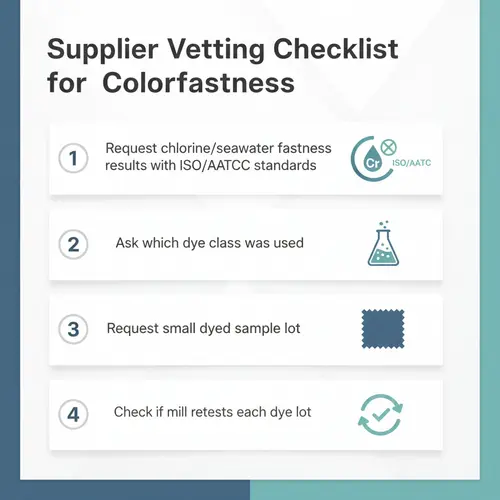
This isn't an abstract principle — it's a specific set of things worth checking before committing to a fabric source, and every item on this list is something a real, reputation-conscious mill or dye house should be able to answer without hesitation:
Ask for chlorine/seawater fastness test results specifically (ISO 105-E03 or AATCC 106), not just a general quality certificate — swimwear-specific fastness testing is a distinct request from general fabric QC.
Ask which dye class was used and why, even without deep dye chemistry knowledge yourself — a mill confident in its own process will name the dye class and explain the reasoning; a vague answer is itself informative.
Request a small dyed sample lot before committing to bulk — this is the same logic as requesting a garment sample before a full production run, applied one level upstream, at the fabric stage.
Check whether the mill retests each dye lot or assumes consistency from a past test — dye lot variation is real, and a mill that retests lot-to-lot is a meaningfully different level of quality control than one relying on a single historical result.
The same principle applies beyond color — most of swim fabric's functional performance, including PFAS-free status, comes from fiber and process choices rather than an applied coating
Fiber source is a related but separate question from fiber type — recycled-content fabric (including recycled ocean plastic claims) raises its own verification questions on top of the fastness question above. See what's real and what's still unproven in that category.
The same "root cause isn't always where it looks" logic applies to stretch recovery too — a suit losing its shape isn't always the base fabric's fault. See what actually determines swimwear stretch recovery, including a construction-stage cause most sourcing guides skip.
This list is deliberately practical rather than technical — it's built around what a brand can actually verify from a buyer's side, not what would require an in-house textile chemist to evaluate. This is also exactly the kind of specification we track as part of our structured fabric and trims library — fastness test results tied to a specific fabric entry, not a general claim attached to the category.
FAQ
Q: Is fading always a sign of a low-quality fabric?
A: Not necessarily "low quality" in a general sense — it's usually a specific fastness property (chlorine, light, or rubbing resistance) that wasn't adequately controlled during dyeing. A fabric can be fine in every other respect and still fail one specific fastness test.
Q: Why do some swimwear pieces stain other fabrics in the wash or in a bag?
A: That's a crocking (rubbing) fastness issue specifically — color transferring off the fabric through friction rather than through washing or light exposure. It's tested separately from fading under standards like AATCC 8.
Q: Is polyester or nylon better for chlorine resistance?
A: Polyester-based blends generally hold up better against chlorine exposure specifically, which is worth asking about directly if a fading complaint is concentrated around pool use rather than general wear.
Q: If colorfastness is really about the fabric mill, what can a garment manufacturer actually do about it?
A: The most reliable lever is supplier selection and vetting — working with fabric mills and dye houses that have a real reputation to protect and can speak specifically to their own dye process and testing, rather than assuming any dyed fabric is equivalent. This is closer to a sourcing discipline than a chemistry fix.
Q: Should I ask for colorfastness test results before placing a bulk order?
A: Yes, particularly chlorine/seawater fastness (ISO 105-E03 or AATCC 106) for anything marketed as swimwear — it's a standard, requestable test, and a supplier who can't produce results for it is worth asking more questions before committing to volume.
Dealing with a fading or color-transfer issue on a current fabric, or sourcing a new style and want it vetted upfront? Send us the details — we'll tell you honestly what we can verify and where the real risk sits.