
Recycled Ocean Plastic Swimwear: What's Real, What's Unproven
"Made from recycled ocean plastic" has been a swimwear marketing line since at least 2019, when a major sportswear brand's ocean-plastic sneaker and swimwear partnership first drew scrutiny for blurring the line between plastic collected directly from the ocean and plastic collected from beaches and coastal areas before it ever reached the water — a distinction environmental groups have been pushing back on for years as consumers assume more direct ocean cleanup impact than the label actually represents. That distinction still isn't consistently disclosed today. The honest picture, based on what's actually verifiable in the supply chain, has two very different halves: real, meaningful progress on the raw-material side, and a genuinely unresolved question about what happens after the garment is worn out.
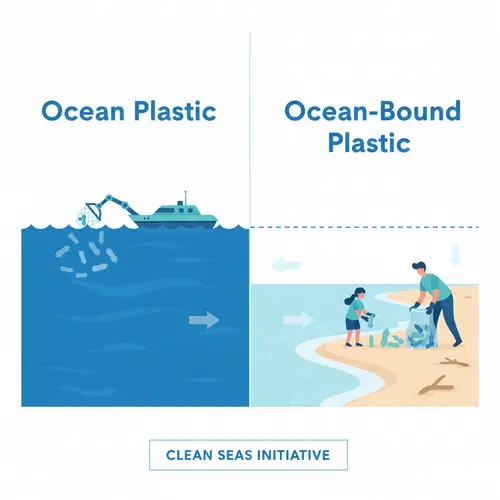
What's genuinely real: raw material recycling has advanced
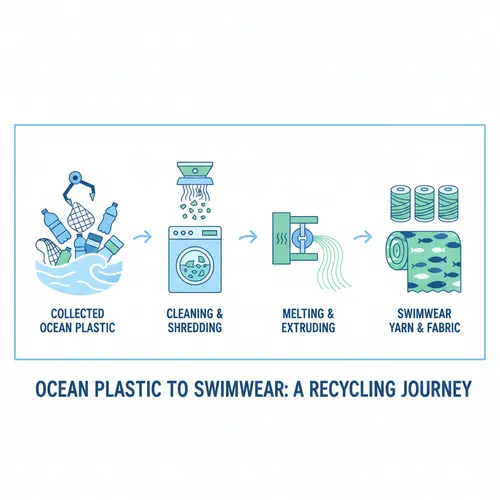
It would be inaccurate to wave this off as pure marketing. Environmental pressure and recycling demand have real driven investment in how waste plastic gets turned into usable yarn. Italian fabric mills were early leaders in processing ocean-source and other waste plastics into performance nylon and polyester yarn suitable for swimwear. That capability isn't limited to Italy anymore — a growing number of Chinese fabric suppliers now hold the real qualifications and processing technology to do the same, converting collected ocean and coastal plastic waste into spinnable yarn at production scale. This part of the story holds up to scrutiny: the raw-material recycling technology genuinely exists, and it's genuinely being used — the same real progress we've documented with recycled elastane sourcing more broadly, where the raw-material innovation is real even when the marketing built on top of it sometimes overreaches.
The part that stays unclear: does the loop actually close?
Here's the honest gap that doesn't get the same attention: once a garment made from recycled plastic reaches the end of its life, whether it actually gets recycled again into new yarn is a different question entirely — and by most available accounts, the share of finished garments that make it back into new textile fiber is very small. Industry-wide circular economy research consistently puts the amount of clothing recycled into new garments at under 1% globally. Swimwear doesn't have a documented exception to that pattern.
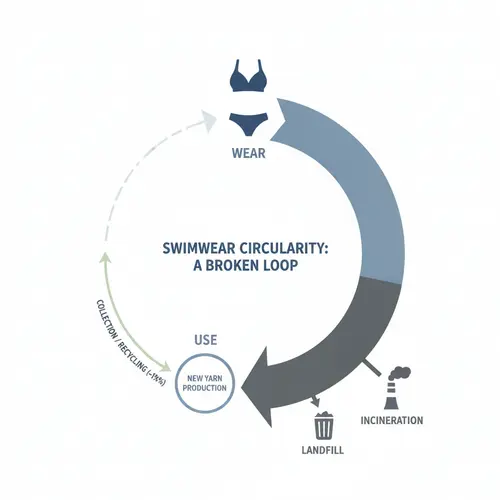
Part of the reason is technical, not just logistical: colored and dyed plastic is genuinely harder to recycle a second time than clear or undyed material, because the color itself can contaminate the reprocessing and negatively affect the properties of whatever gets made from it. Swimwear fabric is almost never sold undyed, which means the "second recycling" step swimwear would need to actually close the loop is fighting the same color-contamination problem we've written about with dye chemistry generally — it's not a hypothetical obstacle, it's a real one built into how colored synthetic fiber behaves.
Why this has produced new packaging and recycling policy
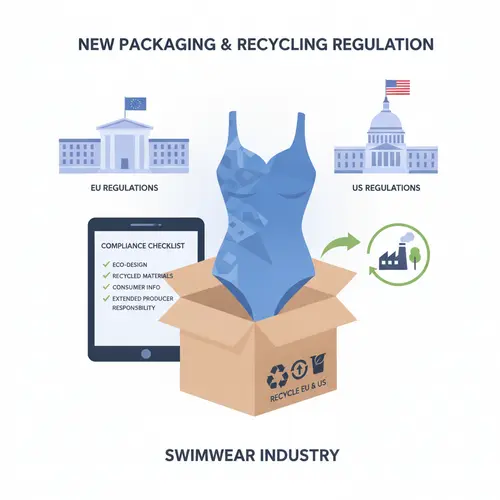
This gap between "recyclable in theory" and "actually recycled at scale" is part of why regulators in both the EU and US have introduced new packaging, recycling, and extended-producer-responsibility rules in recent years — rules we've covered elsewhere as they apply to swimwear specifically. We're not going to get into the broader political motivations behind that regulatory trend here — that's a separate, more contested conversation. What's relevant for sourcing purposes is narrower: the fact that governments are stepping in with new rules at all is itself a signal that voluntary "closing the loop" claims haven't been happening reliably enough on their own to make regulation unnecessary.
Our honest position: real progress, real skepticism about proof
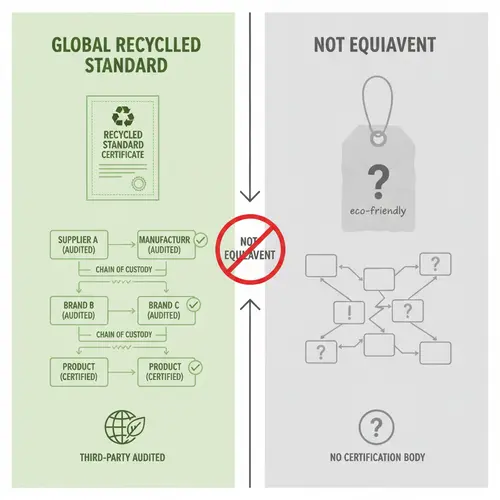
We support genuine environmental progress in this industry, and we're not neutral about that. What we are neutral about is unverified marketing. Two questions sit at the center of nearly every "recycled" or "ocean plastic" fabric claim, and the honest answer is that the industry doesn't have a consistent, transparent way to verify either one: Is this fabric actually made from the recycled or ocean-source material it claims to be? And separately, can this specific garment actually be recycled again once it's worn out? Both claims deserve the same scrutiny we've applied to any fabric certificate — a supplier's word, or a marketing claim on a hangtag, isn't independent verification, and a real certification chain is the minimum bar worth asking for before treating a "recycled ocean plastic" claim as fact. In practice, that means asking specifically whether a fabric carries GRS (Global Recycled Standard) certification — a third-party-audited chain-of-custody standard requiring a minimum 50% recycled content for product-level labeling — rather than accepting a general "eco-friendly" or "sustainable" claim with no certification body behind it at all.
What's real vs. what's unverified, at a glance
Claim | Status |
|---|---|
Waste plastic (including ocean-source) can be processed into usable swim fabric yarn | Real, established technology, increasingly available from both Italian and Chinese suppliers |
A specific fabric batch is genuinely made from the recycled/ocean-source material claimed | Verifiable only through real third-party certification (e.g. GRS) — not verifiable from marketing copy alone |
A worn-out garment made from recycled fabric gets recycled again into new yarn | Technically possible, but happens at a very small scale industry-wide; colored/dyed fabric faces a real added technical barrier |
New EU/US packaging and recycling regulation will close this gap on its own | Too early to say — the honest position is that regulation is a response to the gap, not proof the gap is already closed |
FAQ
Q: Is "recycled ocean plastic" swimwear fabric a real thing, or pure marketing? A: Both, in different places. The raw-material recycling technology is real and has genuinely advanced — Italian and increasingly Chinese suppliers can process real ocean and coastal waste plastic into usable yarn. Whether a specific product's marketing claim is accurately representing its actual supply chain is a separate question that needs real verification, not an assumption.
Q: What's the difference between "ocean plastic" and "ocean-bound plastic"? A: "Ocean plastic" typically implies material collected directly from open water. "Ocean-bound plastic" refers to material collected from beaches, coastlines, or waste streams at risk of entering the ocean but not yet in it. The distinction matters and isn't always disclosed clearly on a product label.
Q: Can a recycled swimwear garment be recycled again after it's worn out? A: Technically yes, but in practice this happens at a very small scale across the industry — commonly cited estimates put clothing recycled into new garments at under 1% globally. Dyed and colored fabric, which describes nearly all swimwear, faces a real additional technical barrier because color can contaminate the reprocessing.
Q: How can a brand actually verify a "recycled" fabric claim from a supplier? A: Ask for real third-party certification — GRS (Global Recycled Standard) or an equivalent recognized standard — rather than accepting a supplier's description or a marketing claim at face value. The same verification standard that applies to any fabric certificate applies here.
Q: Do new EU and US recycling regulations mean this problem is being solved? A: New regulation is a response to the gap between recycling claims and recycling reality, not proof that the gap has closed. It's worth tracking these rules for compliance purposes, but they don't retroactively verify claims made before they existed.