
Why We Won't Send Client Photos — What Actually Protects You
Byoyoyi.ai— written with AI-assisted research, reviewed and fact-checked in-house.
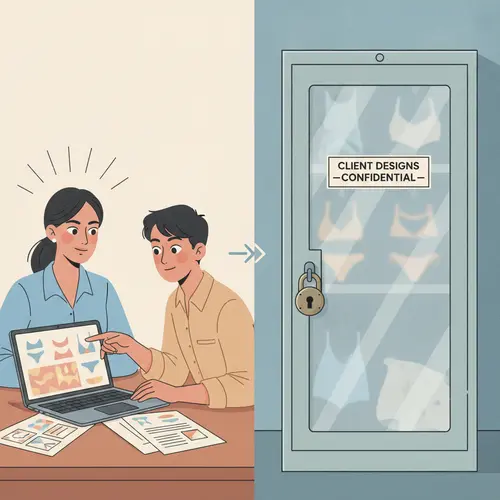
A recurring conversation with new buyers goes something like this: a brand reaches out, we ask for design references to quote from, and at some point they ask a completely reasonable question — "can I see photos of what you've actually made?" We can't send them. Not because we don't have real work to show, but because that work belongs to other clients who trusted us with their designs before this conversation ever happened. This creates real friction, and it's worth explaining honestly why it happens, and what an NDA can and can't actually do about it.
The Conversation We Have Often
A new buyer, especially one who's been burned before or is comparing several factories, wants proof of real capability before committing time to a relationship. That's a fair instinct. The natural next question is whether signing a non-disclosure agreement solves the underlying tension — if both sides sign something, shouldn't that unlock more transparency?
In practice, it doesn't resolve the core issue, for a reason that has nothing to do with either party's intentions: the photos being asked for aren't ours to share. They're another brand's confidential designs, produced under the same expectation of confidentiality the buyer asking is themselves hoping for. Showing them — NDA or not — would mean we're the kind of factory that shows client work around. That's not a reassuring signal to send to someone deciding whether to trust us with their own designs next.
What an NDA Actually Protects — And What It Doesn't
This is where it's worth being precise, because "we signed an NDA" gets treated as a solved problem more often than it should be.
A standard Western-style NDA is built around protecting information as long as it stays secret — legally, that's a narrower concept than most buyers assume, and it's frequently unenforceable against a Chinese manufacturer in a Chinese court if the agreement isn't specifically structured for Chinese jurisdiction. What actually holds up is a different, more specific instrument — an NNN agreement (non-use, non-disclosure, non-circumvention), governed by Chinese law, written in Chinese, and enforceable in a Chinese court or through arbitration. The distinction matters because a standard NDA doesn't address a Chinese manufacturer using your design or your production capacity for a similar product under their own label — an NNN agreement's non-use clause is what actually covers that.
Even with the right agreement in place, enforcement has a real practical limit: proving that a disclosure or misuse actually happened is often the hardest part of any case, regardless of which document was signed.
The Honest Reflection Behind This
Here's the part that matters more than the paperwork: if a client's design were ever copied — by us or by anyone else in this industry — having a signed agreement on file wouldn't have prevented it from happening. An agreement is a legal remedy you can pursue after something goes wrong. It is not a mechanism that stops the wrong from happening in the first place. What actually determines whether a design stays confidential is whether a factory treats that as a baseline standard of conduct, independent of whether paperwork exists — the same way most people don't need a contract to know they shouldn't take something that isn't theirs.
We still sign NDAs and NNN agreements when clients want them, and we'd recommend a properly structured NNN agreement over a generic NDA for anyone serious about the strongest legal position available. But we don't want a buyer to believe that a signature is what's actually protecting them day to day. It isn't. The factory's own standards are — and that's harder to verify than a signature, which is exactly why it deserves more scrutiny, not less.
What to Check Instead of Asking for Photos
If a factory can't ethically show you other clients' work, here's what actually tells you something real about whether they can be trusted with yours:
Ask specific construction questions and watch how they answer. A factory that's actually built garments like yours will ask you clarifying questions back — about stretch tolerance, seam placement, hardware sizing — rather than just saying yes to everything. The same red flag applies here as anywhere else in sourcing: a factory that never says "that's difficult" or "here's the trade-off" is one to be more cautious with, not less.
Request a video call of the actual physical workshop. This shows real production capacity without exposing any specific client's design.
Start with a small paid sample rather than requiring a portfolio upfront. This is exactly why low-MOQ sampling exists as a starting point — it lets you evaluate real capability on your own design, at low financial risk, without needing to see anyone else's.
Treat any document — NDA, NNN, or fabric certificate — as a starting point, not a guarantee.The same caution that applies to verifying a fabric certificate applies here: a document is only as reliable as the party standing behind it.
If protection under Chinese law matters to you, ask specifically for an NNN agreement, not a generic NDA template — and confirm it's governed by Chinese law, written in Chinese, and enforceable in a Chinese court or through arbitration.
Why We're Not Changing This Policy
We understand this makes the first conversation with a new brand harder, and we've lost inquiries over it. But the alternative — showing prospective clients photos of what we've built for existing ones — would mean every future client reading this, including the brand we're talking to right now, has no real reason to trust that their own designs will be treated the same way once they're the "existing client" instead of the one asking.
FAQ
Q: If you won't show client photos, how can I evaluate your actual capability before ordering?
A: Through a direct conversation about your specific design — the questions we ask back, and the trade-offs we flag, tell you more about real capability than a photo of someone else's product would. A video call of our physical workshop and a small paid sample are also real, verifiable options that don't require showing anyone else's confidential work.
Q: Is a standard NDA enough to protect my design when working with a Chinese manufacturer?
A: Generally not on its own. A Western-style NDA is frequently difficult to enforce in a Chinese court. An NNN agreement (non-use, non-disclosure, non-circumvention) governed by Chinese law is the stronger, more specific instrument if formal legal protection matters to you.
Q: If I sign an NDA or NNN agreement, does that guarantee my design won't be copied?
A: No agreement guarantees that. It gives you legal recourse after the fact if misuse can be proven, which is itself often difficult. The actual, day-to-day protection comes from a factory's own standards of conduct, not the existence of a signed document.
Q: Why do trading companies seem more willing to show photos than real factories?
A: A trading company often aggregates output sourced from multiple factories and isn't bound to any single client relationship the way a factory producing directly for a specific brand is — which can make them more willing to show a broad range of generic work.
New to working with a swimwear manufacturer and not sure how to evaluate one without seeing a portfolio? Ask us your hardest construction question — how we respond will tell you more than any photo could.