
Why Swim Brands Sell Sets, Not Separates — It Isn't Production
Byoyoyi.ai— written with AI-assisted research, reviewed and fact-checked in-house.
A 2024 Cosmopolitan-reported survey of roughly 2,400 U.S. women found that about 67% wear different sizes on their bikini top and bottom. Body-shape data backs this up structurally, not just anecdotally: chest-to-hip ratio varies enormously across the population, with one widely cited measurement database putting the median at 0.92 and the middle range spanning roughly 0.86 to 0.98 — meaning a fixed-set bikini sized as one number fits the median wearer's top or bottom correctly, rarely both at once. Given that, it's a fair question why most swimwear brands still sell fixed sets rather than letting buyers mix sizes. The common assumption is that separates are harder to manufacture. Based on what we actually see in production, that's not the real reason at all.
The Production Side: This Isn't a Manufacturing Problem
Making a top in one size and a bottom in a different size isn't meaningfully harder than making a matched set — it's normal production either way. The pattern grading, cutting, and sewing work exactly the same way whether a top and bottom end up boxed together or shipped as two separate SKUs. The real cost difference shows up somewhere most people wouldn't guess: packaging.
Packaging a top and bottom separately — two bags instead of one combined set bag — takes a bit more handling time and uses more packaging material. Concretely, that adds roughly ¥1 RMB per piece, and the full real-world delta between offering separates versus fixed sets, once cutting and packaging time are both accounted for, comes out to under $1 USD per piece. That's the entire manufacturing cost story. It's real, but it's not the barrier that generic sourcing content implies when it talks about how "difficult" swimwear grading is — grading complexity is a genuine challenge tied to precision sizing generally (we've written about this in the context of bra-sized swim), but it has nothing to do with whether a top and bottom are sold as a fixed pair or as independent pieces.
So Why Do Brands Sell Sets Anyway? It's a Margin and Shipping Question
The real reason fixed sets dominate retail swim isn't production — it's the economics on the selling side, and this becomes clear once you've actually run a direct-to-consumer storefront rather than just a factory.
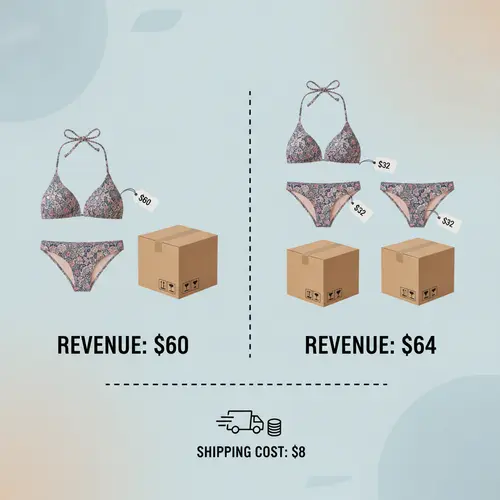
Average order value matters more than most brands admit. A bundled set carries a higher price point per transaction than either piece sold alone, and that translates directly into better margin economics per order — selling a $60 set converts better, dollar for dollar, than trying to separately convert a $32 top and a $32 bottom as two distinct purchase decisions.
Shipping pricing works against separates specifically. Domestic couriers in China typically price in flat brackets — under 1kg is one price, regardless of whether that kilogram is one item or two. International shipping tends to work the same way, priced in brackets like under 1 pound rather than by the specific item. That means splitting a set into two separate purchases usually doesn't reduce the shipping cost at all — the shipment likely falls into the same weight bracket either way — while it does reduce the revenue per shipment. From a pure unit-economics standpoint, selling pieces separately can mean carrying the same shipping cost for less revenue, which is a real disincentive that has nothing to do with what's possible to manufacture.
The Consumer Side of the Trade-Off
For the buyer, a fixed set genuinely does save money compared to buying two separately priced pieces — but that discount only pays off for someone whose body proportions land close to the "average" the set was designed around. For the roughly two-thirds of women whose top and bottom sizes don't match, that savings comes at the cost of a set that doesn't actually fit as intended in one piece or the other.
What We Actually See From Our Own Clients
This is the part that might be the most useful data point for an emerging brand: the large majority of our own clients order tops and bottoms separately, packaged separately, in bulk — not as fixed sets. That's because most of the brands we work with are exactly that: brands, not direct-to-consumer sellers moving single units. A brand placing a bulk wholesale order needs the flexibility to offer mix-and-match sizing to its own end customers, and there's no meaningful production reason not to build that flexibility in from the start.
Does This Affect MOQ?
Yes, but not in the way that might be assumed. As a manufacturer, MOQ decisions come down to whether the labor involved is worth the order value — and separate top/bottom ordering does add a small amount of real labor (slightly more cutting coordination, separate packaging), which is where that sub-$1 USD delta comes from. But separate ordering still reaches standard MOQ thresholds without issue in the vast majority of cases. The added complexity is real but modest — it shows up in unit cost, not in whether the order is feasible to run at all.
What This Means for a New Brand
If you're deciding between selling fixed sets or offering mix-and-match sizing, the decision should be driven by your actual customer base and margin strategy — not by an assumption that separates are a manufacturing hurdle, because for a real factory, they largely aren't. If your target customer is the roughly two-thirds of buyers whose proportions don't match a standard set, offering separates is a real, achievable differentiator with only a marginal cost impact. If your business model depends more heavily on average order value — the way a lot of DTC swim brands do — a fixed-set-first strategy makes real financial sense, independent of any production constraint. Either way, MOQ and shipping structure should factor into that decision alongside sizing strategy, not be treated as a separate question.
 Tankini is a real example of a category built entirely around this independent-sizing logic — the top and bottom are sized and sold separately by default, not as an add-on option; see the real construction behind tankini tops for how that plays out for a specific, verifiably older customer base.
FAQ
Q: Is it more expensive to manufacture a bikini top and bottom in different sizes than as a matched set?
A: Barely — the real-world cost difference, mostly from separate packaging and slightly more cutting coordination, comes out to under $1 USD per piece. Grading and sewing work the same way regardless of whether the pieces end up sold together or separately.
Q: Why do most swimwear brands sell fixed sets if most women's top and bottom sizes don't match?
A: It largely comes down to margin and shipping economics rather than manufacturing limits — bundled sets carry a higher average order value, and shipping costs are typically priced in flat weight brackets that don't shrink when a set is split into two separate purchases.
Q: Does offering mix-and-match sizing raise my MOQ?
A: Not meaningfully in most cases — standard MOQ thresholds are still reachable with separate top/bottom ordering. The cost impact shows up as a small per-unit delta, not as a barrier to placing the order at all.
Q: Should my brand sell sets or separates?
A: It depends on your customer base and business model. If most of your target customers have body proportions close to average, sets work well and support higher order value. If your customer base skews toward mismatched proportions — which describes the majority of women, per available sizing survey data — separates are a real, production-feasible way to serve them better.
Deciding between a fixed-set or mix-and-match sizing strategy for your next collection? Tell us your target customer and order volume — we'll tell you honestly what the real cost and MOQ implications look like for your specific case.