
The $300M Swimwear Market Blocked by MOQ and Shipping
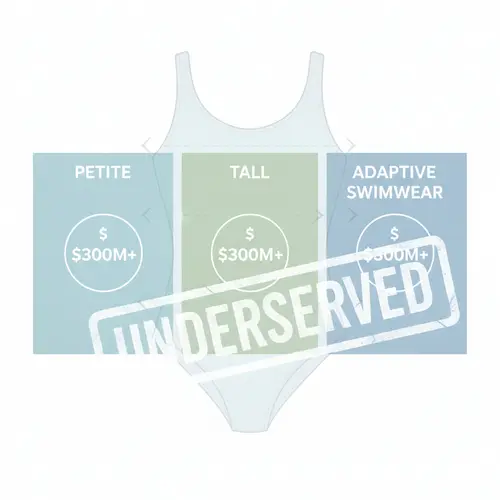
Petite, tall, and adaptive swimwear segments each generate more than $300 million in annual sales, and major brands still cover them poorly. The usual explanation is that big brands simply don't prioritize these customers. That's part of it — but it's not the structural reason. The bigger issue is economic: two compounding cost mechanics make these segments genuinely harder to serve profitably under a standard sourcing model, and most brands never get far enough to find out, because the numbers don't work before design even enters the conversation.
Reason One: More Sizes Means a Higher Effective MOQ
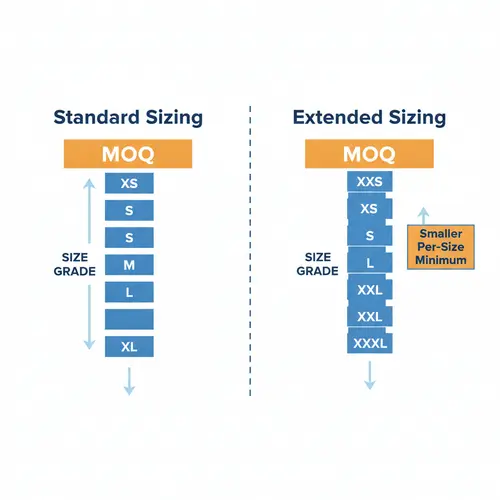
Extended and adaptive sizing isn't a scaled-up version of a straight-size pattern — it typically requires 6 to 8 distinct size grades instead of the 4 to 5 a standard women's swim line runs, which increases the effective MOQ. Since a factory's minimum order quantity is usually set per style, not per size, more required sizes means the same total MOQ has to be split across more size breaks, pushing the effective per-size minimum — and the upfront investment — higher before a brand sells a single unit. This is exactly the kind of math that kills a promising line at the planning stage, regardless of how much real demand exists for it.
It's worth being precise about a related but different question: even a genuinely low-MOQ order still carries real hidden costs at small quantity — fabric procurement, cutting minimums, labor, and shipping brackets all work against a small order in specific, calculable ways, separate from the size-grade math described above.
Reason Two: The Hidden Shipping Cost of More Fabric
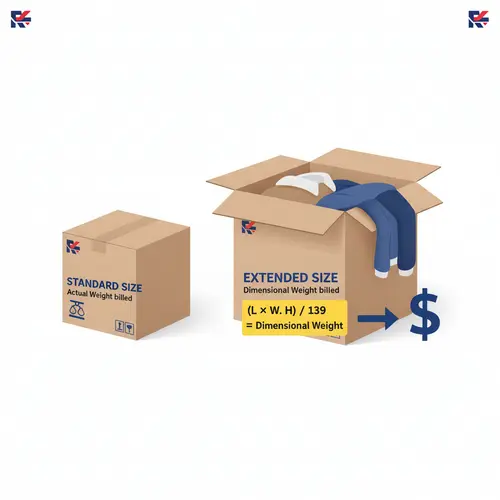
This part gets discussed even less, and it compounds the first problem rather than existing separately from it. International couriers price shipments by dimensional (volumetric) weight, not just actual weight — a package is billed by whichever is higher between its actual weight and a calculated dimensional weight, with FedEx and UPS using a divisor of 139, and DHL and USPS using a divisor of 166 for larger packages. A garment built with more fabric — as extended-size swimwear inherently is — takes up more volume in a box even when the weight difference feels modest, which can push a shipment into a higher dimensional-weight bracket and a meaningfully higher per-unit shipping cost. Stack that on top of a higher effective MOQ, and the combined economics explain a lot of why coverage in this segment stays thin — it's not one problem, it's two problems multiplying each other.
This same bracket-based shipping logic shows up in a completely different sizing question, too. Splitting a bikini top and bottom into two separate purchases doesn't reduce the shipping cost — the shipment still lands in the same weight bracket — but it does reduce the order's revenue, which is a big part of why fixed sets remain the retail default even though it's not a manufacturing limitation.
Why Chinese Cross-Border Sellers Are Already Winning Here
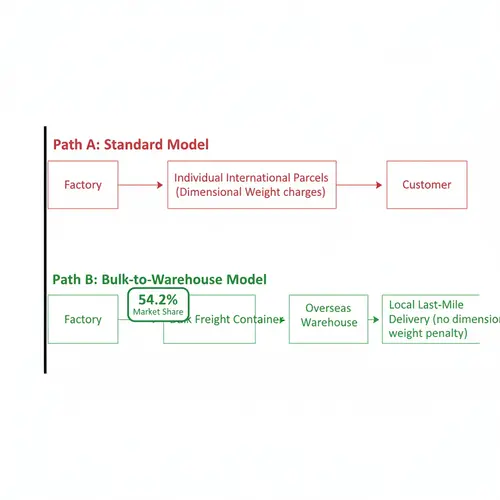
This is the part worth paying attention to: this compound problem has already been solved, just not usually by the brands people expect. Chinese sellers now hold a commanding 54.2% share of the "Clothing, Shoes & Jewelry" category on Amazon's US marketplace overall, dominating multiple sub-categories with over 30% share each — and the structural reason isn't just price, it's logistics. Manufacturers that ship in bulk to overseas warehouses (rather than shipping individual parcels internationally per order) largely sidestep the dimensional-weight penalty altogether, since bulk freight is priced completely differently from small-parcel express shipping. That's the same structure behind our own overseas warehousing setup — bulk to warehouse, then local fulfillment from there — which is exactly what makes serving a segment with inherently bulkier garments economically viable in the first place.
The Real Numbers
Factor | Data |
|---|---|
Underserved segment size | Petite, tall, and adaptive swimwear segments each generate over $300 million in annual sales |
Broader plus-size apparel market | [Projected to reach USD 322,120 million by 2030](https://www.prnewswire.com/news-releases/plus-size-womens-clothing-market-to-reach-usd-322-120-million-by-2030--driven-by-inclusivity-and-evolving-consumer-preferences--credence-research-inc-302320500.html) |
Price premium plus-size customers accept | $50–95 for genuinely flattering, well-constructed suits in extended sizes, not just scaled-up straight-size patterns — the same [low-cost-high-premium logic that applies to textured fabric](https://www.oyoyi.ai/article/detail/ribbed-textured-swimwear-fabric-trend-2026) |
Return rate impact of separates sizing | Reduces return rate from 18% to 9-12% when tops and bottoms are sized independently — consistent with the [broader fit-related return data](https://www.oyoyi.ai/article/detail/why-swimwear-return-rates-are-high) across the category |
Cost to add a premium texture/feature | As little as $2-3 in factory cost, supporting a $10-15 retail premium |
What This Means for Brands
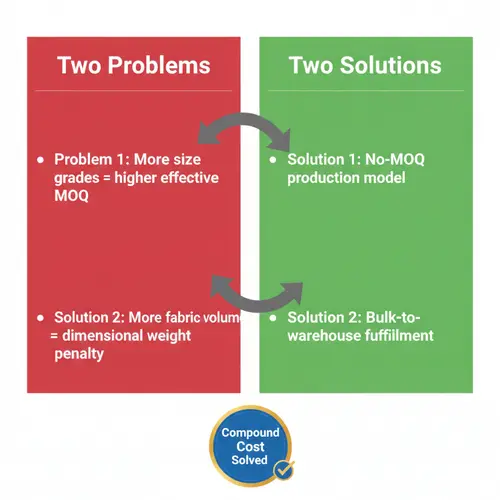
The takeaway isn't "plus-size and adaptive swimwear is unprofitable" — the market data says the opposite. It's that the standard per-style MOQ model, combined with standard small-parcel international shipping, structurally punishes exactly the product category (more sizes, more fabric per unit) that this underserved market needs. A no-MOQ production model removes the first barrier by letting a brand test extended sizing without the inflated upfront commitment a 6-8 size grade normally demands. Pairing that with bulk-to-warehouse fulfillment rather than per-order international shipping removes the second. Neither fix requires a brand to compromise on design or fit — it requires sourcing structured around the actual economics of the category, which is a different problem than most brands realize they're solving.
Period-proof and leak-resistant swimwear is another niche category blocked by this same threshold — the real construction is technically demanding enough that a no-MOQ model is what actually makes it viable. See how we build it.
FAQ
Q: Why do so few major brands offer well-fitted plus-size or adaptive swimwear?
A: It's not primarily a design or priority issue — it's economic. Extended sizing typically needs 6-8 size grades instead of 4-5, which raises the effective MOQ per style, and the additional fabric volume increases international shipping cost through dimensional weight pricing. Both factors compound each other under a standard sourcing model.
Q: What is dimensional weight, and why does it matter for larger garments?
A: Carriers charge based on whichever is higher: a package's actual weight or its calculated volumetric weight, using divisors around 139 (FedEx/UPS) or 166 (USPS/DHL/larger parcels). A bulkier garment can trigger a higher shipping charge than its actual weight would suggest, even if it's not dramatically heavier than a standard-size piece.
Q: How do Chinese cross-border sellers offset these costs successfully?
A: Largely through bulk shipping to overseas warehouses rather than shipping individual parcels internationally per order — bulk freight pricing avoids the dimensional-weight penalty that hits small-parcel express shipping, making it economically viable to serve bulkier product categories at scale.
Q: Does a no-MOQ model actually solve the extended-sizing cost problem?
A: It solves the first half — the inflated upfront commitment from needing more size grades per style. Combined with bulk warehouse fulfillment rather than per-order international shipping, it addresses both compounding cost factors rather than just one.
Q: Will customers actually pay more for well-fitted extended-size swimwear?
A: Market data suggests yes — this segment shows willingness to pay $50-95 for suits that are genuinely engineered for their size range rather than scaled-up straight-size patterns, which is a meaningfully different price tolerance than the broader swimwear market.
Considering an extended-size or adaptive line and not sure the economics work? Send us your size range and target volumes — we'll walk through the real cost structure before you commit to a plan.