
Real Bust Support in Swimwear: What Actually Works
Byoyoyi.ai— written with AI-assisted research, reviewed and fact-checked in-house.
Market research on what women's swimwear buyers actually want ranks "real bust support" as one of the highest-opportunity, least-satisfied demands in the category — commanding a $35-65 price range and a top opportunity score among buyers actively searching for it. It sits in the same pattern we've written about before with tummy-control claims: "supportive" is one of the most overused words on a swimwear product page, and one of the least often backed by actual construction. If you've ever bought a top marketed as "supportive" that turned out to be a padded triangle with string ties, you've already experienced the gap this article is about.
Here's what real bust support is actually built from, what doesn't count no matter what the label says, and why this is genuinely a manufacturing decision, not a design one — one more entry in what we mean by manufacturing feasibility: the gap between what a product page claims and what a factory actually built.
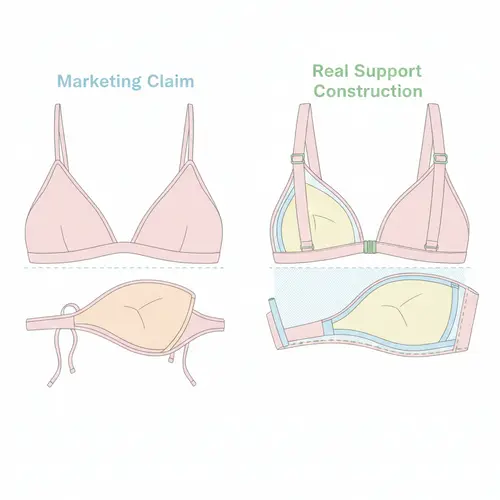
The Six Real Construction Elements
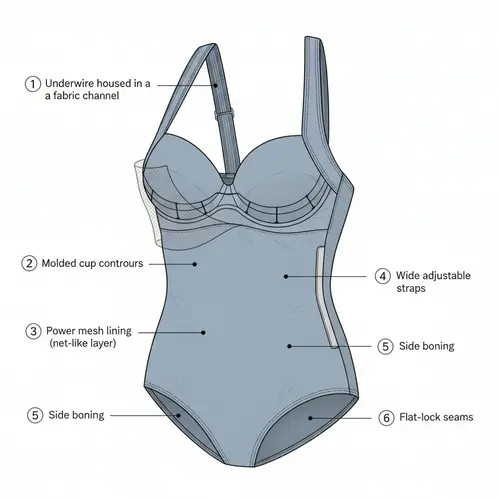
Structural support in swimwear comes from a specific, well-established combination of elements — not any single one of them, and not from padding alone. Each addresses a different part of the support problem:
Element | What It Actually Does | Why It's Often Skipped |
|---|---|---|
Underwire(visible or fully hidden in a fabric channel) | Lifts and separates — the same mechanical function it serves in a standard bra | Adds cost and a manufacturing step (channel construction, wire insertion, wire covering) that scaled-up standard patterns skip |
Molded cups | Hold shape under load and — critically — prevent show-through when the fabric is wet, which soft/unstructured cups don't | Molds are style-specific tooling, so they only make sense at a minimum viable order size |
Power mesh lining | A net-like structural inner layer sewn directly behind the front panel, invisible from outside, doing the actual load-bearing work | It's completely hidden, so cutting it is the easiest place for a factory to quietly cut cost without it showing up in a product photo |
Wide, adjustable straps (1 inch or wider) | Distributes weight across the shoulder instead of concentrating it in a thin strap — this is a real comfort and support factor, not a style choice | Wide straps read as less "delicate" in flat-lay product photography, so thin straps get chosen for the photo, not the wearer |
Side boning | Small flexible stays sewn into the torso side panels that stop the structure from collapsing, twisting, or rolling — standard in technical support brands, absent from standard swim by default | Adds a construction step most factories producing standard swim don't have in their normal workflow |
Flat-lock seams at high-friction points | Under the bust, underarms, and inner thigh — flat-lock seams press flat instead of leaving a raised ridge, which is the difference between comfortable and chafed on a support garment worn tight to the body all day | Standard overlock seams are faster and cheaper to run, and the difference doesn't show up until the garment's actually worn for hours |
Choosing molded-cup construction solves the show-through and shape problems above, but it introduces a separate risk worth knowing about before committing to a production run: a molded cup's shape can drift slightly from mold cycle to mold cycle over a longer run, in ways a sewn or soft-cup construction never will. That's not a reason to avoid molded cups — it's a reason to verify consistency across the run rather than assuming the first approved sample represents every unit that follows. See why an approved sample doesn't guarantee mass-production consistency for how that risk plays out and what actually protects against it.
What Doesn't Count, No Matter What the Label Says
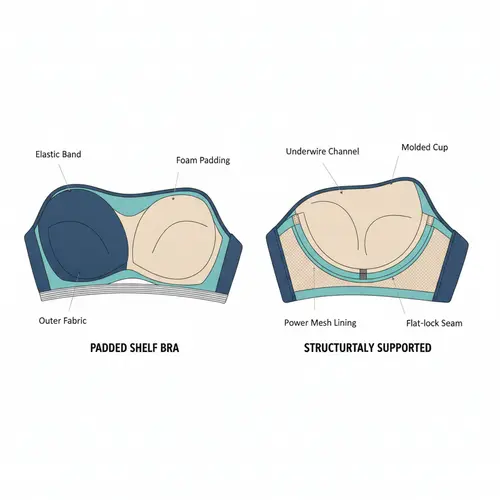
This is worth saying plainly because it's where most disappointment comes from: a padded shelf bra is not a substitute for structural support. A shelf bra — a thin band of elastic with a layer of foam padding sewn behind the front fabric — adds shape and modesty, but it does not lift, separate, or bear real load the way underwire, molded cups, and power mesh do together. Padding changes the silhouette in a photo. Structure changes how the garment behaves on the body during actual movement. These get marketed with the same word — "supportive" — and buyers routinely can't tell the difference until they're already wearing it.
Padding visibility isn't only a wet-fabric problem, either — it's also a color problem. White and pale swim fabric make even a well-built padding insert show through as a visible shape, which is exactly why light-colored designs often need a different lining and padding approach than dark ones.
Bra-Sized Swim: The Precision Layer Most Brands Skip Entirely
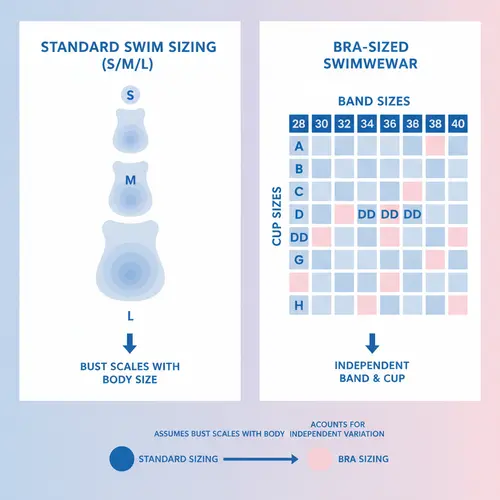
Standard swim sizing (XS-XL, sometimes with a numeric range) assumes bust size scales predictably with overall body size. It doesn't, for a large share of real bodies. Bra-sized swimwear — sized by band and cup independently, the same way a bra is (commonly spanning band sizes 28-40 and cup sizes up to D-K in specialist lines) — is a fundamentally more precise fit system, and it's rare specifically because it multiplies the number of size combinations a factory has to grade, cut, and stock relative to a standard S/M/L run.
This is the same structural tension we've written about with extended and adaptive sizing: more precise sizing means more size grades, which raises the effective minimum order per style under a standard MOQ model. A factory that can produce genuinely low-MOQ runs is structurally better positioned to offer bra-sized swim than one locked into large per-style minimums, because the cost of size-grade complexity doesn't compound the same way.
Why This Is a Manufacturing Decision, Not a Design Decision
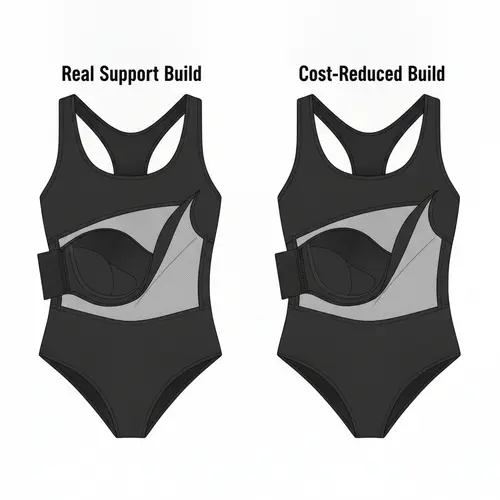
None of the six elements above are exotic or hard to source — underwire, molded cup tooling, power mesh, wide strap webbing, boning, and flat-lock machines are all established, available components and processes. What actually determines whether a "supportive" swim top delivers real support is whether a factory chooses to include them, and that choice is driven by cost and order economics, not by what's technically possible. A factory quoting a low price on a "supportive" style and a factory quoting a higher price for the same visual design are very often quoting two structurally different garments — one with power mesh, boning, and molded cups, and one without any of them, wearing the same marketing language on the product page.
The underlying support-structure engineering isn't new — flexible cup support elements designed to replace or reinforce conventional underwire have been documented in textile patents for decades, refined specifically to improve comfort and support together rather than trading one for the other. The technology to do this properly has existed for a long time; the gap is almost entirely about which brands are willing to build to that standard versus market toward it.
Structure matters just as much when the question isn't support but opacity — why some swimwear turns see-through when wet and some doesn't comes down to the same kind of real construction choice (GSM and lining), not the marketing language on the label. And structural support gets more complicated once you add an access opening to the equation — see our look at the real construction questions behind nursing swimwear. The same principle applies to leak resistance too — what sounds like a fabric problem is usually a construction problem, covered in our breakdown of the real seam structure behind leak-proof, period-proof swimwear. And it applies to cut-out and asymmetric styles too — see how a cut-out edge is actually reinforced without compromising the garment's structural support. The underwire itself carries its own real failure mode worth knowing about — see why underwire poke-through is almost never actually a wire-quality problem.
The same principle applies to leak resistance — what sounds like a fabric problem is usually a construction problem. See our breakdown of the real seam structure behind leak-proof, period-proof swimwear.
And it applies to cut-out and asymmetric styles too — see how a cut-out edge is actually reinforced without compromising the garment's structural support.
The underwire itself carries its own real failure mode worth knowing about — see why underwire poke-through is almost never actually a wire-quality problem.
Not every feasibility judgment comes from direct production experience — sometimes it's an honest read of the engineering involved before we've built it ourselves. Here's our construction breakdown for nursing swimwear,including what we don't know yet.
Bust support is one entry among many in our full real construction guide organized by swimwear type — the same "which construction elements are actually doing the work" question applies across tummy control, compression, and other functional categories.
Underwire tops specifically are also the priciest bikini top style to build, for the same reason — see why bikini top types differ so much in cost for how this plays out across all the common top styles.
Built-in support isn't just an underwire question, either — it's the default expectation for an entire silhouette. See why tankini tops typically build in support by default, unlike a standard bikini top.
Padding is a related but distinct decision from the structural elements covered here — see the real mold cost and rebate structure for custom padding if your design uses padding alongside or instead of structural support.
FAQ
Q: Is a padded top ever enough for real support?
A: For a small bust with minimal support needs, padding alone can be sufficient for comfort and coverage. For anyone who needs the garment to actually lift, separate, and stay in place through movement, padding alone doesn't do that — it changes appearance, not mechanical support.
Q: What's the single most-skipped element in "supportive" swimwear?
A: Power mesh lining, because it's completely invisible in a finished garment. It's the easiest place for a factory to cut cost without the difference showing up in a product photo — you genuinely can't tell it's missing until you're wearing the suit.
Q: Why is bra-sized swimwear so much rarer than standard S/M/L swim sizing?
A: It requires grading, cutting, and stocking far more size combinations — band and cup sized independently instead of one general size range — which raises the effective minimum order per style under a standard MOQ model. It's a cost-structure problem more than a design or demand problem.
Q: Does underwire in swimwear need special construction compared to a regular bra?
A: Yes — the wire needs to be housed in a channel that can handle repeated wet-dry cycling and chlorine exposure without the casing breaking down, which is a different durability requirement than dry-wear bra construction.
Q: What should I actually look for on a product page to tell if support is real?
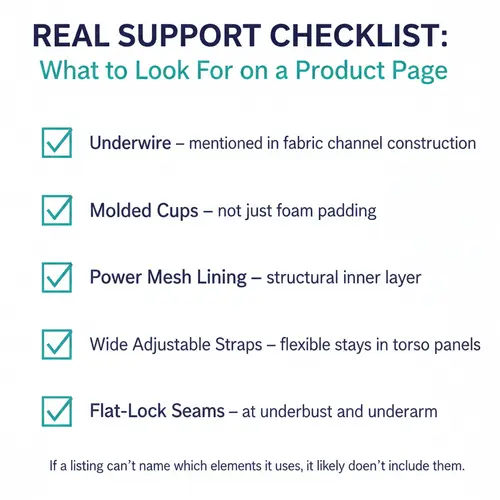
A: Specific construction language — underwire, molded cups, power mesh lining, boning, wide adjustable straps — rather than just the word "supportive" on its own. If a listing can't name which of these elements it uses, it's a strong signal it may not include them.
Q: Are flat-lock seams really worth the extra step for a swim top?
A: For any garment worn snug against the body for hours — which support-focused swimwear is — yes. The difference at friction points like under the bust and underarms is the difference between wearable all day and visibly chafed by the afternoon.
Q: Can this level of construction be done at low order quantities?
A: It depends on the element — power mesh, boning, and wide strap webbing are all compatible with small-batch production. Molded cups specifically require tooling, so they carry more of a volume threshold than the other elements, which is worth discussing directly if you're planning a small first run.
Designing a support-focused style and not sure which of these elements your current factory is actually including? Send us the product description you've been quoted against — we'll tell you plainly what's likely in the build and what's probably just padding.