
Swimwear Strap Construction: Elastic-Core vs. Fabric Tube
A swimwear strap that's meant to be wrapped around the body multiple times and cut to a custom length runs into a construction decision most buyers never think about until it's too late: whether the strap has an elastic core sewn inside the fabric tube, or is just fabric sewn into a tube with nothing inside it. Both are real, standard methods. The difference isn't which one is "better" — it's that an elastic core changes how the strap performs and what happens the moment a customer picks up scissors.
At a Glance
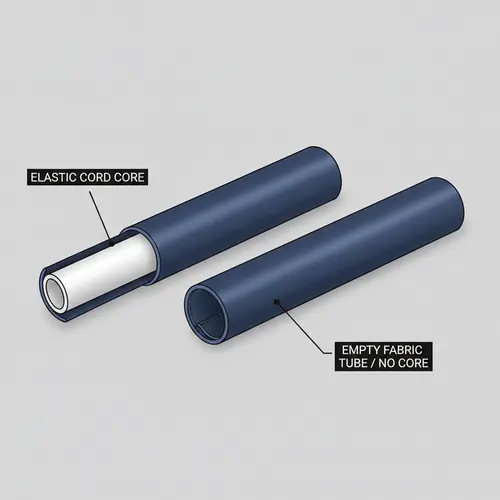
Elastic-Core Tube Strap | Fabric-Only Tube Strap | |
|---|---|---|
Construction | Fabric tube sewn around an elastic cord/strip, then turned right-side out | Fabric folded and sewn into a tube, no internal core |
Stretch recovery | Strong — the elastic core does the recovering, not just the swim fabric | Weaker — relies entirely on the swim fabric's own stretch, which fatigues faster under repeated pulling |
Can the end customer cut it to length? | Not cleanly — cutting exposes the raw elastic core at the cut end | Yes — no core to expose, cut ends can be finished simply |
Best fit | Fixed-length straps, structural load-bearing ties | Extra-long straps meant to be wrapped and self-trimmed by the customer |
Feel | Firmer, more "held" tension | Softer, relies on fabric weight and knit for hold |
How Each One Is Actually Built
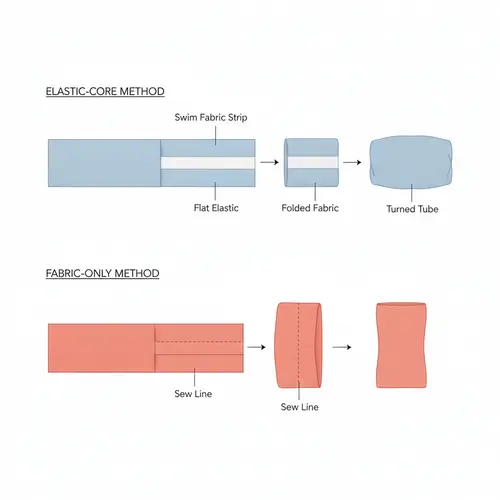
Elastic-core construction starts with a strip of elastic cord or flat elastic, encased inside a folded strip of swim fabric, then sewn and turned right-side out so the seam sits hidden inside the tube — the same "turned strap" method used across swimwear and activewear construction generally, where the fabric tube is essentially a covered sleeve for the elastic doing the actual recovery work. This same tube-over-core structure shows up outside swimwear too — patented cord and strap designs built for repeated stretch describe the same core-inside-a-tubular-cover logic, which is a good sign this is a genuinely load-tested construction approach, not something specific to one factory's habits.
Fabric-only tube construction is simpler: a strip of swim fabric is folded lengthwise and sewn or serged along the open edge, then turned right-side out into a tube — with nothing inside it. What holds the strap's shape and stretch is entirely the swim fabric itself (its own spandex/elastane content and knit structure), not a dedicated elastic component. It's a genuinely capable method for the right use case, not a corner-cutting shortcut — the trade-off is specific and predictable, not a general quality drop.
The Trade-Off That Actually Matters: Recovery vs. Self-Cutting
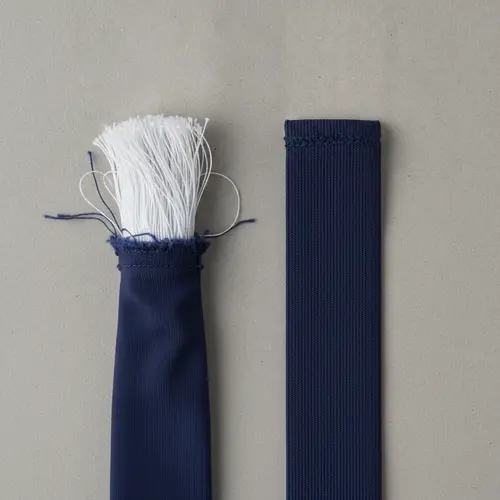
Here's the real decision point, based on a real production conversation: a client building a modular swimwear line — where the strap is sold separately from the top and bottom, made extra-long so a customer can wrap it around their body multiple times and tie it in different configurations — specifically wanted the strap without an elastic core, even after we explained that skipping the core would reduce stretch recovery and durability under repeated pulling.
The reason was specific and correct for her use case: an elastic-core strap that gets cut to length exposes the raw elastic core at the cut end — a visible white or colored core showing through the fabric edge, which looks unfinished and can fray. A fabric-only tube has no core to expose, so a customer can trim it to their preferred length without the cut end looking like a mistake. For a product designed around the customer customizing fit length themselves, that self-cut cleanliness mattered more than maximum recovery performance — a genuinely different priority than a fixed-length structural strap, where recovery and durability matter more than end-user trimming.
This is the kind of trade-off that doesn't show up in generic "how to sew a strap" tutorials, which are written for someone making one strap to a fixed, known length — not for a wholesale product where thousands of customers will each cut the same strap to a different length after it ships.
When Each Construction Actually Makes Sense
Choose elastic-core construction when:
The strap is cut to a fixed, factory-finished length and won't be trimmed by the end customer
The strap carries real structural load — over-the-shoulder straps on a one-piece, or any tie point expected to hold tension repeatedly over the life of the garment
Recovery and shape retention matter more than end-user customization
Choose fabric-only tube construction when:
The strap is designed to be trimmed to length by the customer after purchase
The product is positioned around wrap-and-tie versatility (multiple wraps, multiple tying styles) rather than one fixed silhouette
A slightly softer hand-feel and lower stretch-recovery ceiling is an acceptable trade for that flexibility
Neither construction is more "premium" than the other in the abstract — the right choice depends entirely on whether a human is going to cut the strap after it leaves the factory.
A Related Decision: How the Strap Actually Connects to the Garment
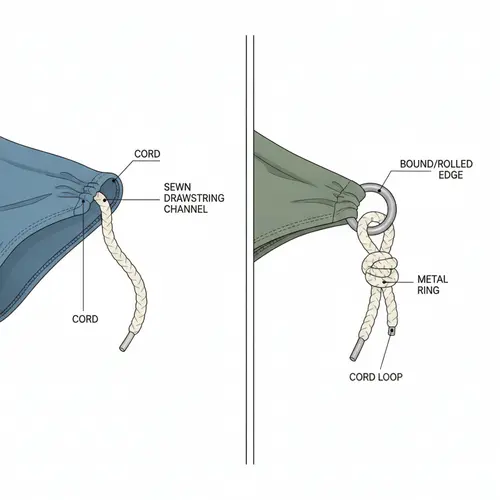
Strap construction (elastic-core vs. fabric-only) is a separate question from how the strap connects to the top or bottom it's paired with — some edges use a self-adjusting drawstring channel (no hardware needed), while others use a bound/rolled edge that structurally requires a metal ring or fabric loop to thread a cord through, since a cord can't pass directly through a finished bound edge the way it can through an open channel. That connection-method decision has its own trade-offs worth covering on its own — for now, the practical note is that a garment can mix both: one edge with its own drawstring channel, another edge with a bound finish that needs a ring, depending on what each piece needs to do.
If you're also evaluating modular, detachable strap systems as a product line rather than a single construction detail, see our breakdown of how detachable, modular bikini straps are actually built, which covers the channel/loop attachment side and real pricing for selling straps separately from the garment.
Real Cost Context
In our own production, extra straps sold separately from the main garment are priced per set rather than folded into the garment's base cost — a common structure for brands selling straps as an add-on or mix-and-match accessory rather than a fixed, non-removable component. Whether the strap uses an elastic core or not doesn't meaningfully change this pricing structure on its own; the construction choice is a durability/functionality decision, not a cost driver in either direction.
For the fabric doing the actual recovery work in either construction, elastane content and knit structure — not GSM — is what determines how well a strap holds its shape over time, which is worth knowing regardless of which strap construction you choose. Both construction methods are documented alongside the rest of our real trim and hardware specs in our fabric and trim library.
If you want to see the actual hardware options (rings, sliders, adjusters) that pair with either strap type, our hardware and trims library is browsable directly by material and finish.
FAQ
Q: Is an elastic-core strap always the higher-quality option?
A: Not universally — it's the better choice for recovery and durability under repeated tension, but it's the wrong choice if the strap is meant to be trimmed to length by the end customer, since cutting it exposes the raw core at the cut end.
Q: Can a fabric-only tube strap be cut to length cleanly?
A: Yes — since there's no internal core to expose, a fabric-only tube can be trimmed and the cut end finished simply, without the unfinished look an exposed elastic core creates.
Q: Does skipping the elastic core make the strap weaker?
A: It reduces stretch recovery and durability under repeated pulling compared to an elastic-core strap, since the fabric-only version relies entirely on the swim fabric's own stretch rather than a dedicated elastic component. Whether that trade-off matters depends on how the strap will actually be used.
Q: Why would a brand want customers to cut their own straps?
A: It's common in modular or wrap-style swimwear designs, where one extra-long strap is meant to wrap around the body multiple times and be tied in different configurations — letting the customer trim it to their own body size and preferred tying style rather than shipping a fixed length.
Q: Is one construction method more expensive to produce than the other?
A: Not meaningfully in most cases — the choice is primarily a durability and end-use decision, not a cost driver. Pricing for separately-sold straps is typically set per set or per unit regardless of which construction is used.
Q: Can the same swimwear piece use both types of strap construction?
A: Yes — a single design can reasonably use elastic-core construction for a load-bearing strap and fabric-only construction for a decorative or customer-trimmed wrap strap, depending on what each element needs to do.
Designing a modular or wrap-style swimwear piece and not sure which strap construction fits? Tell us how the strap will be worn and whether the customer will trim it themselves — we'll recommend the right build before you commit to a sample.