
How Detachable, Modular Bikini Straps Are Actually Built
Over the past few months, we've received — and fulfilled — more than one real order for the same unusual request: a bikini collection where the straps aren't sewn onto the garment at all. Instead, the top and bottom panels are built with finished channels or loops, and the straps are supplied as a separate, fully-finished product — extra-long, uncut, and meant to be threaded and trimmed by the customer herself, or sold on their own as a customizable accessory. This isn't a one-off request anymore; it's a real, repeatable pattern worth explaining properly.
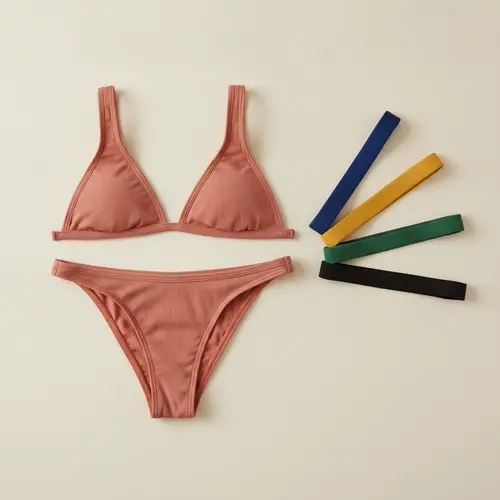
What This Request Actually Specifies
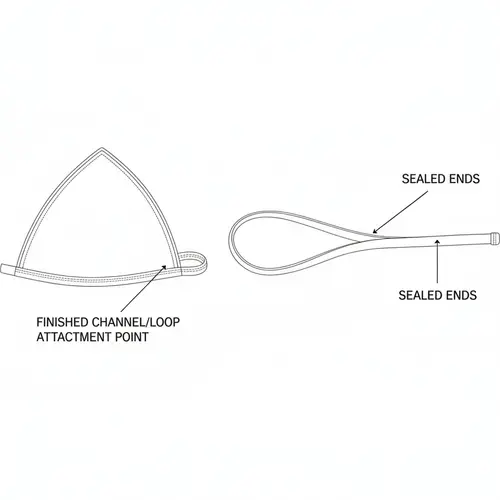
Two distinct construction requirements sit underneath "modular" or "customizable strap" bikinis, and they're worth separating clearly:
The panel needs a finished channel or loop, not a sewn-on strap — a real attachment point the customer can thread her own strap through.
The strap itself needs to be a separate, fully-constructed, finished product — not a raw fabric strip — supplied unattached, in an extra-long length so it can wrap the body more than once and be trimmed to whatever length actually fits.
How the Channel or Loop Actually Gets Built
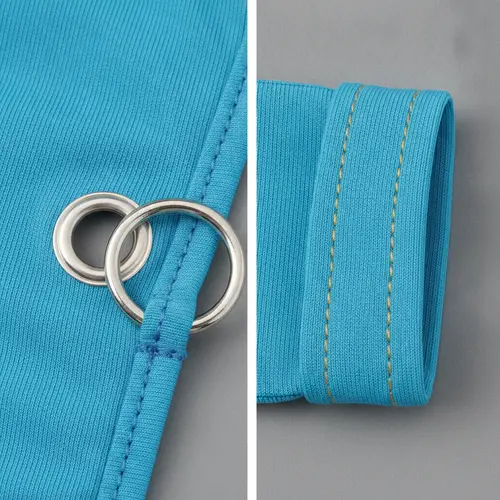
There are two real ways to build the attachment point on the panel, and which one makes sense depends on the style:
Metal hardware (eyelets or D-rings) — a reinforced metal loop set into the panel edge, giving a fixed, durable thread-through point.
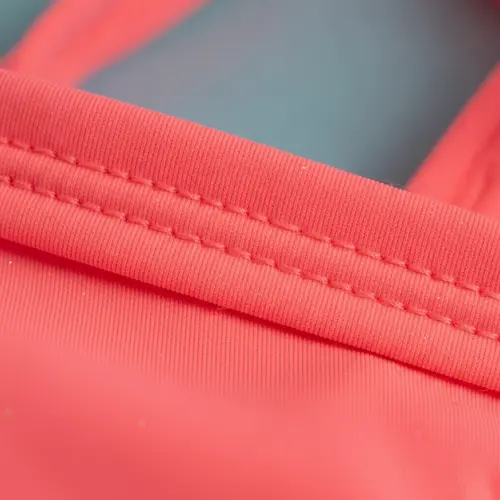
A sewn fabric channel — no metal at all; the panel's own fabric is folded and stitched to create a casing the strap threads through, relying on the seam construction itself rather than hardware.
Both are real, viable options — we build either depending on what the design calls for, not a one-size-fits-all default. A metal loop tends to suit a more structured or hardware-forward design; a fabric channel keeps the look cleaner and softer, with no visible hardware at all.
This isn't always a free choice, though — the edge finish itself sometimes decides it for you. A drawstring channel needs a folded, hemmed edge to thread through; a bound or rolled edge (fabric wrapped and stitched flat around the raw edge) structurally can't hold a drawstring the same way, since there's no folded casing for the cord to pass through. On a bound edge, a metal ring or fabric loop is the only real way to give the drawstring something to thread onto — it's not a style preference at that point, it's what the edge construction allows.
This came up directly on a real order: one top style needed to support several different tying configurations, and the customer specifically ruled out a metal ring for that reason — a fixed ring point limits how many ways a strap can be tied, where an open channel lets the strap move and re-tie more freely. The same order's bottom styles went the other way: two of the three bottom cuts used a bound edge finish, which meant they needed a ring or loop to thread the tie through, while the third bottom style had its own drawstring channel built in and needed no hardware at all. All three approaches shipped in the same collection — the point isn't that one method is correct, it's that the edge finish and the tying behavior you want both constrain the choice before "which looks better" even comes into it.
When a ring is the right call, the material matters more than it might seem: a silver-finish ring can usually be genuine stainless steel with no plating needed, since stainless already looks right in that color — but any other color requires a zinc alloy base with electroplating, which then needs to hold up under real pool conditions. We test that plating with a real chlorine-resistance check (48 hours) before it ships in a colored finish, the same logic covered in more depth in our breakdown of why plating method matters more than the ring's design.
The Strap Itself: Not a New Fabric, a New Way of Selling It
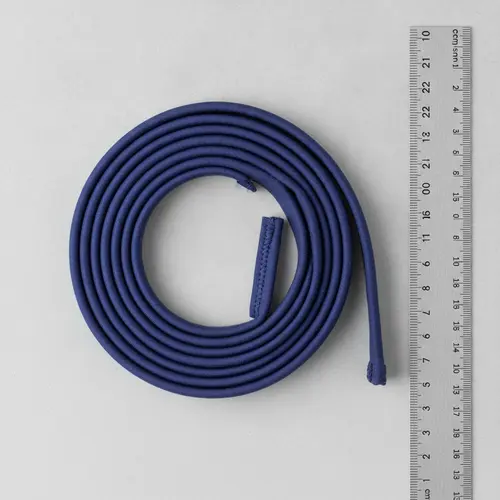
Here's the part worth being direct about, because it's easy to assume this requires some exotic new material: the strap construction itself is essentially identical to a standard bikini tie. There's no special stretch fabric or proprietary braiding involved. What's actually different is that it's made extra-long and sold as its own standalone item — worn as a self-tied strap the way a traditional bikini tie already works, except decoupled from a single garment and offered as a separately purchasable, mix-and-match accessory. The real innovation in this request isn't a fabrication technique — it's a retail and SKU strategy built on top of a component we already know how to make well.
The one construction detail that does matter here is the finished end. Our standard method is fold-back reinforcement stitched on a flatbed machine — the raw end of the strap is folded back on itself and secured with flat stitching, which seals the edge against fraying. That covers the two ends we finish at the factory. It's worth flagging honestly for any brand building this kind of product: if a customer trims the strap to a custom length at home, that new cut edge won't have this same factory-level finishing — which is a real detail worth addressing in customer instructions (a simple knot, or a heat-seal if the strap fiber is synthetic) rather than assuming the fabric won't fray once it's cut outside the factory.
There's a related construction choice worth knowing before specifying a customer-trimmed strap: whether the strap itself is built with an elastic core inside the fabric tube, or is a fabric-only tube with no core. An elastic core improves recovery and durability, but cutting it exposes the raw core at the new edge — a separate, more visible problem than simple fraying. See elastic-core vs. fabric-only tube strap construction for how that trade-off plays out specifically for straps designed to be customer-trimmed.
Real Pricing From an Actual Quote
Based on a real quote we gave for exactly this kind of order (one top style, three bottom cuts, four solid colors, plus additional finished straps in extra colors and prints):
Item | Real Pricing |
|---|---|
Sample fee (1 top + 3 bottom cuts) | $200 USD, includes one free revision (international shipping not included) |
MOQ | Flexible based on brand direction — minimum 10 pieces per size, per color, for tops; same minimum for bottoms |
Extra strap sets (additional colors/prints) | $1 USD flat for a full set of straps per top or bottom, regardless of whether that style uses 1 or 2 straps |
Bulk unit price | Scales down with quantity — unit price is never more than 50% of the sample fee, even at very low quantities (1–2 pieces), and drops further (with shorter lead time) as order volume grows |
Why This Model Fits Small, Customization-Led Brands Especially Well
Decoupling the strap from the garment turns what used to be a single fixed component into an independent, cross-sellable product line — a customer (or a brand's own customer, downstream) can buy one panel set and multiple strap colorways without needing a full new SKU for every color combination. That's a genuinely efficient structure for a brand testing a small, differentiated launch rather than committing to mass production, which is exactly the kind of order this fits well under a genuinely flexible, low-MOQ manufacturing model — the MOQ structure above (10 pieces per size/color) reflects that directly.
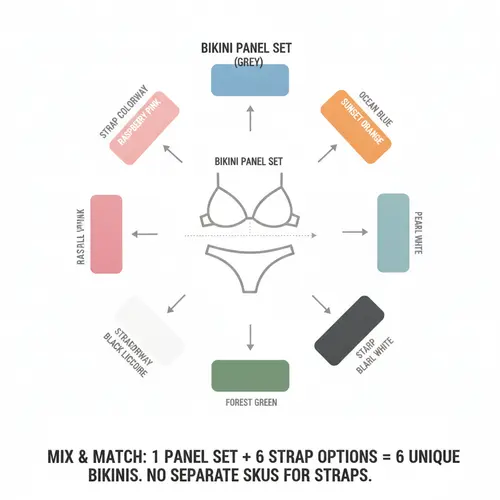
The same channel-and-strap logic applies beyond bikini tops, too — tie-side and side-adjuster bikini bottoms already work on a related principle of separating the fastening mechanism from the main panel; see the real construction differences across bikini bottom types for how that comparison holds up on the bottoms side specifically.
This is one entry in the full real construction guide organized by swimwear type — a technique that applies across tops and bottoms rather than being tied to one specific silhouette.
This modular approach is a related but distinct construction logic from a convertible/multi-way top's built-in hardware — see what actually drives cost across bikini top types for how the two compare.
FAQ
Q: Does a detachable-strap bikini need special fabric?
A: No — the strap itself is typically built the same way as a standard bikini tie. What's different is the length (extra-long, for wrapping and self-trimming) and that it's sold as a separate item rather than sewn permanently to the garment.
Q: Should the channel use metal hardware or a fabric casing?
A: Either works, and the right choice depends on the design. Metal eyelets or D-rings suit a more structured, hardware-forward look; a sewn fabric channel keeps the design cleaner with no visible hardware. We build both, chosen per style.
Q: If a customer cuts the strap to their own length at home, will the new edge fray?
A: It can, since our factory-level fold-back-and-stitch finishing only covers the ends we manufacture. Brands offering this kind of customizable strap should give customers simple finishing guidance for a self-cut edge — a knot, or a heat-seal if the strap fiber is synthetic.
Q: What's a realistic MOQ for a modular bikini collection like this?
A: Based on a real order we've quoted, the floor was 10 pieces per size, per color, for both tops and bottoms — with flexibility built around the brand's specific launch plan rather than one fixed number across the board.
Q: Can extra strap colors or prints be added after the initial order?
A: Yes — this is part of what makes the modular structure work. Additional finished strap sets in new colors or prints can be ordered on their own, separate from placing a full new top or bottom order.
Q: Is this a completely new construction technique, or a repackaged existing one?
A: It's genuinely closer to the second — the strap and channel construction methods themselves are well-established. What's new is the business model: separating a normally fixed component into its own customizable, resellable product line.
Developing a modular or customer-customizable swim line and want real construction guidance and pricing before you finalize your design? Send us your sketches or reference photos — a formal tech pack isn't required to get started.