
Neon Swimwear for SS2027: What's Actually Achievable
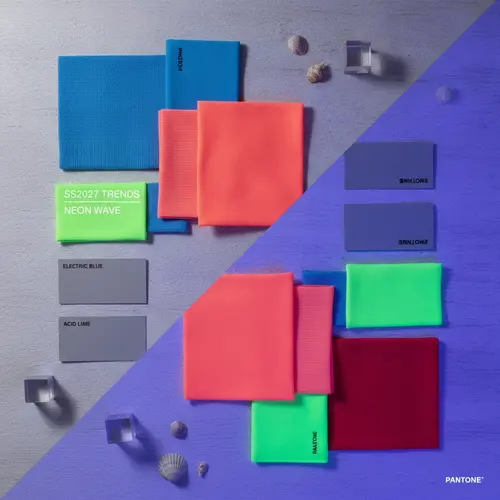
Trend forecasts for SS2027 keep landing on the same message: neons, electric blues, and bright corals are coming back in a big way. Lycra's own SS2027 swimwear trend report points to "neons, electric blues, bright corals" everywhere next season, and Pine Crest Fabrics' color trend forecast independently calls out shades like "Flame Scarlet" and "Acid Lime," specifically recommending UV-reactive prints and fluorescent-shade fabrics as the materials to match them. For a brand planning a launch around this trend, the real question isn't whether neon is fashionable right now — it's whether it can actually be produced at bulk-order quality. The honest answer splits into two very different problems, and only one of them is genuinely hard.
High saturation and true fluorescence are not the same problem
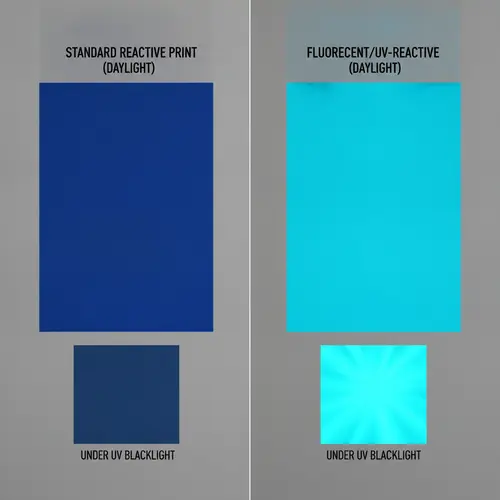
"Bright" and "glowing" get used almost interchangeably in trend coverage, but they come from different places in production. A vivid, highly saturated color — electric blue, hot coral, acid lime — is still a standard dye or pigment color; it's just intense. Direct-injection reactive printing solves this reliably, closing most of the saturation gap between what a design brief calls for and what standard digital sublimation printing can reproduce — the same technique and the same saturation gap we've written about in the context of AI-generated color renders, where matching an AI render's punchy saturation in real bulk dyeing is already a known trade-off. In our own production, this technique handles the overwhelming majority of "this needs to look more vivid" requests without needing to change anything else about the process.
True fluorescence — the kind that reads as glowing or UV-reactive rather than just bold — is a different category of problem, and it's the one that actually holds up SS2027-style neon requests.
Why fluorescent color specifically is harder
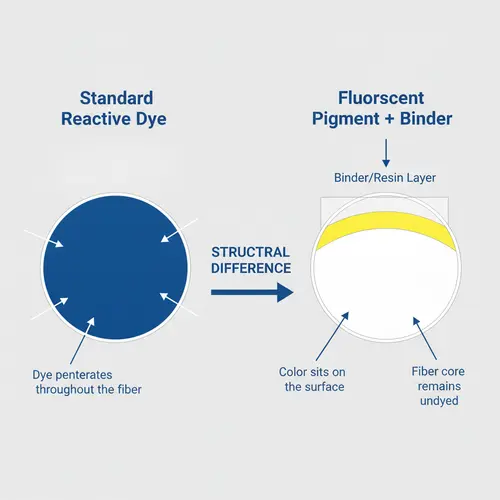
Our own read on this, based on what we've seen in production, is that the real constraint sits with the colorant chemistry itself and the safety/compliance scrutiny it draws — and that lines up with what's publicly documented about how fluorescent textile effects actually get made. Fluorescent color in textiles is typically achieved differently than standard dyeing: rather than being carried through the fiber the way a conventional reactive or disperse dye is, fluorescent effects are commonly built through a luminescent pigment layered on with a binder, or delivered via optical brightening agents. AFIRM Group's Restricted Substances List — the industry-standard chemical restriction reference most apparel brands' compliance teams already work from — specifically flags formaldehyde as showing up in "resins, binders, and fixing agents for dyes and pigments, especially those with fluorescent effects." That's a direct, documented link between fluorescent textile color and exactly the kind of restricted-substance scrutiny our own experience pointed us toward, even though we haven't run our own lab analysis confirming which specific fluorescent formulations are or aren't compliant for a given order.
There's a second, practical issue layered on top of the compliance question: a pigment-and-binder color system behaves differently under repeated chlorine and UV exposure than a color that's carried through the fiber itself. That's the same structural distinction we've written about elsewhere — performance built into fiber and knit structure tends to hold up better over time than performance applied as a surface treatment — and it's a real factor worth asking about specifically if a fluorescent colorway is under consideration for swimwear that needs to survive pool and ocean use, not just a single photo shoot.
What actually happens when a client asks for this
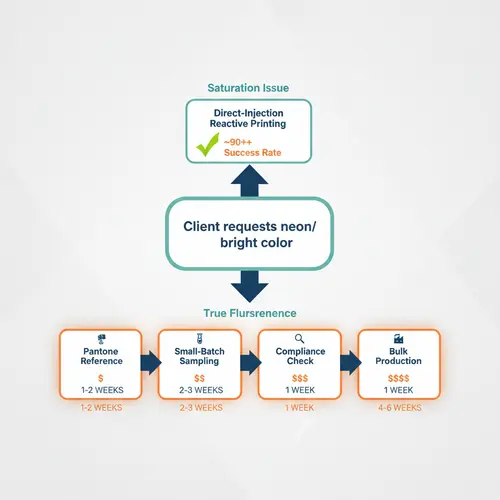
Clients have asked us for neon and high-saturation colorways, and the path we take depends on which problem it actually is:
If it's a saturation issue — a bold, vivid color that just needs to look more intense than a standard color card offers — direct-injection printing resolves it in the large majority of cases, without needing custom color development.
If it's a genuinely new or hard-to-match shade, including possible fluorescent requests, the client provides a Pantone reference code, and we move into custom color matching: working with our existing fabric suppliers or sourcing additional ones specifically for sample development, starting from a small trial batch rather than committing straight to bulk.
Trend-driven color availability also shifts on its own, independent of anything we do — fabric suppliers actively update their standard color card offerings as a trend gains traction in the market, which means some "hard to get" colors become standard offerings within a season or two simply because supplier demand catches up.
The honest constraint across all of this isn't feasibility — it's price. Custom color development is achievable for essentially any target shade a client can provide a real Pantone reference for; the only real variable is whether the client is willing to absorb the cost and lead time of small-batch sampling to get there. This is the same trade-off we've documented for color-matching challenges generally — getting an exact target shade right at scale is rarely a hard stop, but it's rarely free either, and treating it as a cost-and-time conversation upfront avoids surprises later. It also sits squarely in the kind of decision covered in our broader real fabric and trim library: color, like fabric composition, is a sourcing variable worth understanding in real terms rather than assuming a color card is the ceiling of what's possible.
Saturation vs. fluorescence: the real comparison
High-saturation color (vivid, bold) | True fluorescent color | |
|---|---|---|
Typical solution | Direct-injection reactive printing | Custom dye/pigment development |
Success rate with standard process | \~90%+ | Case-by-case, requires sampling |
Compliance consideration | Standard dye compliance | Extra scrutiny — binder/resin chemistry often restricted-substance relevant |
Durability consideration | Standard chlorine/UV performance | Depends on whether color is fiber-carried or surface-applied |
Path if standard process doesn't match | Rarely needed | Pantone-matched custom dyeing, small-batch trial |
Cost driver | Minimal above standard | Scales with number of sampling rounds and supplier sourcing needed |
FAQ
Q: Can you make swimwear in a true neon or glow-in-UV fluorescent color? A: It's achievable through custom color development — providing a Pantone reference and working through small-batch sampling with fabric suppliers — but it's a different, more involved process than a standard vivid color, and it comes with real cost and lead-time trade-offs.
Q: Why is fluorescent color harder than just "very bright" color? A: Standard high-saturation colors are typically achieved with direct-injection printing on the same reactive dye systems used for regular swim colors. True fluorescent effects are more commonly built with a pigment-and-binder system layered onto the fabric, which is a different chemistry with its own compliance and durability considerations.
Q: Does a fluorescent color affect how well the swimwear holds up over time? A: Potentially — colorants applied as a surface layer rather than carried through the fiber can behave differently under repeated chlorine and UV exposure. This is worth asking about specifically for any fluorescent colorway intended for actual pool or ocean use rather than photography alone.
Q: If a trending color isn't on a fabric supplier's current color card, does that mean it can't be sourced? A: Not necessarily. Fabric suppliers actively update their standard offerings as a trend gains traction, so a color that requires custom development today may become a standard option within a season or two as market demand catches up.
Q: What does it actually cost to get a custom, trend-matched color made? A: It varies by how far the target shade is from standard offerings and how many sampling rounds it takes to match a specific Pantone reference. Starting from a small trial batch rather than committing to bulk is the standard way we manage that cost while the color gets dialed in.