
Why Your Swimwear Factory Shouldn't Need a Full Tech Pack
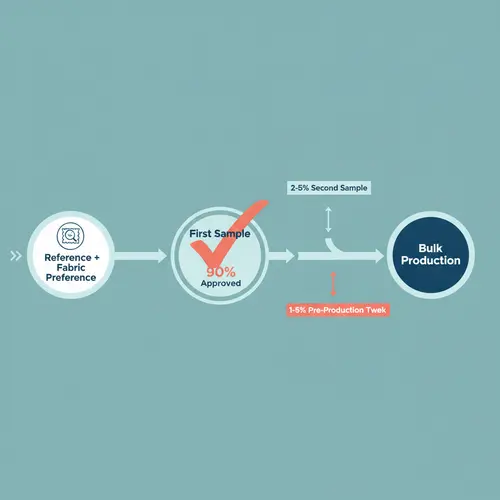
If a swimwear brand can hand a factory a fully specified tech pack — stretch percentages, lining construction, seam allowances, boning placement — that brand probably doesn't need a manufacturing partner anymore. It needs a factory that just executes instructions. Most swimwear brands, especially first-time or category-expanding ones, aren't at that stage, and they shouldn't have to fake it. In our own production data, roughly 90% of first samples are approved as-is, 2-5% need a second sample round, and 1-5% need a small pre-production tweak — without ever requiring the client to write a technical spec.
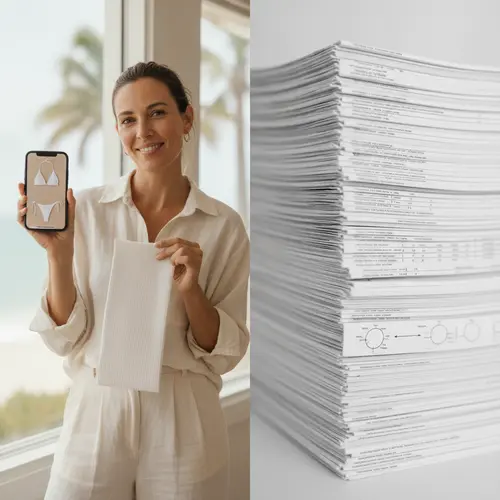
The advice everyone gives brands is backwards
Search "swimwear tech pack" and nearly every result tells brands the same thing: write a complete spec sheet, or expect 3-5 rounds of costly revisions. That advice isn't wrong for generic apparel — it comes from real, well-documented pain. But it quietly assumes the brand already knows what a swimwear-specific spec should say. For swimwear specifically, that assumption usually doesn't hold, because swim construction knowledge (stretch recovery behavior of nylon-spandex vs polyester-spandex, lining layer counts, boning and underwire placement, chlorine-resistant seam finishing) sits with an experienced factory, not with a founder who has never built a garment before. It's the same underlying problem we flagged in our breakdown of why AI-generated swim designs mislead brands before sampling: the gap between what a design looks like and what a factory can actually build isn't something a brand can close by trying harder at documentation. It has to be closed on the manufacturing side.
This gap doesn't stay contained to the sampling stage, either — it resurfaces downstream as returns, which is where the cost of a badly-judged first sample actually shows up on a brand's P&L. Fit and sizing problems are already the single largest driver of returns across apparel broadly — one 2026 industry benchmark analysis puts size and fit issues at roughly half of all apparel returns, citing NRF-sourced data. Telling an inexperienced brand "just spec it correctly" doesn't fix that gap; it just moves the failure point earlier, from the return desk to the sampling stage. It's also why global standards bodies keep revising how body measurements get translated into garment sizing in the first place — ISO's 8559 series exists specifically to reduce fit-driven returns by standardizing how manufacturers translate body dimensions into size labels, which is part of why "which country's sizing standard applies" is a real question worth researching per order rather than assuming a universal default.
What we actually ask for instead
Instead of a spec sheet, we ask three things a brand founder can always answer, even with zero technical background:
A reference style or link — a garment they like the shape of, even from a completely different brand
A fabric preference — texture, stretch feel, or a swatch/photo of something similar they've seen
What needs to change — the silhouette adjustments, hardware or trims to add, whether their own logo or brand label goes on it
From there, if the brand doesn't know their target sizing standard, we ask which country or region they're selling into, then research the anthropometric sizing data for that market before cutting the first sample — rather than guessing or defaulting silently.
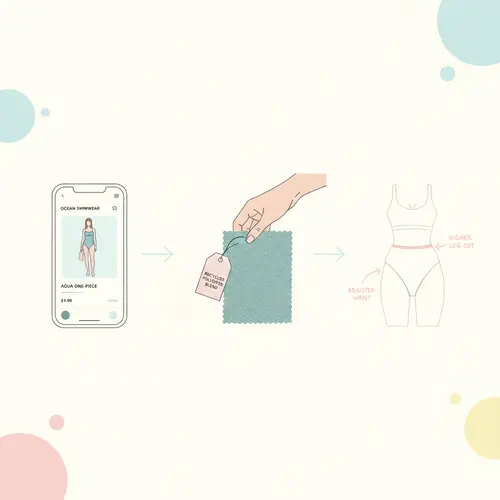 A complete technical specification is not the same as a useful starting file. If you want to organize those references before discussing a sample, our AI swimwear tech pack workflow and human review guide explains what the tool can help record and what still needs confirmation.
What happens when the brand genuinely doesn't know
Client's technical knowledge | What we do before cutting |
|---|---|
Knows nothing about construction | Build to a standard house mannequin/dress form, using reference photos + stated market for sizing |
Knows their target country but not sizing standards | Research that market's real size distribution before pattern-making, not after |
Has worn/tested a similar garment | Ask them to photograph and annotate that garment directly rather than describe it in words |
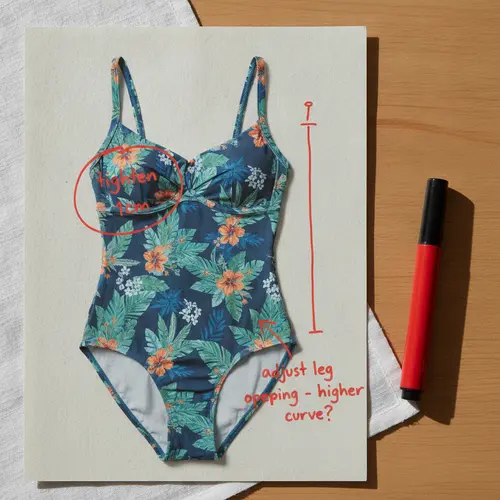
Comes back after the first sample with changes | They mark up the physical sample photo with what to adjust — no new spec document needed |
Where the 10% actually comes from
The 2-5% needing a second sample round and 1-5% needing a pre-production tweak aren't random — they cluster around cases where a brand's vision only becomes clear once they can see and touch a physical object, not a description of one. That's a normal part of design iteration, not a failure of the process. The fix isn't a better questionnaire on the front end; it's a fast, low-friction way to correct on the back end. When a second sample is needed, we ask the client to photograph the first sample with the requested changes marked directly on the fabric — a fit adjustment circled, a strap length marked with a pin — rather than translating the change into technical language themselves. That single habit is what keeps a correction loop from turning into an open-ended revision cycle, which is the actual expensive failure mode described in most tech-pack guidance.
One outside comparison point: industry data on apparel tech packs broadly puts the cost of an incomplete spec at 3-5 sample rounds instead of 1-2, adding weeks and real rework cost per style. Our number for swimwear specifically sits well inside that "healthy" range even when the client supplies effectively no spec at all — because the judgment work happens on our side, upfront, instead of being outsourced to a brand that isn't equipped for it yet.
A fast first-sample approval rate only matters if the rest of the timeline is also fast — see our real order-to-delivery timeline for a startup brand, which runs closer to 3-4 weeks than the 6-9 months most sourcing guides quote.
The one honest exception: color
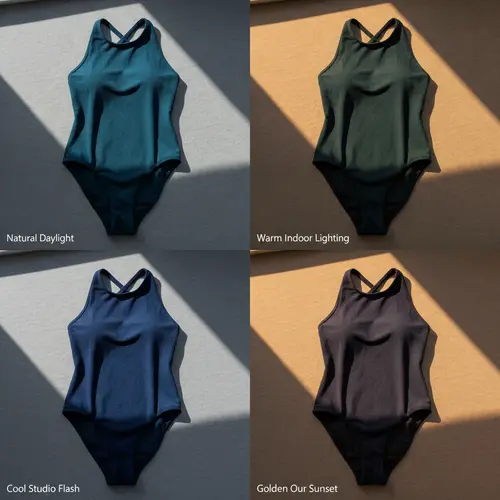
The only place our first-sample accuracy consistently slips isn't construction — it's color. A sample can be built exactly to the reference and still photograph differently than expected under different lighting or camera settings, particularly with darker or highly saturated colorways. That's a color science and photography issue, not a construction one, and we handle it separately.
Our revision policy
One sample revision is included at no additional charge (the client covers return shipping only). In practice, most brands never need to use it — but it exists precisely for the 2-5% of cases above, so a normal design iteration never turns into a paid renegotiation. This ties back to the broader honesty principle we try to apply across every stage of manufacturing feasibility: if something is genuinely going to need a second round, we'd rather build that into the process upfront than pretend a spec sheet alone will prevent it.
This same gap between industry-standard assumptions and our real process shows up in timeline expectations too — most sourcing guides recommend planning 6-9 months ahead, but our real order-to-delivery cycle for a standard order runs closer to 3-4 weeks. See the full breakdown here.
Skipping the tech pack tells you what we need to get started — the next real question most brands ask is what a full quote actually contains once sampling is done. We break that down line by line here.
Not needing a full tech pack is one part of a bigger question brands often bring up next: whether we're OEM, ODM, or private label. Here's exactly where we stand on that, including what we deliberately don't offer.
FAQ
Q: Do we need to fill out a technical spec sheet with stretch percentages and construction details before you'll quote us? A: No. We ask for a reference style, a fabric preference, and what you want changed. The construction judgment — stretch ratios, lining layers, seam type — is our job, not yours.
Q: What information do you actually need from a first-time brand? A: A style reference (even a competitor's product link), a fabric preference, and clarity on hardware, trims, and branding (your logo, labels). That's usually enough to build an accurate first sample.
Q: What happens if we genuinely don't know our target market's sizing standards? A: Tell us which country or region you're selling into. We research the real sizing data for that market before we cut, rather than defaulting to a generic size chart.
Q: How often do samples need a second round? A: In our own data, about 90% of first samples are approved as-is. Roughly 2-5% need a second sample, and 1-5% need only a small adjustment before bulk production.
Q: What's included in the free revision, and what isn't? A: One sample revision and reshipment is free; you only cover the return shipping cost. You mark the changes directly on the returned sample rather than rewriting a spec document.
Q: Why not just ask brands to learn the technical vocabulary first? A: Because that's exactly the barrier that keeps early-stage and category-expanding brands from launching at all. Requiring fluency in swim-specific construction terms before we'll quote a sample defeats the point of a no-MOQ, any-stage model — the whole premise is that brands shouldn't need factory-level manufacturing knowledge just to get a first sample made.
Q: Does this process work for complex construction like compression, underwire, or bonded seams? A: Yes, with one caveat: the more technical the construction, the more it helps if the client can point to a reference garment they've physically worn, since some construction choices (support level, compression grade) are easier to judge by feel than by description.