
Why Small-Parcel Dropshipping Doesn't Work Anymore
Byoyoyi.ai— written with AI-assisted research, reviewed and fact-checked in-house.
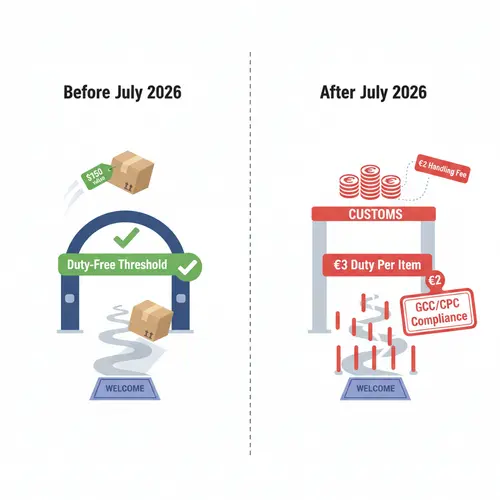
The economics that made small-parcel dropshipping viable have largely disappeared. As of July 1, 2026, the EU eliminated its €150 duty-free threshold entirely, replacing it with a flat €3 customs duty per item (charged by tariff/HS code classification, not once per parcel — so a multi-product order can trigger multiple €3 charges), with a separate handling fee of roughly €2 per parcel expected around November 2026. On the U.S. side, we've already covered how certification requirements like GCC and CPC add real, non-optional cost to compliant shipments. Low-value, race-to-the-bottom small-parcel shipping isn't a viable default strategy anymore — but that doesn't mean direct shipping from China is dead. It means the decision needs to be made deliberately, not by default.
When Direct Shipping Still Makes Sense
Direct shipping remains genuinely advantageous when the numbers support it — specifically when goods carry high enough value that importing in bulk to an overseas warehouse and paying the associated import duty there still gets absorbed by the value of the goods, effectively making the per-unit duty cost negligible relative to what the product is worth. Where direct shipping stops making sense is exactly where the recent policy changes hit hardest: low-value goods that used to rely on duty-free thresholds now carry proportionally heavy fixed costs (the flat €3 EU duty, potential handling fees, and compliance certification costs) that eat disproportionately into thin margins. The "low value, low price, ship it small" model the EU regulation was specifically designed to target is the model that no longer pencils out.
This is the same weight-and-value logic that applies to shipping bulkier products like extended-size swimwear internationally — the actual per-unit shipping economics depend on the relationship between what you're shipping and what it's worth, not a single "shipping is expensive now" generalization.
China-Direct vs. Overseas Warehouse: The Real Trade-offs
Factor | China-Direct Shipping | Overseas Warehouse |
|---|---|---|
Storage cost | None — nothing sits waiting | Ongoing carrying cost for stored inventory |
Quality control | Every item inspected individually before shipping | Inventory checked once, earlier, in bulk |
Best for | Lower, inconsistent volume; multiple markets; higher-value items | Consistent volume; concentrated in 1-2 markets; speed-sensitive |
Typical cost | Roughly under $10 USD/lb | Warehousing + local fulfillment fees, generally lower per-unit at scale |
Typical transit time | 10-15 days to US and Europe | Domestic-speed delivery once inventory is positioned |
Risk | \~0.1% loss/damage rate; resend is the practical fix | Upfront capital tied up in inventory positioned before it sells |
What a Single Test-Order Parcel Actually Costs
The table above describes direct shipping broadly. For a brand testing one product at a time — dropshipping a single piece before committing to any inventory — the real per-parcel economics look different from the per-pound bulk rate above, because a single small parcel carries its own courier handling fee on top of weight. For a real swimwear piece at about 200–300 grams, economy courier shipping runs about $10–20 USD, landing in about 12 working days. That's higher per pound than the roughly under-$10/lb bulk rate in the table above — the difference isn't a contradiction, it's the same "value and volume" threshold from the section above, applied at the smallest possible scale. A single light parcel pays a courier's minimum handling cost regardless of how little it weighs, while bulk freight spreads that fixed cost across a much larger shipment. There's also a packaging detail worth naming explicitly for this stage: a true dropship-test parcel ships blind — no company name, logo, or return address tied to the factory on the package — so the brand selling the product, not the factory behind it, is what the end customer sees. This is standard for dropship-model sourcing generally, and worth confirming directly with any supplier rather than assuming it's included.
What Actually Makes China-Direct Fulfillment Work
Beyond the value threshold above, there's a real operational case for China-based direct fulfillment that has nothing to do with duty avoidance:
No storage fees — nothing sits in a warehouse accumulating carrying cost while waiting for an order.
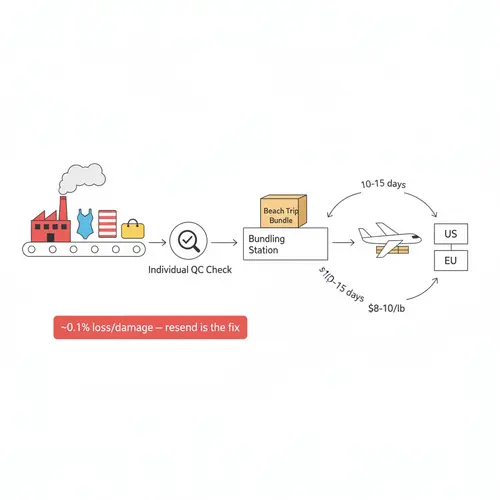
Individual, careful inspection before every shipment — each item gets checked before it goes out, rather than being pulled from bulk-stored inventory that was quality-checked once, earlier, in a different batch.
Efficient multi-SKU bundling — combining products around a single customer occasion (a swimsuit, a beach towel, and a travel bag, for example, bundled as one "beach trip" order) is genuinely more efficient to assemble from a China-based fulfillment point than from a split overseas warehouse setup, since all the components are already in one place.
Real, current pricing: roughly under $10 USD per pound, with typical transit times of 10-15 days to both the U.S. and Europe — workable for brands that aren't promising next-day delivery.
Worth separating clearly: that 10-15 day figure describes standard direct-shipping transit broadly. For smaller, lighter orders specifically, our real full order-to-delivery cycle — including production — typically runs closer to 3-4 weeks total, using DHL for the shipping leg rather than standard freight.
The honest trade-off: there's a real, if small, loss/damage rate of around 0.1%, and when it happens, the practical recourse is simply resending the item — there isn't a mature insurance/compensation infrastructure built around individual small parcels the way there is around bulk freight.
The Decision Isn't Permanent — It's a Threshold
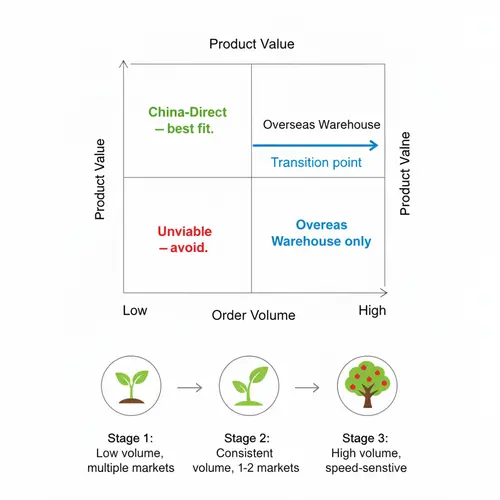
This is exactly the transition we're currently working through with a real client case we've written about before — a lingerie brand that expanded into swimwear with us, scaled to over 20,000 units a month, and is now moving toward a China-direct, no-inventory model for part of their volume. The point isn't that one model replaces the other permanently. It's that order volume, product value, and delivery-speed expectations shift over time, and the fulfillment strategy should shift with them rather than staying locked into whatever setup a brand started with.
A practical way to think about the threshold: if your order volume is low, your product value is moderate-to-high, and your customers are spread across multiple countries, direct shipping (with the new duty costs priced in) is often still simpler than committing capital to overseas warehouse inventory. Once order volume is consistent, concentrated in one or two markets, and speed becomes a competitive factor, that's when overseas warehousing starts to outperform direct shipping on a per-unit basis — not before.
FAQ
Q: Does the new EU duty apply to samples or B2B shipments too, or just consumer orders?
A: The €3 duty specifically targets low-value consignments sold through distance selling (e-commerce) from non-EU sellers to consumers — it's aimed at the direct-to-consumer parcel volume the EU flagged as the source of the competitive imbalance, not standard B2B bulk shipments, which fall under normal customs procedures.
Q: Is small-parcel dropshipping from China completely unviable now?
A: Not completely, but the economics have shifted. It still works for higher-value goods where the EU's flat per-item duty and any handling fees are small relative to the product's value. It's specifically the low-value, thin-margin model that's lost its viability.
Q: How is the new EU €3 duty actually calculated?
A: It's charged per item, based on tariff/HS code classification — not a flat fee per parcel. A single parcel containing multiple product types can trigger the €3 charge more than once, which matters for bundled or multi-SKU orders specifically.
Q: What's the realistic cost and timeline for China-direct shipping right now?
A: Roughly under $10 USD per pound, with typical transit times of 10-15 days to both the U.S. and Europe. There's a small loss/damage rate around 0.1%, and the practical fix when that happens is resending the item rather than relying on a formal insurance claims process.
Q: When should a growing brand switch from direct shipping to an overseas warehouse?
A: Generally once order volume becomes consistent, demand concentrates in one or two core markets, and delivery speed becomes a real competitive factor — at that point, the fixed costs of overseas warehousing start to outperform the per-unit costs of direct shipping.
Q: Does bundling multiple products into one order still make sense under the new EU rules?
A: It can still make operational sense — items already being fulfilled from one location are genuinely easier to bundle around a single customer occasion — but bundling multiple product categories now means the €3 duty can apply more than once per parcel, which needs to be priced into the offer rather than assumed away.
Q: What does it cost to ship a single test piece via dropshipping, versus the bulk rate above?
A: For a single swimwear piece around 200–300 grams, economy courier shipping runs about $10–20 USD, in about 12 working days — higher per pound than the bulk rate because a single small parcel still carries a courier's minimum handling cost. The package ships blind, with no company info tied to the factory.
Trying to figure out whether direct shipping or overseas warehousing fits your current order volume and markets? Send us your numbers — we'll walk through the real cost comparison before you commit to a setup.