
Why We Don't Tell Startup Brands to Plan 6 Months Ahead
Nearly every swimwear sourcing guide gives the same advice: start working with your manufacturer 6-9 months before your target season. Industry guidance commonly puts the safe planning window at 6-9 months, with bulk retailer orders typically placed 6-9 months before summer to build in time for 45-60 day production cycles and 30-45 day ocean freight. That advice is real, and it's not wrong — but it comes from a specific kind of order, placed by a specific kind of buyer, and it doesn't describe what actually happens for most of the early-stage brands we work with. For a standard order from a small brand, our real order-to-delivery timeline runs closer to 3-4 weeks, not months, and it moves with the variables described below. It is worth explaining honestly why the gap is that large.
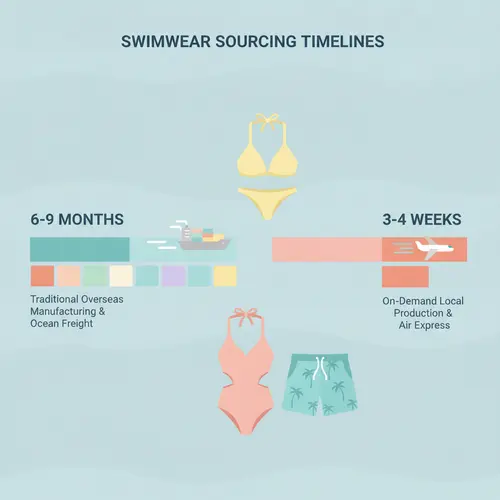
Where the "6-9 months ahead" rule actually comes from
This guidance isn't invented — it reflects real, long-standing sourcing behavior. Ten years ago, before working directly with emerging brands, a large share of orders came from southern China trading companies and bulk buyers restocking last year's proven bestsellers. Those buyers planned that far ahead for two specific, practical reasons that have nothing to do with how long a garment physically takes to make: they knew China's manufacturing calendar well enough to order during the off-season, when factory capacity is open and pricing is more favorable, and they booked ocean freight early to lock in the cheaper shipping rate rather than paying for rushed freight closer to season. Neither reason is really about production lead time — both are about a buyer who already knows exactly what they want (a repeat of something that already sold) optimizing for cost.
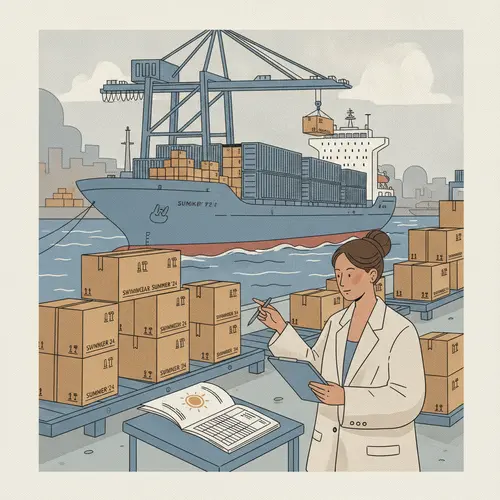
Why "plan the next season's design 6-9 months out" mostly applies to mature brands
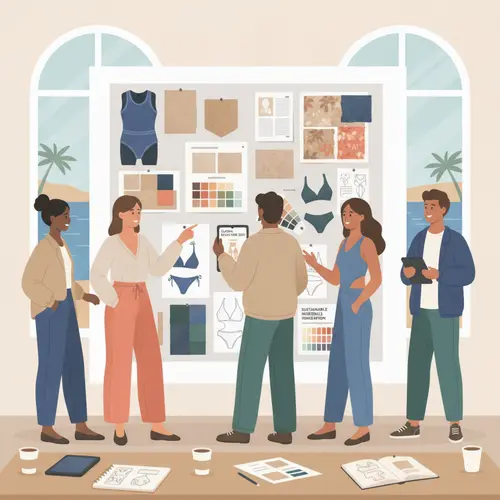
There's a second version of this advice aimed at genuinely new seasonal collections rather than restocks, and it deserves the same honest scrutiny. Planning a full next-season collection that far in advance only makes practical sense for a brand that already has real conviction about where the season is heading — established brands with design teams and market data can commit to a color story and silhouette direction 6-9 months out because they have a defensible basis for that bet. An early-stage or first-time brand usually doesn't have that clarity yet, and forcing a rigid 6-9 month planning cycle onto a brand that's still finding its direction doesn't actually serve them — it just adds pressure to commit to a design bet before the market signal that should inform it even exists.
What our real timeline actually looks like
For the brands we work with — most of them early-stage, testing in small batches rather than locking in a full season's forecast — the real numbers are dramatically shorter than the industry-standard guidance:
Stage | Real Timeline |
|---|---|
Sample development | Varies: 2 days at the fastest, about 7-10 days for a standard sample, and up to 30 days for a project with custom hardware, packaging, and several revision rounds (see how long a swimwear sample really takes) |
Sample revision needed | Rare for standard styles — most first samples are approved as-is — and more common when custom hardware, print, or packaging is involved. |
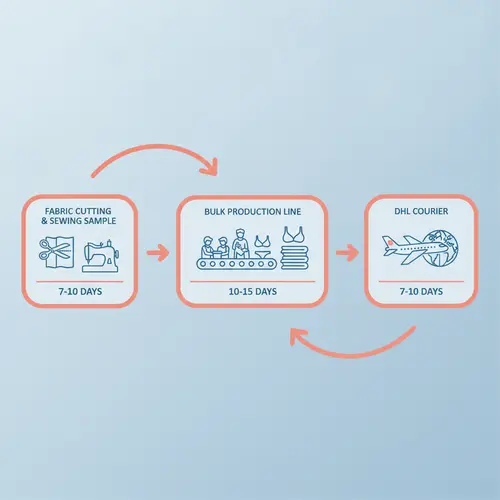
Bulk production | 10-15 days |
Shipping (small orders/lighter weight, typically DHL) | 7-10 days |
Full cycle, confirmed order to delivery | Roughly 3-4 weeks for a standard order; longer with custom elements |
That's the real number most brands should be planning around, not the 6-9 month figure built for a completely different kind of order — a figure that also assumes a fairly standard 45-60 day factory production cycle plus separate ocean freight transit, the kind of extended supply-chain window that a no-MOQ, fast-turnaround model is specifically built to compress. Speed here isn't an incidental detail — it's directly tied to why brands come back for fast reorders once a style proves out, the same pattern we've seen play out with clients who moved from a first sample to consistent monthly volume within a matter of months, not seasons.
Sample time is not a fixed number at our factory. It depends on the materials, the print or dye method, and whether a sample has to be confirmed by the client first, and we give a firm timeline only after the details are settled and payment is made.
The one honest exception: custom fabric development
There's one part of this that genuinely can't be compressed, and we won't pretend otherwise: developing a fully custom fabric from scratch — a new composition, weight, or finish that doesn't already exist in a supplier's standard offering — takes real time regardless of how responsive the rest of our process is. That's a chemistry and production-scheduling constraint, not something a faster workflow can shortcut.
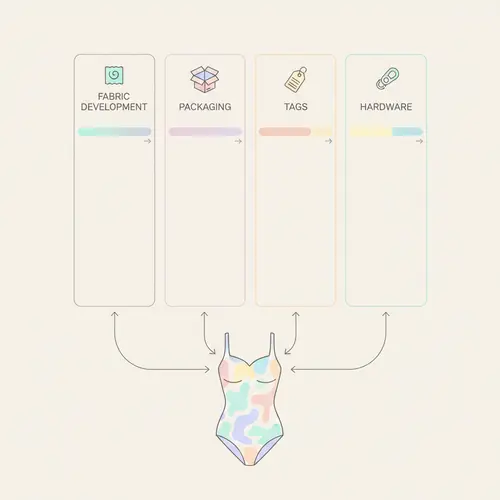
What we can control is how that time interacts with everything else. Custom fabric development, packaging, tags, and hardware customization all run in parallel, not stacked one after another. In practice, that means a fully custom order — new fabric plus custom packaging plus custom hardware — typically adds somewhere between 7 and 15 extra days Some projects stretch further: in the most involved one we have handled, with custom hardware, a custom packaging bag, hang tags, a gift box, and a peak-season print queue, the samples alone took 30 days. on top of the standard timeline above, not a separate multi-week delay for each customized element. This is the same logic behind why weight and shipping bracket decisions matter as much as production time for a small brand's real landed timeline — the fastest production schedule in the world doesn't help if the shipping method wasn't planned alongside it.
What actually makes this level of responsiveness possible
The speed described above isn't a marketing number — it's built on a proprietary supply chain system we've developed in-house that can allocate an order across multiple partner factories based on real-time capacity, rather than queuing every order through a single production line. That's what keeps a 3-4 week real cycle achievable even during the periods when order volume is highest for us, which — worth noting honestly — tends to run from around October through the following February, as brands start moving on their season regardless of what the generic 6-9 month guidance says.
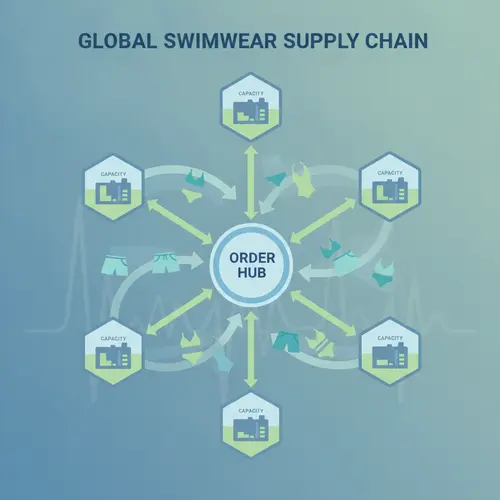 One honest caveat worth flagging alongside the numbers above: this fast timeline assumes production capacity is available when your order comes in. A genuinely small, low-MOQ order can sometimes wait longer than a large bulk order if it has to queue behind production already in progress — see the real hidden costs and lead-time trade-offs behind low-MOQ orders specifically for the fuller picture.
Why We Don't Quote One Fixed Sample Time
Swimwear is a non-standard category with a lot of moving parts, so any single number, whether it is 3 days or 3 weeks, only describes one specific combination of choices. A factory that gives you one fixed time before it knows your materials is guessing. These are the variables that actually change the timeline:
In our own projects, the fastest sample took 2 days and the slowest took 30; the full breakdown of both cases is in how long a swimwear sample really takes.
What changes | Why it affects time |
|---|---|
Custom vs. stock materials and trims | Stock items can start right away; custom items need to be developed or sourced first |
Print or dye method | Different methods have different steps, and some cannot start until the fabric is ready |
Custom fabric | A fabric that has to be developed adds its own sampling round before the garment sample starts |
Shipping | Materials or samples that must be transported add days that have nothing to do with sewing |
Client confirmation | If the sample goes to the client for approval before bulk, the clock includes that round trip |
Both real cases, the 2-day sample and the 30-day project, are broken down in how long a swimwear sample really takes.
We give a firm timeline only after we have talked through these points and payment is made. Even then, it can move a few days earlier or later, because materials and shipping do not always run to schedule. This is the same logic as why there is no fixed MOQ: both depend on the specifics of your order, not on a number we set in advance. For the cost side of a sample, see what is actually in a factory sample quote, and for the fabric side of the timeline, see how fabric rolls and custom development work.
FAQ
Q: How long does a swimwear sample take?
It depends on your materials, print or dye method, whether the fabric is custom, shipping, and whether you need to confirm a sample before bulk. We give a firm timeline only after the details are settled and payment is made, and it can still shift by a few days either way. Our fastest sample took 2 days and our slowest project took 30; see both cases side by side.
Q: Should I ignore the "start 6-9 months ahead" advice entirely? A: Not entirely — it's genuinely useful for a mature brand restocking a proven bestseller or locking in ocean freight savings during the off-season. It's just not a requirement for an early-stage brand testing a new design in a small batch, which is most of who we work with.
Q: What's the real timeline from placing an order to receiving it? A: For a standard order without fully custom fabric, roughly 3-4 weeks total: 7-10 days for sampling (rarely needing revision), 10-15 days for bulk production, and 7-10 days for shipping via DHL on smaller, lighter orders.
Q: Does custom fabric always add significant time? A: Yes, developing a genuinely new fabric from scratch can't be rushed. But packaging, tags, and hardware customization happen in parallel with fabric development rather than adding sequential delays, so a fully custom order typically adds 7-15 days total, not weeks per customized element.In the most involved project we have handled, with custom hardware, packaging, hang tags, and a gift box, the samples took 30 days.
Q: If I'm launching a brand new design with no sales history yet, when should I actually start? A: There's real flexibility here precisely because our real cycle is weeks, not months — you don't need to commit to a full season's design direction 6-9 months out the way a mature brand might. Testing a smaller run closer to when you actually have market clarity is a reasonable approach with a manufacturing partner built around fast turnaround.
Q: Why do you see your highest order volume from October through February? A: That's roughly when brands — regardless of what timeline they were originally planning around — start moving on their upcoming season. It lines up with when the broader industry tends to place orders, even though our own real turnaround doesn't require starting that early.