
Men's Swim Trunks: The Real Fabric Divide, Explained
Byoyoyi.ai— written with AI-assisted research, reviewed and fact-checked in-house.
Men's and women's swimwear are built from fundamentally different fabric categories, and it's not a styling choice — it's a construction one. Men's swim trunks are typically a two-way stretch woven fabric, engineered specifically so the fabric doesn't cling to skin whether you're in the water or out of it. Women's swimwear is typically a four-way stretch knit, built to hug the body closely. That divide has real technical roots, and understanding it also explains where the line is actually starting to blur — and where it isn't.
Men's swimwear is a real, sizable share of the category, not a niche afterthought — B2B wholesale data from JOOR puts men's swim at roughly 22% of total swimwear sales volume, against women's at 73% and children's at 4%. That's a large enough share that the construction differences below are worth understanding on their own terms, not as a footnote to women's swimwear.
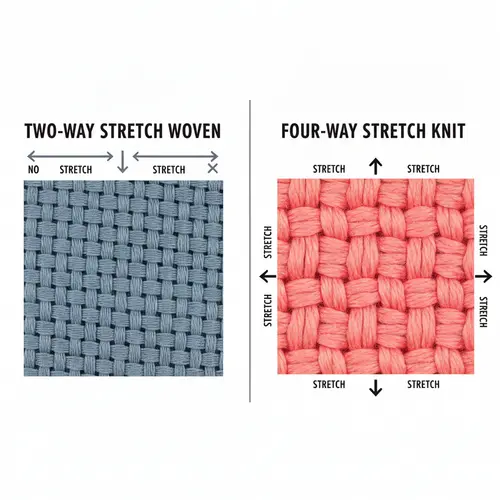
The Real Construction: Woven Shell, Mesh Liner
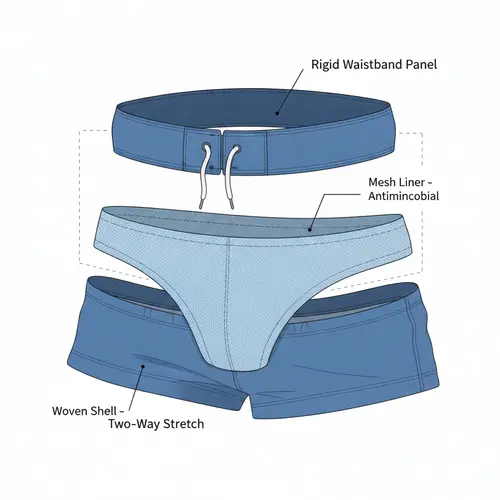
The standard men's swim trunk construction is a woven outer shell — commonly called "board short fabric" — with virtually no stretch through the length or width of the fabric on its own, though a small percentage of spandex woven into one direction gives it a two-way give. This is a fundamentally different construction principle than the knit-based stretch mechanics behind most women's swimwear: knit fabric gets its stretch from interlocking loops in the fabric structure itself, while woven fabric only stretches if spandex is deliberately woven into it, and even then, typically in one direction only. This is deliberate: a rigid, non-clinging shell is what keeps the trunk from looking or feeling like a second skin, wet or dry. This is one more entry in our real fabric and trims library — the construction logic behind a fabric choice, not just the fabric name.
Underneath, the liner is a one-piece mesh brief, integrated directly into the construction rather than sewn in as an afterthought. Liner mesh is typically chosen specifically for functional properties — antimicrobial and odor-resistant finishes are common priorities, since this layer sits in direct, extended skin contact the way any swimwear does. Some board short construction goes further: Billabong's technical breakdown of their own product describes a fixed, two-ply rigid panel at the waistband — secured with a drawcord — specifically so the short stays in place during genuinely active water sports, while the rest of the short uses four-way stretch fabric for freedom of movement. That's a hybrid construction within men's swim itself: rigid where it needs to hold position, stretch where it needs to move.
Why the Divide Exists — It's Not Arbitrary
Here's the part worth understanding before asking whether the two categories should merge: historically, women's swimwear design prioritized appearance first, while men's swimwear design has consistently prioritized comfort and function — down to the fabric choice itself, going back over a century of the category's development. That's not a value judgment on either category — it's a genuinely different design brief. Women's four-way stretch knit exists to shape and follow the body closely, which is a legitimate functional goal for that category's typical use case. Men's woven, non-clinging shell exists to avoid that closeness, which is an equally legitimate functional goal for a different use case. The fabric difference is downstream of two different design problems, not an arbitrary tradition that's overdue for correction.
Where the Line Is Actually Blurring — And It's Not What You'd Expect
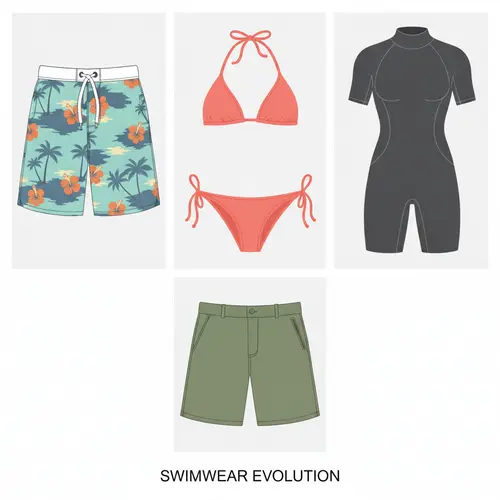
A real gender-neutral swimwear category does exist — brands like TomboyX, Chromat, and Humankind build swim lines specifically for all gender identities and expressions. But it's worth noting how that convergence is actually happening: these brands build primarily in stretch knit, compression-capable fabric — the construction family closer to traditional women's swimwear — rather than moving women's design toward men's woven boardshort construction. Where blurring is happening, it's happening through a third category (compression swim tops, swim binders, unisuits) built for a specific inclusive-fit purpose, not through men broadly adopting women's fabric or vice versa in the mainstream market.
The more relevant convergence for mainstream men's swim is the "hybrid shorts" trend — shorts engineered to transition from pool to casual wear with matte finishes and tailored waistbands, sometimes incorporating a compression liner. That's the same "beyond the pool" crossover logic we've written about for women's swimwear, showing up independently on the men's side — not because men's swim is becoming "women's fabric," but because the same underlying market pressure (garments that work in more than one setting) is reaching both categories.
The Seersucker Question: A Different Technique Than Rib Knit
The seersucker (puckered) texture appearing in men's swim trunks is achieved through yarn-dyed weaving — a woven construction technique using differently-tensioned yarns to create the characteristic puckered surface — which is a genuinely different process from the knitting-based rib texture we've covered on the women's side. Seersucker is already common in women's swimwear; its move into men's trunks is a real example of a technique crossing over between categories even while the underlying fabric construction (woven vs. knit) stays separate. That distinction matters if you're sourcing: asking for "seersucker" and asking for "ribbed texture" are two different production processes, not two names for the same effect.
The Real Pain Point: Comfort and Versatility, Not Visual Uniformity
Based on how men's swim trunks are actually reviewed and marketed, the dominant real pain points are comfort (chafe-free liner, moisture-wicking, quick-dry performance) and versatility (holding up across swimming, casual wear, and everything in between) — not a stated demand for men's and women's swimwear to visually or materially match. The gender-neutral segment is a real, growing, specific market with its own genuine demand — it's just a different demand than "make men's trunks out of women's fabric," and treating it as the same question undersells both categories.
Men's trunks are one entry in the full real construction guide organized by swimwear type, alongside training suits, race suits, and other categories where the fabric choice is a construction decision, not a styling one.
FAQ
Q: Why don't men's swim trunks use the same stretch knit fabric as women's swimwear?
A: The two fabric families solve different design problems. Women's four-way stretch knit is built to closely follow the body's shape; men's woven shell is built specifically to avoid clinging to the body, wet or dry. Both are legitimate functional choices for their respective typical use cases, not an arbitrary difference.
Q: Is gender-neutral swimwear made from men's or women's fabric?
A: Neither, exactly — gender-neutral swim brands typically build in stretch knit, compression-capable fabric, which is closer to the traditional women's swim fabric family than to men's woven boardshort construction. It's a distinct approach built for a specific inclusive-fit purpose.
Q: What's actually different about a board short's waistband construction?
A: Many board shorts use a fixed, rigid two-ply panel at the waistband secured with a drawcord, specifically to keep the short in place during active water sports, while the rest of the garment uses stretch fabric for mobility — a hybrid construction within men's swim itself.
Q: Is seersucker in men's swimwear the same technique as ribbed knit fabric?
A: No — seersucker is achieved through yarn-dyed weaving (a woven technique), while rib texture comes from a knitting process. They produce different textures through fundamentally different fabric constructions, even though both add dimensional surface interest.
Q: What do men's swimwear buyers actually complain about most?
A: Comfort issues (chafing, clinging when wet, slow drying) and durability (fading, stiffening after washes) come up far more than requests for visual consistency with women's swimwear — the real demand is functional, not aesthetic parity between categories.
Sourcing men's swim trunks and want to get the woven shell, liner, or waistband construction right the first time? Send us your design — we'll tell you what construction actually fits your use case.