
Why Ribbed Textured Swimwear Fabric Is Trending in 2026
Ribbed, wave-textured knit fabric — often called "channel rib" fabric in the industry — is showing up everywhere in resort and swimwear collections right now. It's not a coincidence, and it's not just a styling trend. The texture is a direct result of a specific knitting process, and understanding that process is the difference between sourcing a fabric that photographs beautifully for one season and building a swimwear line around a fabric you actually understand.
Here's what's driving the trend, and the real production numbers behind it.
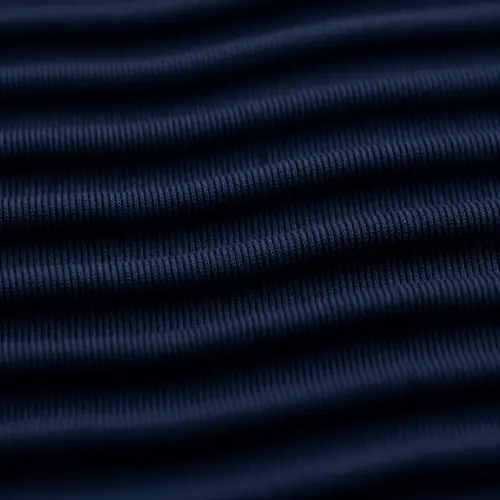
What "Ribbed" Fabric Actually Is — A Knitting Process, Not a Print
Channel rib texture isn't printed or pressed onto fabric after the fact. It's formed during knitting itself, through a jacquard/pleat knitting technique that pulls the fabric's width in as the texture forms.
A base fabric that would normally knit out at 165–180cm wide shrinks down to roughly 100–130cm once the ribbed texture is knitted in. The deeper and denser the ribs, the more the width contracts — and the heavier the resulting fabric gets. At the extreme end, a deep, dense rib construction can knit down to as narrow as 90cm while reaching around 300gsm, compared to a lighter, shallower rib that stays closer to 125cm.
We've been working directly with one such fabric — supplier code CX8900, a 60% polyester / 40% covered-spandex construction that knits out at 125cm and 285±10gsm, available in 30 colorways. It's a useful reference point because it sits in the middle of the range: dense enough to hold a strong 3D texture, not so extreme that width and yield become impractical.
Ribbed texture isn't the only case where a surface effect is actually a knitting decision rather than a print or post-treatment — the same principle applies to another 2026 trend, crinkle texture, which splits into its own two distinct real production methods (one construction-level, one fabric-level like this one).
The Rib "Family" Isn't One Texture — It's a Spectrum
Within channel rib fabric, the industry recognizes several distinct sub-types based on rib width, depth, and line direction. These aren't interchangeable — the right one depends on the visual weight and drape you're designing for:
Type | Line Direction | Rib Character | Typical Visual Effect |
|---|---|---|---|
Wide channel (宽坑条) | Straight | Wide, shallow-to-medium depth | Bold, structured stripes |
Fine channel (细坑条) | Straight | Narrow, closely spaced | Subtle texture, reads almost solid from a distance |
Ant cloth (蚂蚁布) | Straight | Very fine, densely packed | Fine granular texture, minimal visual "line" effect |
Small wave (小波浪) | Curved | Shallow curve, tight repeat | Soft, gentle movement |
Large wave (大波浪) | Curved | Deep curve, wide repeat | Strong dimensional, statement texture |
Importantly, the ribs run as lines, not as a crossing/intersecting grid — which is part of why the texture reads as strongly three-dimensional and directional rather than a flat surface pattern. This is a real construction difference, not just a visual one, and it affects how a pattern piece drapes and how print or embroidery would (or wouldn't) sit on top of it.
Why It's Winning in Swim and Resortwear Specifically
Channel rib is a knit fabric with roots in general apparel — it's been part of casual and outerwear knitwear for years before crossing into swim and resortwear. That crossover matters for two practical reasons:
It photographs exceptionally well. The deep, directional texture catches light and shadow in a way flat swim fabrics don't, which is a real advantage for brands whose growth depends on scroll-stopping product photography and multi-scene content — beach, pool, resort, street.
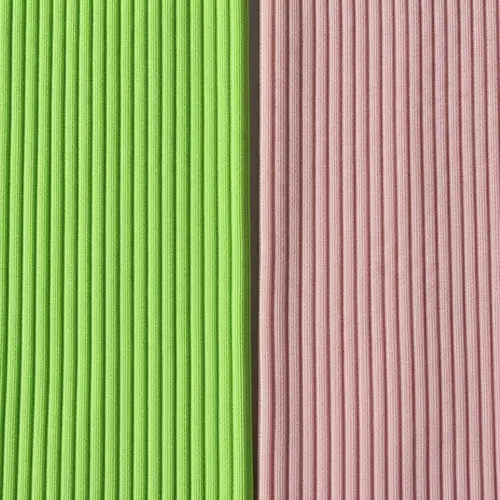
It's genuinely comfortable to wear, without the compression feel that a lot of standard high-stretch swim fabrics have. That's a meaningful difference for a customer trying it on — and it's part of why textured knits are gaining ground in swim-to-street crossover pieces, not just poolside styles. Since this fabric sits in direct, prolonged skin contact the same way any swimwear does, it's worth sourcing from suppliers who can provide OEKO-TEX STANDARD 100 certification — the independent, internationally recognized testing system for harmful substances in textiles, with stricter requirements for products in close, extended skin contact.
The honest trade-off: as a textured knit, it doesn't dry as fast as a smooth, tightly-woven swim fabric, and it will absorb somewhat more water. This doesn't meaningfully affect comfort while worn, but it's worth knowing before you commit a full collection to it — and it's exactly the kind of spec that gets left out of AI-generated tech packs and generic sourcing content, because it only shows up when you've actually handled the fabric.
The Customization Economics — Where This Gets Interesting for Growing Brands
This is the part most sourcing content skips entirely: channel rib fabric is genuinely customizable — texture depth, rib pattern, and fiber composition can all be adjusted for a brand that has a confident design direction and a defined budget.
Typical custom development sampling runs $100–200 USD. What makes this worth paying attention to is the yield: a single production run of a customized fabric can produce enough yardage for roughly 3,000 bikini sets — meaning the fabric itself becomes the foundation for an entire product series, not a one-off style. For a brand in a growth phase, that's a low barrier to building something visually distinct across swim, beachwear, and adjacent apparel, rather than sourcing the same stock fabric every competitor has access to.
The same principle — a trending texture or silhouette is a construction decision, not a shortcut — applies to another 2026 trend too. See how cut-out swimwear is actually reinforced at the edge without the opening curling or losing shape.
FAQ
Q: Does ribbed swimwear fabric take longer to dry than standard swim fabric?
A: Yes — as a textured knit, it holds slightly more water than a smooth, tightly-woven swim fabric. It doesn't affect wearing comfort, but it's a real difference worth planning for in product descriptions and care instructions.
Q: What's a realistic MOQ for customizing a ribbed fabric texture?
A: Development sampling typically runs $100–200 USD, and a single fabric production run can yield enough for approximately 3,000 bikini sets — making it accessible for brands planning a full collection rather than a single style.
Q: What width and weight should I expect from ribbed swim fabric?
A: It varies with rib depth: shallower, less dense ribs knit out closer to 125–130cm at a lighter weight; deeper, denser ribs can go as narrow as 90cm and as heavy as ~300gsm. Always ask for the specific width and gsm for the exact rib depth you're sourcing — "ribbed fabric" alone isn't a specific enough spec to build a tech pack around.
This kind of real spec data is exactly what we maintain across our full fabric and trim library — not just for ribbed fabric, but for every material we work with.
Have a specific rib pattern or weight in mind? We work directly with real fabric data like this — reach out to talk through what's actually feasible before you finalize a tech pack.