
Modest Swimwear Construction: Real Fabric and Fit Challenges
This is one entry in our broader real construction guide organized by swimwear type, covering the life-stage and special-use categories alongside modest swimwear.
Modest swimwear — long sleeves, long bottoms, often paired with a matching headscarf — isn't a niche experiment anymore. Technavio's swimwear market analysis names the expansion of modest swimwear, including burkinis, as a key trend addressing diverse consumer needs and expanding market accessibility. The instinct when sourcing this category is to assume everything gets harder because there's more fabric to work with. In practice, the real construction challenge is much more specific than that — and it's not where most buyers expect it.
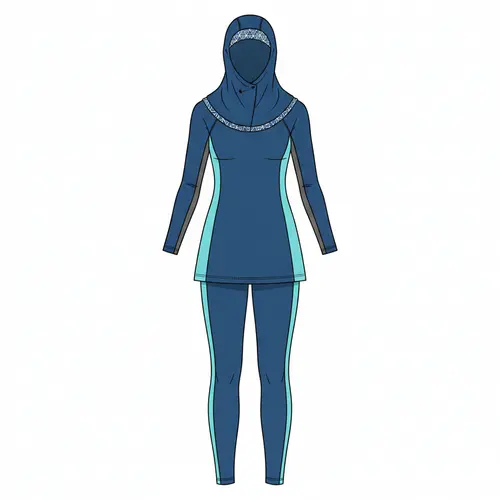
The Real Difficulty Isn't the Coverage — It's the Underarm
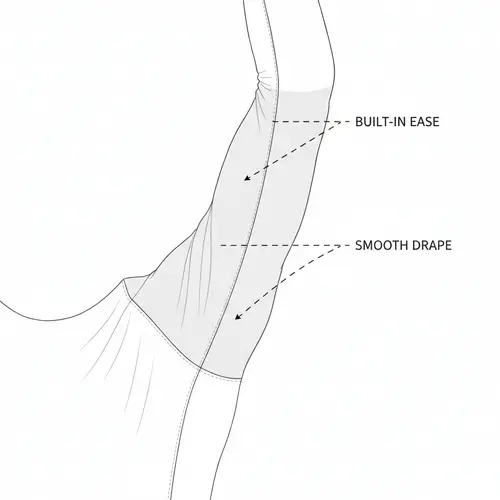
More fabric doesn't automatically mean more difficulty everywhere on the garment. In real production, two areas get evaluated very differently:
The underarm is the genuine technical challenge. This is a high-mobility joint, and a long sleeve crossing it needs the right amount of built-in ease (褶量) in the pattern, plus a pattern shape that keeps the fabric draping smoothly through a full range of arm movement. Get this wrong and the sleeve either restricts movement or bunches up unattractively every time the arm lifts — a functional problem, not just a look problem. This is a well-documented principle in garment patternmaking more broadly: insufficient ease at the underarm is a common cause of restricted range of motion in any sleeved garment, not something specific to swimwear — it's just that modest swimwear's longer sleeve length makes the consequence of getting it wrong more noticeable.
The crotch/groin area on long bottoms is mainly an aesthetic consideration, not a structural one. There's real pattern work involved, but it's about how the garment looks and sits, not a functional stress point the way the underarm is.
This is worth knowing because it changes what actually deserves scrutiny on a sample: a long-sleeve, long-pant modest swimsuit isn't uniformly more complex than standard swimwear — the complexity is concentrated at one specific joint.
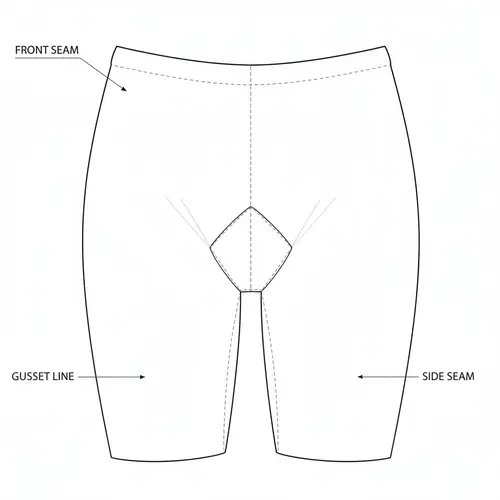
We Use a Standardized Base Pattern, Not a Custom Build Each Time
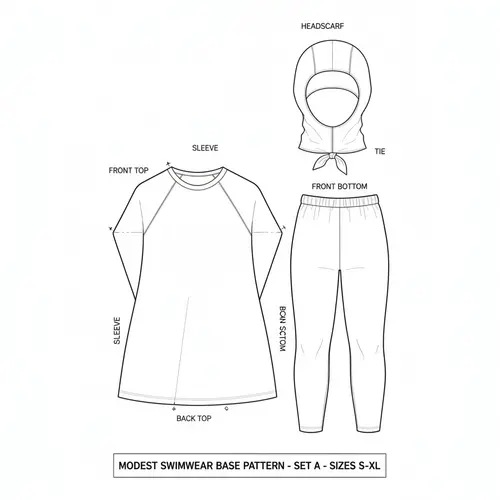
Rather than re-engineering the pattern from scratch for every modest swimwear order, we work from a standard, established modest swimwear pattern base. This matters practically: it means fit and construction quality are consistent order to order, rather than being reinvented (and re-risked) each time, and it's part of why this category fits naturally into a no-MOQ incubation model — a proven base pattern lowers the real risk of a small first order for a brand testing this category.
Headscarf Construction: Real Fabric and Quantities
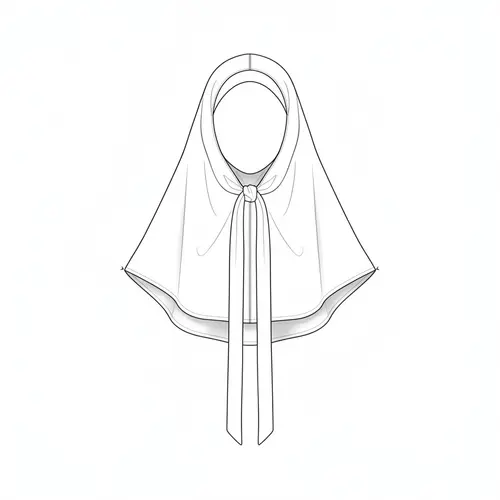
The matching headscarf that often accompanies a modest swimwear set is built with genuinely modest fabric requirements, not a major added-cost component:
Fixation is achieved through pattern draping, not hardware. The construction is closer to a cape-like panel of fabric with ties attached, designed to gather and secure hair the way a wrap would — not a structured piece with clips or elastic bands. Exact styling follows whatever the client specifies.
Fabric choice is typically chiffon, or matched to the body fabric. Both are common, and the choice comes down to the design direction the client wants.
Real fabric usage is small: roughly 0.2 meters for a standard headscarf piece, or around 0.3 meters for a larger style.
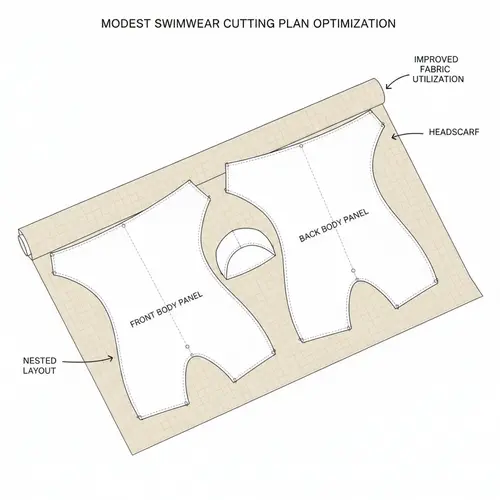
When the headscarf uses the same fabric as the body of the suit, it can actually improve overall fabric utilization — the smaller headscarf pattern piece nests into the cutting layout alongside the larger body panels, filling space that might otherwise go to waste. This is the same fabric-efficiency principle we've written about elsewhere: pattern nesting efficiency depends on how shapes fit together, not on using less fabric in isolation.
Standard vs. Modest Swimwear: What Actually Changes
Factor | Standard Swimwear | Modest Swimwear |
|---|---|---|
Fabric quantity | Baseline | Higher overall, but not uniformly distributed |
Technical difficulty concentration | Spread across bust/back construction | Concentrated at the underarm (ease + drape) |
Crotch/groin construction | Standard | Aesthetic pattern consideration, not a functional stress point |
Headscarf (if included) | N/A | \~0.2–0.3m fabric, tie-based fixation via pattern draping |
Pattern approach | Style-specific | Standardized modest base pattern, adapted per design |
What This Means for Sourcing Modest Swimwear
If you're bringing a modest swimwear line to a factory, the useful questions to ask aren't just about fabric — they're about whether the supplier has a proven base pattern for this category and can speak specifically to how they handle underarm ease. A supplier who treats a long-sleeve swimsuit as "the same pattern, just longer" is more likely to produce a restrictive or poorly-draping underarm than one working from a pattern genuinely built for this category. The same applies to headscarf components: ask about fabric matching options and realistic yardage, since it's a smaller cost addition than it might appear.
This same care in matching construction to a garment's actual real-world use — not just its visual coverage — is the same principle behind how nursing access points get built without compromising the garment's structure: the visible feature isn't the hard part, the specific functional detail underneath it is.
FAQ
Q: Does modest swimwear require significantly more fabric than standard swimwear?
A: More overall, yes, but the increase isn't the main technical challenge — the real difficulty is concentrated at the underarm, where sleeve movement and drape need specific pattern ease, not just extra fabric.
Q: What's the hardest part of pattern-making for long-sleeve swimwear?
A: The underarm. It's a high-mobility joint, and the pattern needs the right built-in ease to allow full arm movement without restricting the wearer or causing the fabric to bunch unattractively.
Q: Is the crotch/groin area on long swim pants a technical challenge?
A: It's more of an aesthetic and fit consideration than a structural one — real pattern work is involved, but it's not a functional stress point the way the underarm is.
Q: How much fabric does a matching headscarf actually require?
A: Roughly 0.2 meters for a standard piece, or about 0.3 meters for a larger style — a modest addition, especially when the fabric matches the body of the suit and can be nested efficiently into the same cutting layout.
Q: Does a headscarf need special hardware to stay secured?
A: Not typically — fixation is usually achieved through the pattern itself (a draped panel with ties), rather than clips, elastic, or other hardware, and can be adapted to specific styling requests.
Q: Is modest swimwear a real, growing market, or a niche request?
A: It's a genuinely growing segment — market research firms including Technavio specifically identify modest swimwear and burkini expansion as a key trend in the broader swimwear category, not a marginal request.
Bringing a modest swimwear line to market and want to know what the real construction and fabric requirements look like for your design? Send us the details — we'll walk you through what's actually involved.