
Types of Bikini Bottoms: The Real Construction Differences
This is one entry in our broader real construction guide organized by swimwear type — if bottoms aren't the only piece you're sourcing, that page maps out the same real-construction approach across tops, one-pieces, and other categories.
Bikini bottom terminology isn't standardized — what one brand calls "cheeky," another calls "high-cut," and a third calls both the same thing. Style guides that sort bottoms by name end up sorting by marketing language, not by anything a factory actually builds differently. Here's the same 10 types, sorted by what actually changes on the production floor: fabric usage, process complexity, real cost, and where quality problems actually show up.
At a Glance
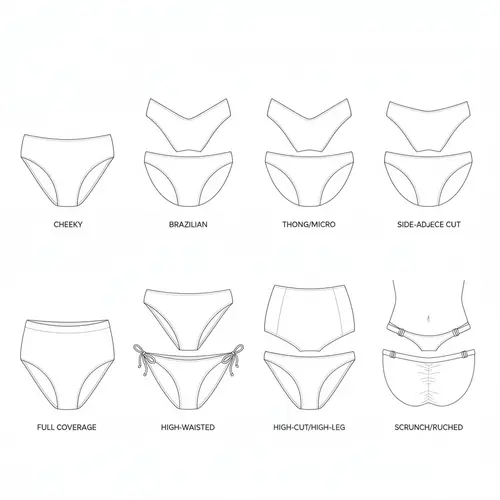
# | Type | Real Construction | Cost Tier |
|---|---|---|---|
1 | Full Coverage | Mid-to-high rise, full rear coverage, fixed side seams | Standard |
2 | Cheeky | Lower rise, partial rear coverage, fixed or high-cut sides | Standard |
3 | Brazilian | High-cut leg opening, high rear coverage exposure | Standard — most fabric-efficient |
4 | Thong / Micro | Minimal fabric, strap-style rear panel | Standard |
5 | High-Waisted | Waistline sits above the natural waist, more front coverage | Standard |
6 | Tie-Side | Sides fastened with fabric ties rather than sewn seams | Standard |
7 | High-Cut / High-Leg | Leg opening cut higher toward the hip | Standard |
8 | One-Piece Cut | Front cut as a single continuous panel, only the back has a seam | Lowest — fewest processes despite more fabric waste |
9 | Side-Adjuster | Metal slider hardware at the sides, adjustable like a bra strap | Higher — hardware cost + plating requirement |
10 | Scrunch / Ruched | Elastic stitched into the back seam while stretched, creating a gathered effect | Highest — most labor-intensive of the group |
Fabric Usage: The Counterintuitive Part
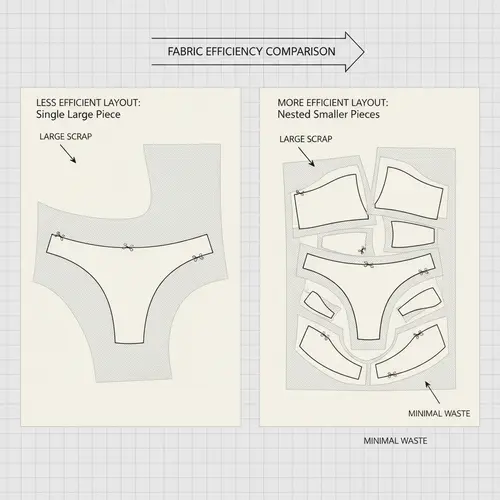
Brazilian styles use the least fabric of the group — the high-cut leg line and narrower back panel simply require less material per piece. What's less obvious: one-piece cut bottoms, despite being the simplest-looking style, actually waste more fabric than multi-panel styles. A single continuous front panel doesn't nest as efficiently on a fabric roll as several smaller pattern pieces do — smaller, irregular shapes fill in the gaps between larger cuts, while one big panel leaves more unusable scrap around it. It's a real trade-off worth knowing: fewer seams doesn't mean less material.
Cutting Complexity Isn't the Cost Driver It Used to Be
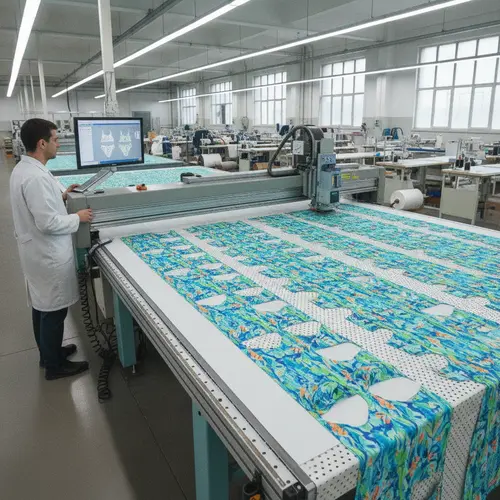
It's worth clearing up a common assumption directly: more pattern pieces do not mean harder cutting. Fabric cutting in modern production runs on computer-guided automated cutting systems, and these systems cut multiple layers with the same precision and repeatability regardless of how many pattern pieces a style requires — a one-piece front panel and a six-piece scrunch-back bottom take the same cutting effort from the machine's perspective. The real cost differences below come from sewing labor and hardware, not from cutting.
What Actually Ranks Cost, High to Low
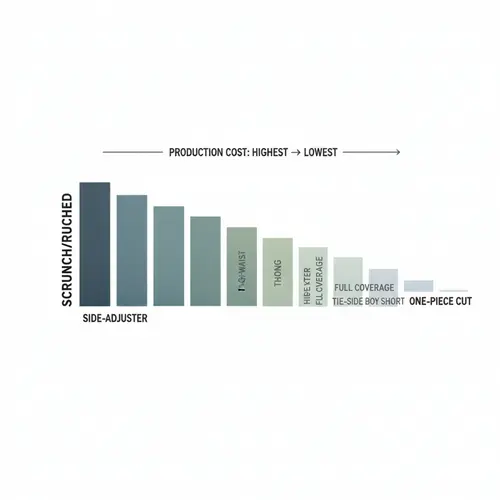
Based on real production cost, the ranking across this group is: scrunch/ruched > side-adjuster > the remaining seven standard types > one-piece cut. Two underlying factors explain almost the entire ranking:
More hardware components raise cost. Side-adjuster styles need metal sliders (and the plating process behind them — more on that below), which standard tie-side or fixed-side styles don't require.
More cut pieces raise cost. Scrunch/ruched construction typically involves more panels (the gathered back panel, the lining, the side bands) than a standard fixed-side bottom, and the ruching itself is a slower, more attention-heavy sewing step than a straight seam.
One-piece cut sits at the bottom of the cost ranking for the opposite reason: fewer seams and no hardware, even though it uses somewhat more fabric per piece than the more efficient cuts.
This is the same construction technique behind the ruched effect we've written about in crinkle swimwear's two construction methods — scrunch-back bottoms are essentially the elastic-thread-ruching method from that piece, applied specifically to a bottom's back panel.
Where the Real Quality Risks Actually Sit
Two specific, verifiable quality risks come up in this group — not general "quality varies" advice, but the actual failure points:
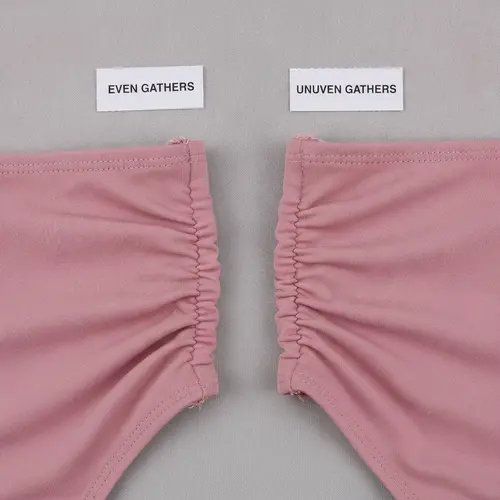
Scrunch/ruched consistency. The gathering effect depends on stitching elastic while it's stretched to a consistent tension. Batch-to-batch (or even piece-to-piece) inconsistency in how tight that elastic is pulled during stitching shows up as visibly uneven ruching, and the elastic's own recovery over time affects how long that gathered shape holds.
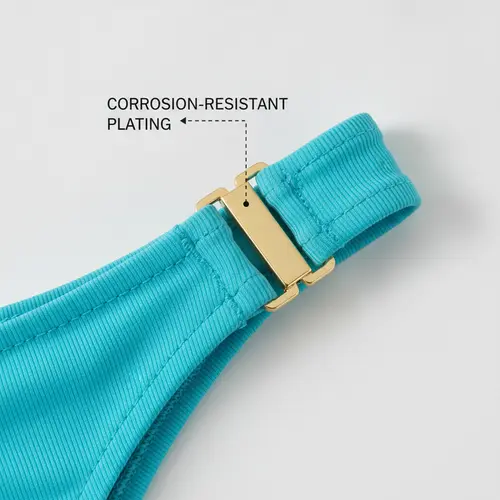
Side-adjuster hardware corrosion. Metal sliders sit in direct, repeated contact with pool and ocean water, which makes plating quality the real determinant of whether they last. This needs the same rack plating process — not barrel plating — that we've covered for other swimwear hardware, plus a real chlorine-exposure check before the hardware goes into production — we run ours to a 48-hour benchmark. The general industry method for evaluating plated-metal corrosion resistance is salt spray (fog) testing under ASTM B117, the standard reference point for how coated metal parts hold up under sustained corrosive exposure — our in-house chlorine check is a practical, swim-specific version of the same underlying concern, not a formal ASTM B117 test report.
Tie-side and side-adjuster construction both separate the fastening from the main panel, which is the same underlying principle behind a newer, more complete version of that idea — fully detachable, modular straps sold as their own customizable product, rather than fixed to one garment at all.
For the top-side and full-silhouette version of this same real-cost question, see our breakdowns of bikini top types and whether one-piece is actually harder to build than a bikini.
The scrunch/ruched back construction described above is also the technique behind ruffle detailing elsewhere on a garment — see the two real ways ruffle swimwear gets built.
FAQ
Q: Which bikini bottom type is cheapest to produce?
A: One-piece cut bottoms sit at the lowest cost tier in this group — fewer seams and no hardware outweigh the fact that they use slightly more fabric per piece due to less efficient pattern nesting.
Q: Does more fabric coverage always mean higher cost?
A: No. Coverage level and cost aren't directly linked in this group — Brazilian styles (less coverage) are among the most fabric-efficient, while scrunch/ruched styles (moderate coverage) are the most expensive due to labor, not fabric amount.
Q: Why would a "simple-looking" one-piece cut bottom use more fabric than a multi-panel style?
A: Because pattern nesting efficiency depends on shape, not piece count. A single large panel leaves more unusable scrap on the fabric roll than several smaller, differently-shaped pieces that can be nested together more tightly.
Q: Is cutting a more complex, multi-panel style actually harder for a factory?
A: Not with modern automated cutting equipment — computer-guided cutting systems handle multi-piece patterns with the same precision as simple ones. The cost difference in complex styles comes from sewing and hardware, not cutting.
Q: What's the real difference between tie-side and side-adjuster construction?
A: Tie-side uses fabric ties sewn directly to the garment with no metal hardware required. Side-adjuster uses a metal slider (similar to a bra strap adjuster), which adds both a hardware cost and a plating/corrosion-resistance requirement that tie-side doesn't have.
Q: What should I ask a supplier about scrunch/ruched bottoms before ordering?
A: Ask how they control ruching consistency across a production batch, since gathering tightness depends on stitching tension during construction — a supplier without a specific answer for this is more likely to ship inconsistent results.
Q: Do side-adjuster hardware pieces need special testing?
A: They should. Because the hardware sits in constant contact with pool or ocean water, its plating needs to be verified against corrosion, not just assumed. Ask specifically about the plating method (rack vs. barrel) and whether the supplier runs any chlorine-exposure check before production.
Trying to decide between bottom styles for a new line, or want your current supplier's hardware and construction choices checked against what's actually real? Send us the details — we'll tell you honestly what to expect on cost and quality risk.