
One-Piece vs. Bikini: Is It Actually Harder to Build?
Search around for one-piece swimwear manufacturing content and you'll find a consistent claim: one-piece construction is significantly harder than bikini construction because it has to fit the entire torso — shoulder to crotch to shoulder — instead of just the bust and hip separately. It's a plausible-sounding claim. Based on our own real production experience across both categories, though, we don't fully agree with it. The difficulty gap isn't as large as that framing suggests.
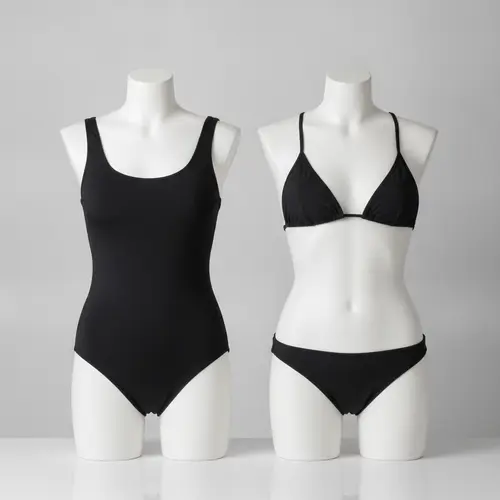
What Actually Differs: Fabric Quantity, Not Construction Skill
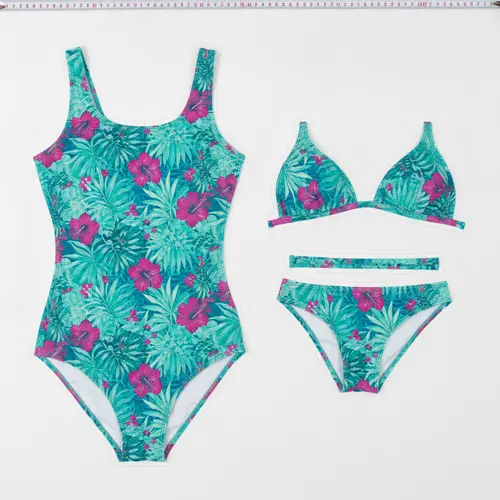
The real, consistent difference between the two categories is straightforward: one-piece uses more fabric, because it covers more of the body. That's a cost factor, not a construction-difficulty factor. Cutting a longer, continuous torso panel doesn't require a fundamentally different skill set or process from cutting a bikini top and bottom separately — it's more fabric moving through the same cutting and sewing process, not a harder process.
The Elastic-Opening Question — There's No Universal Fixed Ratio
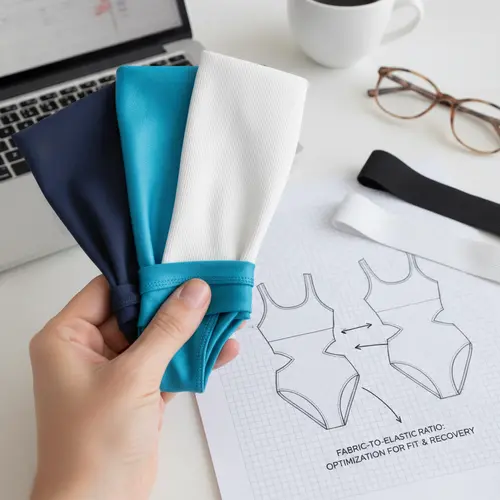
One common technical claim in this space is that necklines and leg openings should always be sewn with the elastic cut to a fixed percentage shorter than the fabric opening — a specific number presented as an industry rule. Based on real practice, there isn't a single fixed ratio that applies across the board. How much shorter the elastic is cut depends on the specific style and the stretch behavior of the specific fabric being used — a lower-stretch fabric and a high-stretch fabric don't call for the same elastic-to-opening ratio, and treating it as one fixed number ignores that fabric-to-fabric variation.
This lines up with how the technique is described in general swimwear construction references, too: the standard method is to sew the elastic into a ring, then stitch it to the fabric opening while gently stretching the elastic to match the fabric's length — a stretch-to-fit process, not a fixed-percentage formula applied uniformly regardless of fabric. Binding is also sometimes used in place of elastic at necklines specifically, though elastic is generally the more comfortable choice for leg openings, which is part of why the two openings on the same garment don't always get treated identically.
Quality Risk: Nothing Unique to One-Piece Construction
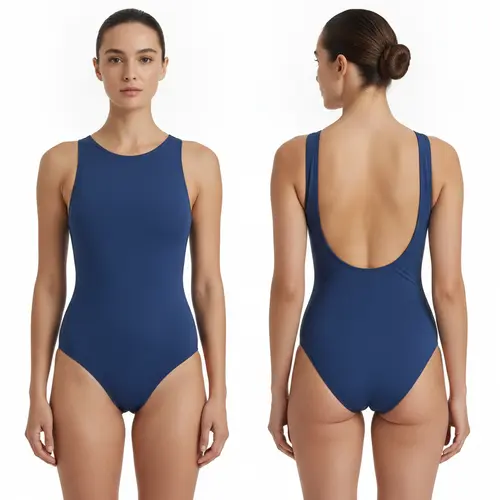
There's also a common assumption that one-piece styles are more prone to specific fit problems — gaping at the neckline, bagging at the leg openings — simply because there's more garment to fit. Based on real production experience, we haven't seen this show up as a distinct, one-piece-specific quality issue. Fit problems at an opening come down to standard construction quality — correct elastic tension for the specific fabric, consistent stitching — the same fundamentals that apply to any swimwear opening, bikini or one-piece. It's not a special risk category that needs separate handling.
What This Means for Sourcing
If a factory is pricing one-piece significantly higher than bikini styles and pointing to "construction difficulty" as the reason, it's worth asking specifically what part of the construction is actually harder — based on our experience, the honest answer is usually just fabric quantity, not a more demanding process. The real question worth asking a supplier isn't "how do you handle the extra difficulty of one-piece," it's "what fabric and elastic ratio are you using for this specific design," since that's the detail that actually determines fit — not the garment category itself.
This is one entry in the full real construction guide organized by swimwear type, alongside our breakdowns of bikini bottom types and bikini top types — read together, the three cover the real cost and construction picture across the most common swimwear silhouettes.
There's one real material where the one-piece-vs-bikini question flips for a different reason entirely: neoprene ("scuba") swimwear is built almost exclusively as bikinis, not because one-piece is harder to construct, but because laminated neoprene fabric doesn't stretch enough to support a fitted one-piece silhouette.
FAQ
Q: Is one-piece swimwear really harder to manufacture than a bikini?
A: Based on real production experience, not significantly. The main real difference is fabric quantity — a one-piece covers more of the body, which affects material cost, not the underlying construction process or skill required.
Q: What elastic-to-opening ratio should I ask for at the neckline or leg openings?
A: There isn't one universal number that applies to every fabric and style. The right ratio depends on the specific fabric's stretch behavior — a supplier who gives you one fixed percentage regardless of fabric is oversimplifying a fabric-specific decision.
Q: Are one-piece swimsuits more likely to gape or bag at the openings?
A: Not based on our production experience — this isn't a distinctive one-piece risk. Fit problems at an opening come down to standard elastic tension and stitching quality, the same fundamentals that apply to any swimwear opening.
Q: If construction difficulty isn't the reason, why does one-piece often cost more?
A: Primarily fabric quantity — covering the full torso simply uses more material than a bikini's separate top and bottom pieces, which is a straightforward cost difference rather than a complexity premium.
Q: What should I actually ask a factory when sourcing one-piece swimwear?
A: Ask about the fabric's stretch behavior and how the elastic ratio is being set for your specific design, rather than accepting a general "one-piece is harder" explanation for pricing or lead time.
Sourcing a one-piece style and want a straight answer on what actually drives cost and fit? Send us your design — we'll tell you honestly what's fabric, what's construction, and where the real trade-offs are.