
Types of Bikini Tops: What Actually Drives the Cost
Eight common bikini top styles — triangle, bandeau, halter, underwire, push-up, bralette/sports, one-shoulder, and convertible — get compared constantly on style and fit. Almost none of that comparison touches what actually determines what they cost to produce. Here's the real answer: it's not the cutting, and it's not really the style name at all.
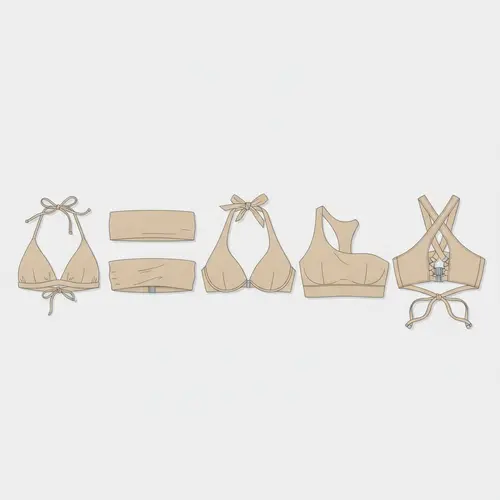
At a Glance
# | Type | Real Construction | Cost Driver |
|---|---|---|---|
1 | Triangle | Two triangular panels, support from tie tension alone | Standard |
2 | Bandeau | Horizontal band, no straps by default | Standard |
3 | Halter | Strap routes around the neck, combinable with any cup shape | Standard |
4 | Underwire | Molded cups + underwire structure | Highest — most components, most assembly steps |
5 | Push-up | Structured padding + specific cut for lift | Standard |
6 | Bralette/Sports | Wide straps + wide band, full coverage cup | Standard |
7 | One-Shoulder | Asymmetric single-strap design | Standard |
8 | Convertible/Multi-way | Detachable/reconfigurable straps | Highest — multiple hardware attachment points |
Cutting Doesn't Drive Cost Here Either
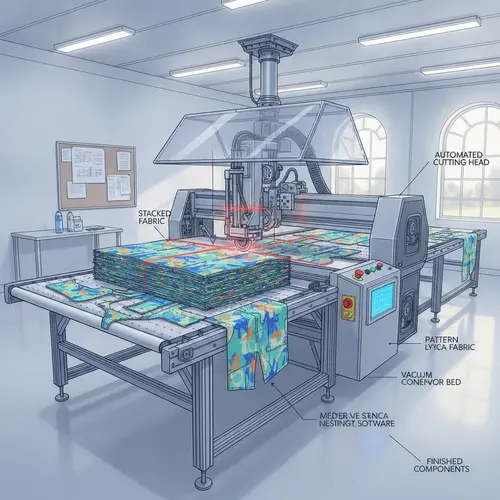
The same finding we've documented for bikini bottom types holds for tops: cutting is entirely automated, so pattern complexity across all eight styles above makes no real difference at the cutting stage. Whatever cost differences exist between these styles, they aren't coming from how hard a given shape is to cut.
What Actually Drives Cost: Fabric Use and Assembly Time
For styles built on a standard base pattern, real cost comes down to two factors — how much fabric a style uses, and how long it takes to assemble. On that basis, underwire and convertible/multi-way tops are the most expensive styles to produce, for two different real reasons:
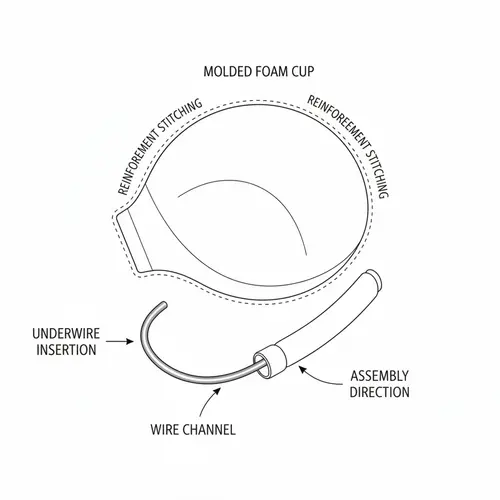
Underwire tops require the most components and the most assembly steps of any style in this group — molded cup tooling, a wire channel, wire insertion, and the reinforcement work around it. This lines up exactly with the six real construction elements that separate genuine structural support from a padded shelf bra — underwire tops are the style where the most of those elements typically come together in one garment.
Convertible/multi-way tops cost more because of multiple hardware attachment points, not fabric — rings, sliders, or similar hardware at several positions on the garment to allow the straps to be reconfigured into different wearing styles. This is a related but distinct construction logic from fully detachable, modular straps sold as a separate product — a convertible top keeps its multiple strap-routing hardware built into one garment, rather than decoupling the strap into its own standalone item, but both solve "more than one way to wear it" through added hardware rather than added fabric.
The remaining six styles in this group — triangle, bandeau, halter, push-up, bralette/sports, and one-shoulder — are all standard-cost styles built on the same base pattern approach, without the extra structural components or hardware that push underwire and convertible tops higher.
The remaining six styles in this group — triangle, bandeau, halter, push-up, bralette/sports, and one-shoulder — are all standard-cost styles built on the same base pattern approach, without the extra structural components or hardware that push underwire and convertible tops higher.
The One Quality Risk We Can Speak to Directly: Underwire
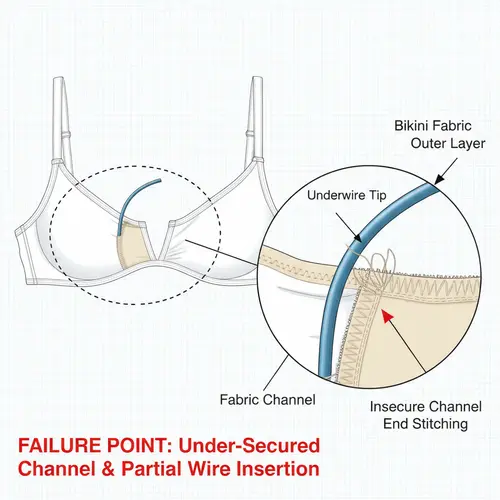
Of the eight styles, underwire tops are the ones most prone to real quality issues — and we've already written a full, dedicated breakdown of exactly why: underwire poke-through is almost never actually a wire-quality problem. The real causes are channel construction and quality-control gaps (a wire that was never fully threaded through the channel, or an under-secured channel end), not the wire itself.
We want to be direct about the rest of this list rather than invent a plausible-sounding answer: specific, verifiable quality-failure patterns for the other seven styles aren't something we have well-characterized data on in the same way we do for underwire. Fit and construction quality on a triangle, bandeau, halter, push-up, bralette, or one-shoulder top come down to standard sewing and finishing quality rather than a distinct, style-specific failure mode we can point to with the same confidence — and we'd rather say that plainly than manufacture a specific-sounding risk for each style that isn't backed by anything real.
What This Means for Sourcing
If cost is the main question, the two styles to budget more carefully for are underwire (structural components and assembly steps) and convertible/multi-way (hardware attachment points) — everything else in this group sits on comparable standard-cost footing, cutting-wise and construction-wise. If underwire is part of your line, the channel construction and QC process is worth asking about directly, since that's where the real risk actually sits.
This is one entry in the full real construction guide organized by swimwear type — see the bottoms-side version of this same cost-driver logic in our bikini bottom types breakdown.and why one-piece isn't actually harder to build than a bikini for the full-silhouette comparison.
The one style where a top's default construction genuinely does differ from these eight is the tankini top — see why built-in support, not fabric coverage, is the real difference there.
FAQ
Q: Which bikini top style is the most expensive to manufacture?
A: Underwire and convertible/multi-way tops are the priciest in this group — underwire due to the number of structural components and assembly steps involved, and convertible tops due to the multiple hardware attachment points needed to support different wearing configurations.
Q: Does a more complex top pattern cost more to cut?
A: No — cutting is fully automated, so pattern complexity doesn't meaningfully affect cost at the cutting stage. Cost differences come from fabric usage and assembly time, not how intricate the pattern shape is.
Q: What's the real difference between a convertible top and detachable modular straps?
A: A convertible top keeps multiple strap-routing hardware points built into one garment, letting it be worn several ways. Fully detachable, modular straps go a step further — the strap is a separate product entirely, sold on its own and swappable across garments, not just reconfigurable within one.
Q: Is underwire really the riskiest style for quality issues?
A: Based on what we can speak to with real confidence, yes — though the real cause is almost always channel construction and QC gaps, not the wire material itself. See our dedicated breakdown for the specific failure points to watch for.
Q: Why doesn't this article go into detail on quality risks for the other seven styles?
A: Because we don't have the same level of well-characterized, verifiable data on style-specific failure patterns for those styles that we do for underwire. We'd rather say that honestly than present a plausible-sounding but unsupported answer.
Comparing bikini top styles for your next line and want a real read on what each one actually costs to build? Send us your designs — we'll tell you honestly where the cost is coming from.