
The Real Reason Most Period-Proof Swimwear Leaks
Most explanations of period-proof swimwear focus on the fabric — "leak-proof material," "PFAS-free barrier," "absorbent core." What almost none of them mention is where leaks actually happen in a badly built garment: not through the fabric itself, but through the needle holes left by ordinary stitching. Any seam that sews straight through a waterproof layer punctures it in the process — and every one of those puncture points is a potential leak path. Here's the real construction problem, and the specific structural fix we use to get around it.
How period-proof swimwear is actually layered
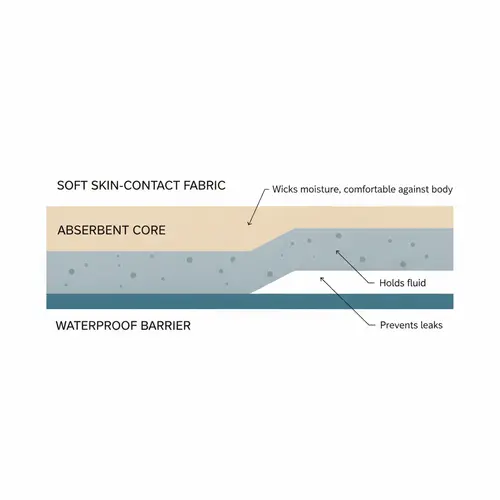
Functionally, leak-resistant swimwear is built from three layers doing three different jobs: a skin-contact layer against the body, an absorbent core in the middle, and a waterproof barrier layer. Peer-reviewed material science on commercial absorbent hygiene products confirms this same three-part logic — independent lab analysis of commercial products found leakproof barrier layers and absorbent cores are evaluated as distinct functional components, not one combined fabric. That part of the structure is fairly standard across the category. The part that actually determines whether the garment leaks is how those layers get joined together.
Where the leaks actually come from
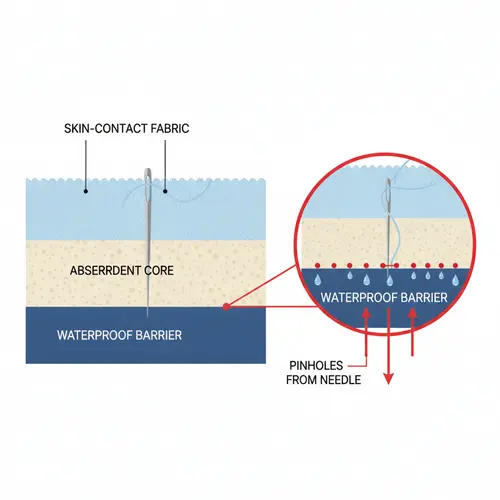
Standard garment construction sews straight through every layer in the stack — skin-contact fabric, absorbent core, waterproof barrier — in one pass. That's fine for ordinary swimwear, where every layer is meant to let some water through anyway. It's a structural problem for a garment where one of those layers specifically isn't supposed to let water through: a needle only has to pass through a waterproof barrier once to create a permanent pinhole, and a garment edge typically has dozens of stitches. Each one is a potential leak point. A "leak-proof" fabric sewn with a standard seam is only as leak-proof as its weakest needle hole.
The construction fix: bonding instead of stitching, with an offset layer structure
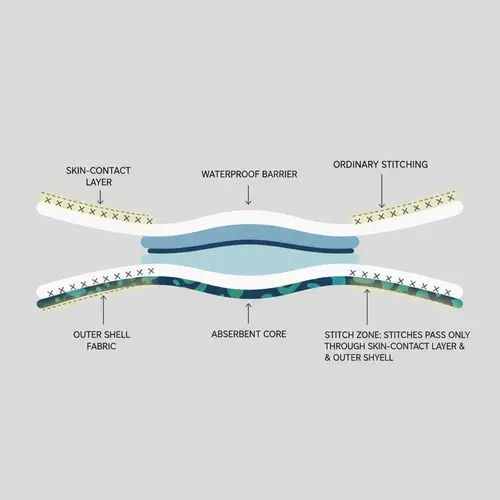
We solve this with a technique borrowed from underwear manufacturing rather than standard swimwear construction: heat/adhesive bonding (压胶) to seamlessly join the waterproof barrier, absorbent core, and skin-contact layer — no stitching through the functional stack at all.
The structural detail that actually makes this work: the waterproof barrier and absorbent core are cut to the same size and shape as each other, but that shape is a consistent margin smaller all around than the skin-contact layer. The skin-contact layer extends past the edge of the bonded core on every side. That extra margin — skin-contact fabric only, no waterproof or absorbent layers underneath it — is where the garment gets sewn to the outer shell fabric, using ordinary stitching.
Layer | How it's joined |
|---|---|
Waterproof barrier + absorbent core | Bonded together (heat/adhesive lamination), cut to identical size |
Skin-contact layer | Sized larger, extends beyond the bonded core on all sides |
Skin-contact layer → outer shell | Sewn with ordinary stitching, in the margin area only |
The result: the visible seam that holds the garment together never passes through the waterproof barrier or the absorbent core. Every needle hole lands only in fabric that was never meant to be waterproof in the first place, so it was never a leak risk to begin with. This is the specific mechanical answer to "why do leak-proof garments still leak at the seams" — it's not usually a bad fabric choice, it's a construction sequence that treats the waterproof layer the same way as any other layer in the stack.
Why this fits a no-MOQ model specifically
Three-layer bonded construction is real added cost and real added process complexity — which is exactly the kind of niche, technically demanding category that standard high-MOQ manufacturing tends to price out entirely. It's the same underlying economics we've written about for other underserved categories blocked by MOQ and shipping thresholds: a small, real market doesn't get served well by a model built around large minimum orders. A no-MOQ approach makes it possible to test a period-proof or leak-resistant line in small batches before committing to the volume a standard factory would require.
What the absorbent core is actually made of
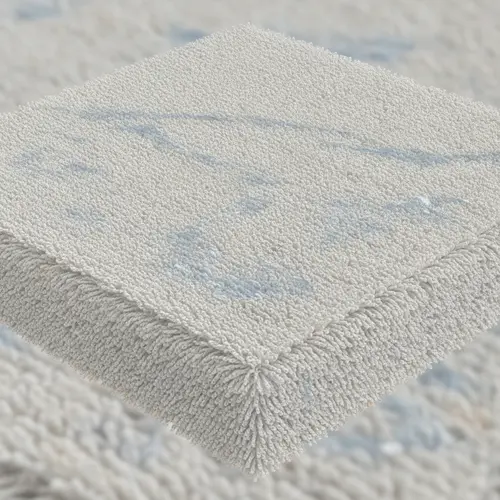
For lighter-flow use, we typically build the absorbent core from microfiber — organic cotton or polyester in a structure similar to towel/terry fabric, chosen for how quickly and evenly it wicks and holds moisture across a flat panel rather than pooling it in one spot. For heavier-flow days, we generally recommend pairing the garment with a tampon or menstrual cup for additional protection rather than relying on the absorbent layer alone — the built-in core is designed as a backup and light-to-moderate-flow solution, not a full replacement for other protection on heavy-flow days.
What this actually costs
The bonding construction and layered structure adds roughly $5-8 USD per unit compared to standard swimwear — the exact number depends heavily on which absorbent and barrier materials are chosen, plus the secondary bonding process itself, which is a separate production step from standard cut-and-sew. This isn't a small-batch surcharge specifically; it reflects the real material and process cost of building three functional layers instead of one.
Where our experience has real limits
We're describing our own real construction approach here, not making a category-wide claim — the same honest-limits standard we try to hold across every manufacturing feasibility question we cover. What we haven't covered in this piece — and what we'd want to understand for any specific order — is which regulatory framework applies to your target market. Absorbent hygiene product regulation varies meaningfully by country: for example, a comparative regulatory review shows China, Korea, and other markets classify and test these products differently, with different mandatory safety and performance requirements. If you're bringing a period-proof swimwear line to a specific market, that's a conversation worth having with us directly before committing to a spec, since the right absorbent material and barrier layer can depend on which market's requirements you're building to. Independent testing bodies like EDANA publish formal testing guidelines for absorbent hygiene products generally, which is a reasonable starting reference if your brand needs to validate absorbency claims formally.
This is also, structurally, the same category of problem we've written about elsewhere — a garment feature that sounds simple from the outside, like genuine bust support built into a swimsuit, but turns out to have a real construction decision behind it that most sourcing content skips entirely. It's the same manufacturing-feasibility question we try to answer honestly across every category we take on.
FAQ
Q: Why does "leak-proof" swimwear sometimes still leak at the seams? A: Almost always because the seam was sewn with standard stitching straight through the waterproof barrier layer, creating needle holes. Each hole is a potential leak path, no matter how good the fabric itself is.
Q: What's actually different about how you construct the layers? A: We bond (rather than stitch) the waterproof barrier and absorbent core together, cut to the same size. The skin-contact layer is cut larger and extends past that bonded core, so the only stitching happens in a margin area that never touches the waterproof or absorbent layers.
Q: What's the absorbent core made from? A: Typically microfiber — organic cotton or polyester in a towel-like structure — for light-to-moderate flow. For heavier flow days, we recommend pairing the garment with a tampon or menstrual cup rather than relying on the built-in core alone.
Q: How much more does this cost compared to standard swimwear? A: Roughly $5-8 USD more per unit, depending mainly on which absorbent and barrier materials you choose, plus the added bonding process step.
Q: Do you handle regulatory certification for period-proof swimwear? A: Certification requirements vary significantly by target market, and this is genuinely outside a one-size-fits-all answer — we'd want to know your specific market before recommending materials or making any performance claims.
Q: Can this construction be used for other absorbent or waterproof swim products, not just period swimwear? A: The same bonding-and-offset-layer logic applies anywhere a garment needs a genuinely waterproof layer joined to other fabric without puncturing it — it's a construction principle, not something specific to one product category.
Exploring a period-proof or leak-resistant swimwear line? Tell us your target flow level, market, and any certification requirements you're aware of, and we'll walk through which absorbent and barrier materials make sense for your order.