
What's Actually in a Swimwear Factory Sample Quote Explained
A real swimwear factory quote is never one number. Ours, for example, breaks into 12 separate cost lines — base sample fee, hardware mold, packaging, hang tags, labels, hygiene liners, padding, fabric minimums, and shipping quoted separately at the end. Most first-time buyers only ask "what's the per-piece price?" and get blindsided three weeks later when hardware, packaging, and fabric minimums show up as line items they never budgeted for. None of this requires a full technical pack to get an accurate quote — it just requires knowing which questions the number leaves unanswered. This article walks through what each line actually covers, using our own pricing structure as the example.
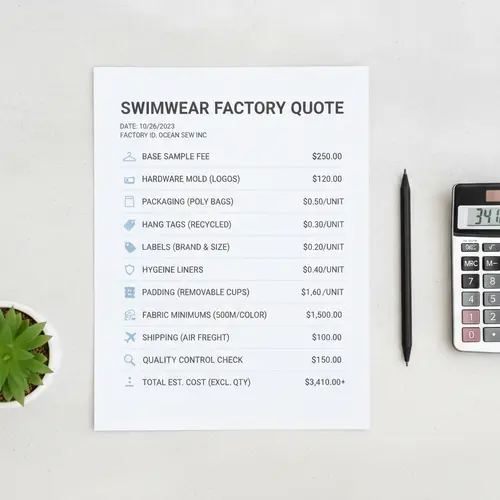
Why swimwear quotes look more complicated than a t-shirt quote
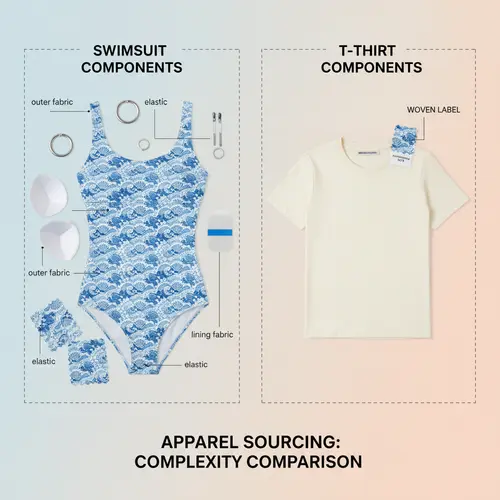
Swimwear has more brand-specific parts than most apparel categories — hardware, bust support padding, hygiene liners, often two to three fabric layers. Each part can be customized, and each customization usually carries its own mold fee and its own MOQ, separate from the garment's own MOQ. That's the real reason a swimwear quote reads longer: not padding, genuinely more decision points. Global demand keeps growing — the market is projected to reach USD 36.2 billion by 2030 according to Grand View Research — meaning more new brands read their first quote wrong every month.
The line items at a glance
Cost line | What it covers | Example pricing (our factory) |
|---|---|---|
Base sample fee | One sample piece + one free revision | $100 (bikini) / $200 (modest swimwear) |
Second sample (same round) | Extra color/size variant in the same batch | Base fee + 50% for the additional piece |
Hardware mold | One-time tooling for custom size/logo hardware | $80 one-time, no unit MOQ |
Hardware unit cost | Per-piece cost once mold exists | $0.3–$2 |
Decoration process | Heat transfer, embroidery, screen print | $50 (digital print/DTG often free) |
Packaging bag | Poly bag vs. cotton/linen pouch | Poly: $80 mold + 1,000–5,000 pc MOQ; Cotton/linen: $30, no MOQ |
Hang tag | Custom brand tag | $50 mold, 1,000–5,000 pc MOQ |
Woven/leather label | Sewn or heat-transfer brand label | $50–$60, 500–1,000 pc MOQ |
Hygiene liner | Disposable protective liner | $50 mold, 5,000 pc MOQ, \~$0.05/unit |
Padding | Custom bust support foam | $400 mold per size, no production MOQ |
Fabric (sample) | 3–5m for sampling | $100 |
Fabric (bulk) | Custom color/composition development | 1,000 kg MOQ (≈8,000 bikinis) |
Shipping | Sample and bulk logistics | Quoted at real-time rates, separately |
Cost is only half of the sample question; for the time side, see how long a swimwear sample really takes.
These are our own numbers as of publication — factories differ, so always ask for a current, itemized quote before deciding. (Our live pricing reference updates as costs change; see the full breakdown linked at the end.)
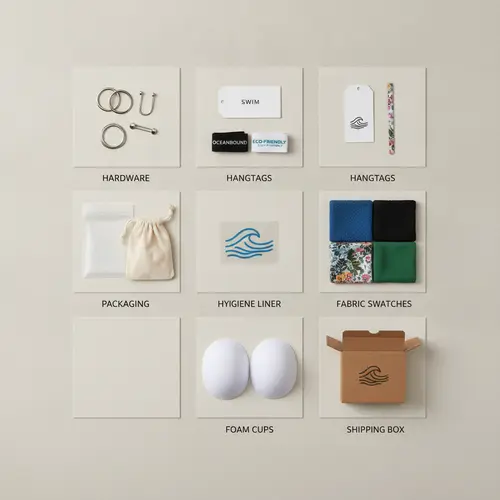
The sample fee is the smallest number on the page — and the one everyone fixates on
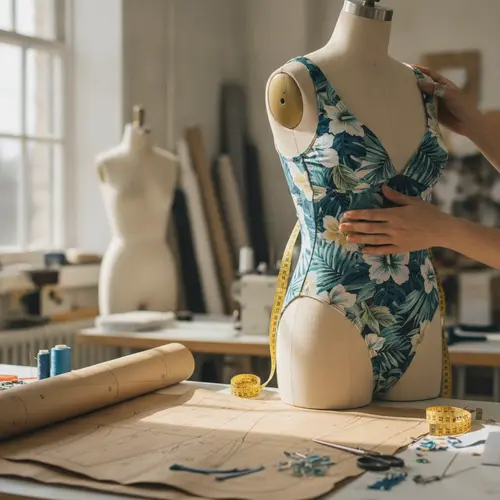
A base sample fee of $100 for a bikini or $200 for a modest-wear set (headscarf, long sleeve top, pants, skirt) typically buys one sample piece and one free revision — a size adjustment, color change, or print pattern tweak — and does not include shipping. A second color or size in the same round usually costs the base fee again plus roughly 50%, since cutting and constructing a second variant still takes real labor even with the pattern already made.
"Free" covers redoing the sample itself, not necessarily reshipping it — see what actually counts as a free revision versus what adds cost for the distinction that trips up most first-time buyers.
The number that changes the economics later is the rebate: many factories, ours included, credit part of the sample fee back once your order crosses a real production threshold — 50% of ours once cumulative orders reach 300 units. Worth asking about upfront, because it reframes the sample fee as a deposit against a future order, not money spent and gone.
Hardware and trims: the "free library, paid customization" model
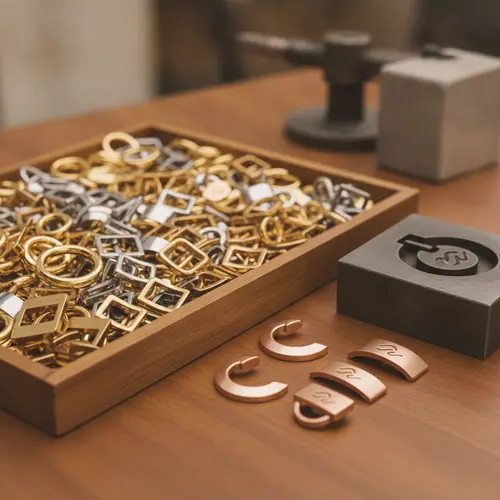
Most factories, including ours, offer a large library of stock hardware (rings, sliders, buckles) at no extra design cost — ours runs 10,000+ existing options. The cost only shows up when you want something custom: a specific size, a logo engraving, a unique finish. That's typically a one-time mold fee (around $80) plus a small per-unit cost afterward ($0.3–$2), usually with no separate MOQ beyond the garment order itself. Startup brands often assume custom hardware needs a large minimum commitment the way custom packaging does — it usually doesn't, because the mold cost is what the factory is recovering, not the unit volume.
Packaging and branding are where the real MOQ traps hide
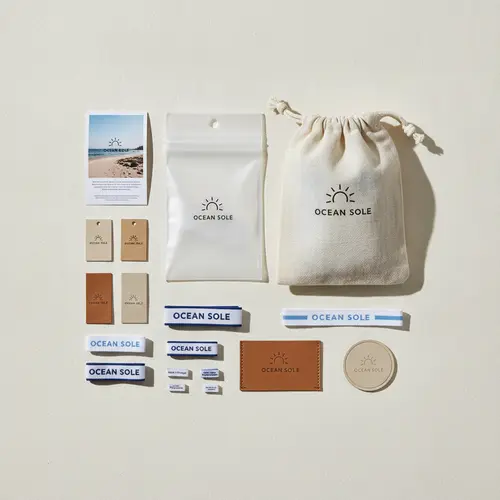
This is where the real budget surprises tend to live. Packaging, hang tags, and woven labels each carry their own MOQs, independent of your garment MOQ:
Poly bags: roughly $80 mold fee plus a 1,000–5,000 piece MOQ, at $0.1–$0.5 per unit — but a cotton or linen pouch can run as low as $30 with no MOQ at all, which is usually the better starting option for a first small-batch order
Hang tags: around $50 mold fee, 1,000–5,000 pieces MOQ (special finishes like 3D embossing or gold foil push per-tag cost toward $1)
Woven or leather labels: $50–$60, with a 500–1,000 piece MOQ
A quote broken into real line items, rather than one bundled number, is itself a signal worth checking for — see how to vet a swimwear factory before you sample for the other questions worth asking alongside the quote itself.
If your first order is 50–100 pieces, custom poly bags or embossed hang tags at 1,000+ MOQ can cost more than the garments themselves. This is exactly the hidden-cost mismatch we've written about for low-MOQ orders generally — the sticker price is rarely the whole story.
Fabric minimums are the wall that actually matters
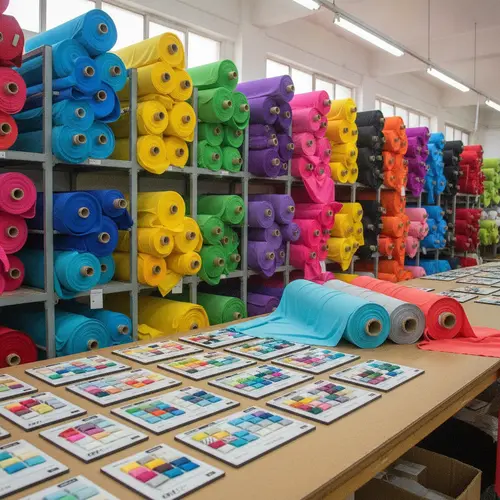
Sampling fabric is cheap and flexible — a $100 fee typically covers 3–5 meters, enough for one or two samples. Bulk fabric is where the real constraint sits: most mills require roughly 1,000 kg per color/composition combination, which works out to roughly 8,000 bikinis, 6,000 one-piece suits, or 3,000 modest swimwear sets, depending on cut. For a new brand, that's the real ceiling on how "custom" your fabric can be in year one. Startup-friendly factories usually offer a workaround — splitting that 1,000 kg across 3–5 colors within the same base composition, so you get a small multi-color capsule instead of one giant single-color run. If a factory doesn't offer that, ask directly; it's a normal accommodation.
Shipping is quoted last, and that's normal — not a red flag
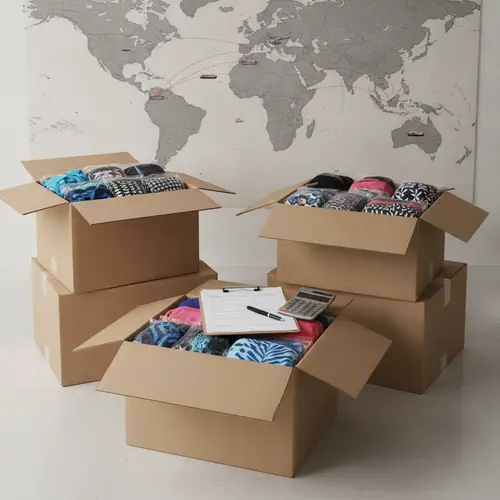
Shipping for both samples and bulk orders is typically quoted separately, at real-time rates, right before dispatch rather than baked into the initial quote. That's standard practice, not evasiveness — freight rates fluctuate week to week, and locking a number in from weeks earlier would just mean padding it to cover the risk. What buyers should ask instead is which Incoterm the quote assumes — FOB, EXW, and DDP shift a meaningfully different set of costs onto you versus the factory, and getting that wrong is a common source of the "surprise" landed-cost gap founders describe after their first order. The U.S. Department of Commerce's trade.gov has a plain-language breakdown of what each term covers.
Reading a quote like a buyer, not a hopeful founder

A few habits separate buyers who don't get surprised from buyers who do:
Ask which line items carry their own MOQ, separate from the garment MOQ — packaging and labels are the usual culprits.
Ask about rebate or credit thresholds on sample and mold fees — many factories offer them but won't volunteer the number unless asked.
Ask exactly what "sample fee" includes — how many revisions, and whether shipping is bundled or separate.
Total your real landed cost, not just the unit price — production, molds, packaging, and shipping together. The U.S. Small Business Administration's startup cost planning framework is a reasonable template for laying this out before you commit capital.
Ask what happens below your target quantity — does price simply rise, or does the factory decline the order? Both are legitimate answers, but you should know which one you're getting.
This doesn't require a sourcing background. It requires treating the first quote as a document to read line by line, not a single number to compare against a competitor's single number.
FAQ
Q: Why is my sample so much more expensive than the advertised per-unit price? A: The advertised per-unit price assumes bulk production. A sample is one-off, hand-cut work with the same labor and pattern-making cost regardless of quantity — that's why sample fees ($100–$200 in our structure) sit well above a single unit's cost inside a 1,000-piece run.
Q: Do I have to accept the factory's standard hardware, packaging, and labels? A: No — almost everything can be customized, but that usually triggers its own mold fee and sometimes its own MOQ. Stock options skip that cost, often the right call for a first small order.
Q: Is a sample fee ever fully refunded? A: Not typically as cash back — more often as a rebate credited against your bulk order once you hit a real volume threshold (300 units, in our structure). Treat it as a deposit against a future order.
Q: What's the most commonly overlooked line item in a swimwear quote? A: Packaging and hang tag MOQs. Buyers budget carefully for fabric and garment cost, then discover a custom poly bag or embossed hang tag alone requires 1,000+ pieces — often more than their entire first garment order.
Q: Are samples and shipping always quoted separately? A: Yes, typically. Shipping is quoted at the real-time rate just before dispatch, because freight pricing changes too often to lock into a quote from weeks earlier.
Q: How much fabric do I need to commit to for a custom color? A: Sampling needs only a few meters. Bulk custom fabric typically requires around 1,000 kg per color — ask whether the factory allows splitting that minimum across several colors in the same base fabric.
Q: Does a lower quantity always mean a proportionally higher price? A: Directionally yes — fixed costs like mold fees and setup time spread across fewer pieces. It's the core mechanic behind why low-MOQ orders carry real hidden costs, not just a higher sticker price.
For the current version of our pricing structure, see our budgeting guide, and read more about the no-MOQ manufacturing model it's built on.
One real cost that doesn't scale down with order size: compliance testing. See what REACH testing for swimwear actually costs, broken into the same kind of real line items as this quote
Ready for a real quote? Send your reference style, fabric preference, and target quantity, and we'll walk you through exactly which line items apply to your project — before you commit to anything.