
Low MOQ Isn't a Hack — Here's What It Actually Costs You
Low MOQ has become the default headline on nearly every startup-facing manufacturer's page right now — "25 pieces," "50 pieces," "no minimum." What almost none of those pages explain is that low MOQ isn't really the thing that makes a supply chain work for a startup brand. It's one visible piece of a broader idea — a flexible supply chain — and by itself, a low number on a quote doesn't tell you what you'll actually pay or how long you'll actually wait. We've written before about our own no-MOQ pricing structure and the shipping and MOQ barriers that block plus-size and other underserved categories; this piece goes further into the specific hidden costs those articles didn't fully break out, and why we'd rather show a brand the full picture upfront than let a low MOQ number do the selling for us.
Low MOQ solves one problem and creates another
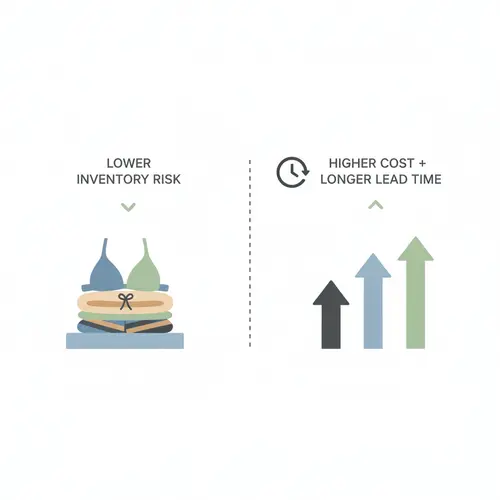
Ordering fewer pieces genuinely reduces inventory risk — that part of the pitch is true. What it doesn't do is reduce cost or lead time; in most cases it increases both. A lower quantity means less volume to spread fixed costs across, and several of those fixed costs are largely invisible until you're already deep into a quote.
Where the real hidden costs actually come from
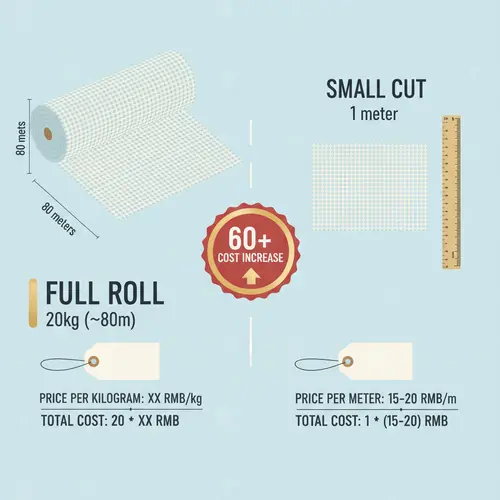
Fabric procurement. A standard fabric roll runs about 20kg, yielding roughly 80 meters. We buy by the kilogram at the full-roll rate. Order less than a full 20kg roll, and pricing shifts to a fixed rate of 15-20 RMB per meter — pushing procurement cost up more than 60% compared to buying the full roll.
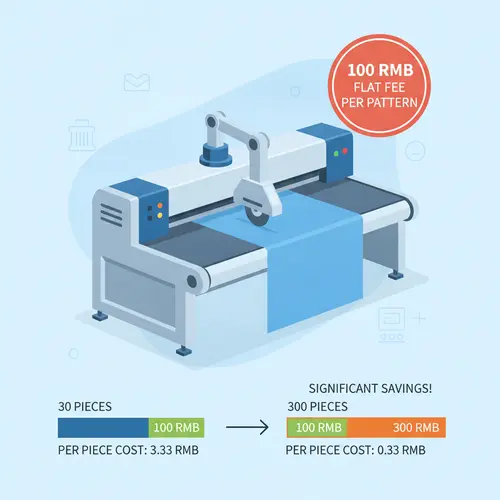
Cutting. Our cutting is fully automated, and the minimum charge is a flat 100 RMB per pattern. That charge is identical whether the order is 30 pieces or 300 pieces — which means at 30 pieces, that fixed fee is spread across a tenth of the units, driving per-piece cost up sharply compared to a larger run of the same pattern.
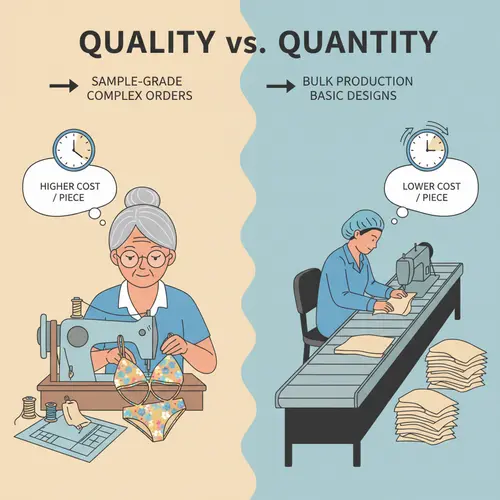
Labor and skill level. A new, unfamiliar style at small volume takes longer to sew simply because the line hasn't built muscle memory on it yet. In some cases, a small or complex order gets routed to more senior, sample-grade workers rather than standard production-line staff — appropriate for getting it right, but it's real added labor cost that a bulk run of the same style wouldn't carry.
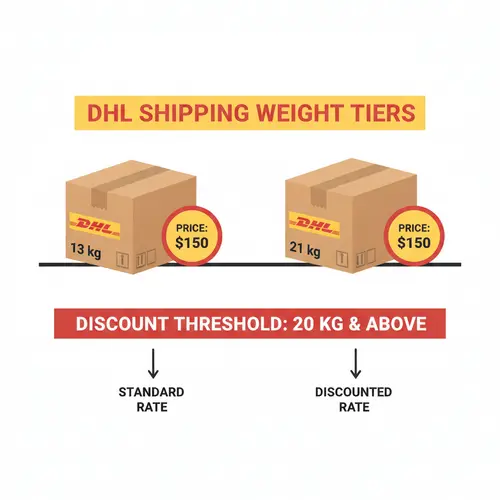
Shipping weight brackets. International couriers price in weight tiers, and the threshold matters more than most brands realize. With DHL specifically, a 13kg shipment and a 21kg shipment can land at the same total charge, because the discount tier only kicks in at 20kg and above. A smaller, lighter shipment doesn't get a proportional discount — it just pays full rate for weight it isn't using.
The part almost nobody talks about: lead time
This is the honest complication that most "low MOQ" marketing skips entirely: a genuinely small order can take longer, not shorter, to produce than a bulk order of 1,000+ pieces. We can't pull a running bulk-production batch off the line to slot in a small order — the small order waits for real production capacity to open up, and depending on what's already queued, that wait can outlast the time it would take to run a much larger batch start to finish.
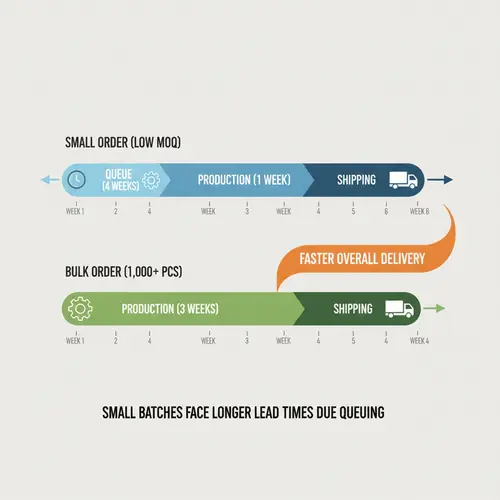
Because of this, our real recommendation to brands is to build an ongoing relationship with us rather than treating each order as a one-off. If sales are going well and a restock is likely, we'd rather know that early — even a small restock — so we can plan for it. Unless an order is genuinely bulk, we ask brands to plan 25-30 days ahead of when they'll actually need inventory in hand. Low MOQ makes it possible to order that way; it doesn't make the wait disappear. This is a real, honest complication worth reading alongside our breakdown of realistic order-to-delivery timelines — that article covers our standard, uncontested timeline; this is the caveat that applies specifically when a small order has to compete with bulk production already in the queue.
What we actually give clients before they commit
Rather than quoting a MOQ number and letting a brand assume that's the whole picture, we calculate the full real investment upfront — total cost and total time, not just a per-unit price — so a brand can weigh a low-MOQ test order against what it would actually take to plan ahead for a larger, better-priced batch instead.
If you want to see what that full real investment actually looks like broken into line items — sample fee, hardware mold, packaging MOQ, fabric minimum, shipping — we've laid out a real quote start to finish in what's actually in a swimwear factory sample quote.
Tariffs are a real cost too, though smaller than most brands assume — see what 2026 tariff pressure has actually added to our own per-unit cost, and why it hasn't changed our MOQ policy the way it's changed a lot of the industry's.
To weigh those costs against stock exposure, compare the supplier cases in how many pieces to order for a first swimwear collection, rather than treating a quoted minimum as your sales forecast.
The real question worth asking a manufacturer
What actually drives success for a fashion brand isn't a low order minimum by itself — it's genuine supply chain responsiveness: how fast a concept becomes a finished product, how quickly a factory can scale a proven style up, and how transparently a factory communicates real cost and timeline before you commit. Academic research on agile fashion supply chains identifies exactly these traits — short time-to-market, the ability to scale production up or down quickly, and rapid incorporation of real market feedback — as the actual drivers of commercial success in fashion, not order quantity in isolation. It's the same principle behind why Shein's manufacturing-to-fulfillment cycle compressed from three weeks to five days became a genuine competitive advantage — the flexibility of the whole system, not any single number in it.
Hidden costs at a glance
Factor | What Changes at Low Quantity |
|---|---|
Fabric | Under 20kg roll: fixed 15-20 RMB/m, 60%+ cost increase vs. full-roll rate |
Cutting | Flat 100 RMB minimum per pattern, same at 30 or 300 pieces |
Labor | Unfamiliar/complex styles may need senior staff, slower per-unit output |
Shipping | DHL charges the same for 13kg as 21kg — no partial-weight discount |
Lead time | Can exceed a 1,000+ piece bulk order's timeline, depending on current production queue |
FAQ
Q: If low MOQ increases cost and can increase lead time, why offer it at all? A: Because it removes the inventory risk that keeps early-stage brands from testing a design at all. The trade-off is real, and we'd rather a brand understand it upfront than discover it after committing.
Q: Why does buying less than a full fabric roll cost so much more per meter? A: A standard roll is about 20kg (roughly 80 meters), and we price by the kilogram at that scale. Below a full roll, pricing shifts to a fixed per-meter rate that runs over 60% higher than the full-roll rate.
Q: Can I avoid the 100 RMB cutting minimum by combining multiple small orders? A: The fee is per pattern, so combining multiple pieces of the same pattern into one cutting run is exactly how that fixed cost gets spread more efficiently — which is part of why planning ahead with us helps.
Q: Why would a small order take longer than a 1,000-piece order? A: Because we can't pause a bulk production run already in progress to slot in a small order. The small order has to wait for real capacity to open, and depending on what's currently queued, that wait can exceed the time a larger batch would take to run start to finish.
Q: How far ahead should I plan a restock if sales are going well? A: Roughly 25-30 days, unless the order is genuinely bulk. We'd rather have that conversation early and plan for it than have a brand assume low-MOQ production means instant turnaround.
Q: Is there a quantity where these hidden costs mostly disappear? A: Generally yes — once an order reaches a full fabric roll's worth of fabric and a cutting run large enough to dilute the flat minimum fee, most of these per-unit penalties shrink substantially. That threshold varies by style, which is why we calculate the real total cost and time for each specific order rather than quoting a single flat answer.