
How to Vet a Swimwear Factory Before You Sample: A Real Checklist
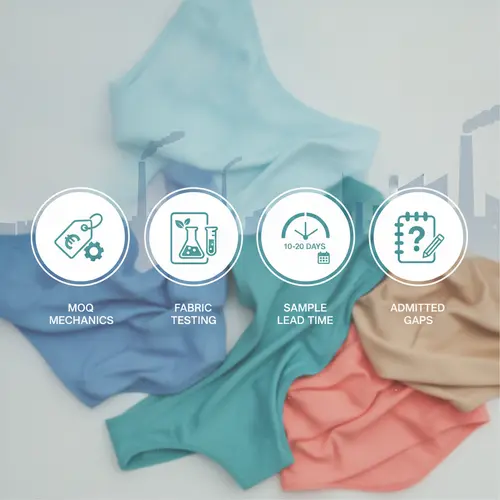
The fastest way to vet a swimwear factory is to ask it questions that only an honest answer can survive: how it prices below its MOQ, whether it has actually lab-tested the claims on its own fabric, how long a sample really takes, and what it admits it doesn't know. Vague, upbeat answers to all four are the real warning sign. Here is what a straight answer to each one actually looks like, and why.
The Short Version
Question to ask | What an honest answer sounds like | What a vague answer sounds like |
|---|---|---|
What happens if my order is under your MOQ? | A specific number and a real reason for the price jump above it | "No minimum, no problem!" with no explanation |
Have you lab-tested this fabric claim? | "No" or a specific certificate, not a marketing adjective | "100% guaranteed" with no report |
How long will my sample really take? | A range tied to your specific materials | One fixed number, quoted before they've seen your design |
What don't you know yet? | A specific, named gap | Nothing — everything is "no problem" |
Question 1: What Happens Below Your MOQ, and Why?
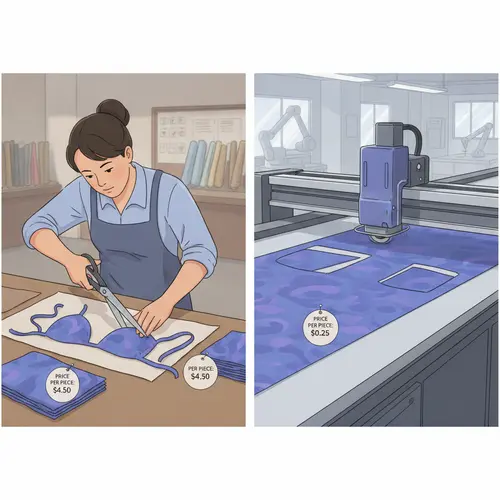
Every factory has a minimum order quantity, and the honest ones can explain why the price changes on either side of it, not just quote you two numbers. In our own production, the reason a small order costs more per piece is usually mechanical: below a certain quantity, cutting has to be done by hand instead of on an automated line, and fabric below a full roll gets cut loose by the meter instead of at the bulk rate. How many suits one fabric roll actually makes and why there's no fixed MOQ both walk through this from the production side, not the sales side.
A factory that can explain the mechanism is telling you something real about its floor. A factory that only says "we do small orders, no problem" is telling you it wants the order, which isn't the same thing.
Question 2: Have You Actually Tested the Claims on Your Fabric?
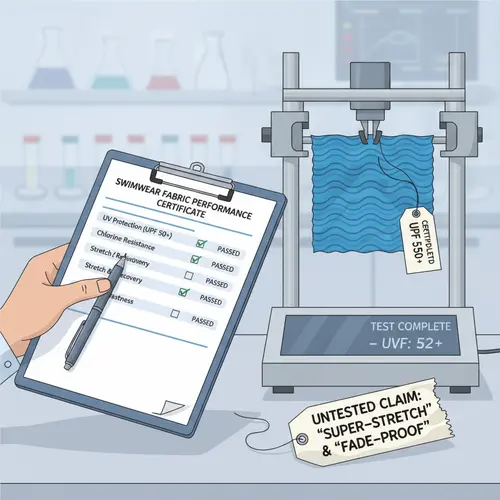
Ask specifically, not generally. "Is this fabric good quality?" gets you a yes every time. "Do you have a lab report for [the specific claim]?" gets you a real answer. We've been on both sides of this question: we don't have an independent UV transmission test for our tan-through mesh, and we say so plainly rather than let the physical mechanism stand in for a certified number — see the honest breakdown of what's real and what isn't tested. The same standard applies to elastane content, where a declared percentage on a spec sheet isn't the same as an independently verified one, and to compliance certificates generally, where lab testing adds real time and sample cost, not just a signature.
A supplier who says "no, we haven't tested that" about one specific claim is more trustworthy on everything else than one who says yes to every question you ask.
Question 3: How Long Will My Sample Actually Take?
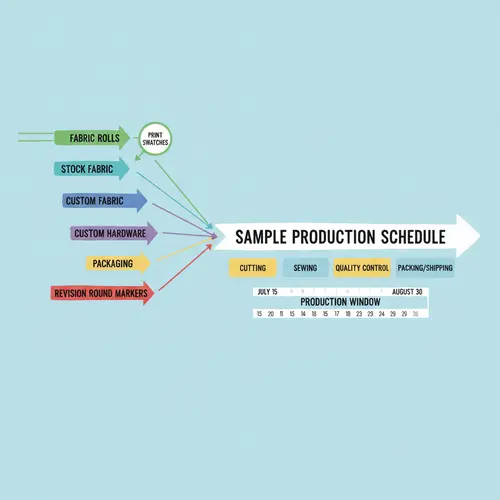
A single fixed number, quoted before a factory has seen your materials, is a guess dressed up as a promise. Our own sample times have run from 2 days, for a basic style in stock fabric, to 30 days, for a project with custom hardware, packaging, and several client revision rounds — the two real cases are broken down here. What actually moves the number is whether your fabric is stock or custom, your print method, and how many rounds of changes you ask for.
Ask what specifically could make your sample faster or slower. A factory that answers with variables is describing its real process. A factory that answers with one number for every inquiry hasn't looked at your project yet.
Question 4: What Don't You Know Yet?
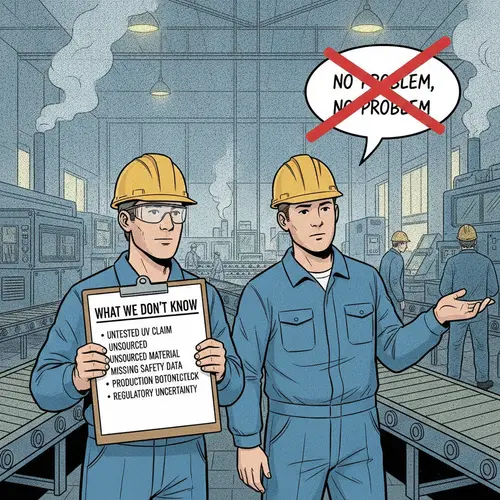
This is the question that's hardest to fake. A factory with nothing it doesn't know is either extremely new to your specific request or not being straight with you. Somewhere in a real conversation, an honest supplier will name a gap: a test it hasn't run, a material it hasn't sourced before, a claim it can't verify, or a timeline that depends on something outside its control. We try to name ours as we go — in what we still don't know about a fabric certificate until we test it ourselves, in where our own competitive-swimwear experience actually stops, and in what a sample approval does and doesn't prove about bulk consistency.
Two Follow-Up Checks Worth Doing
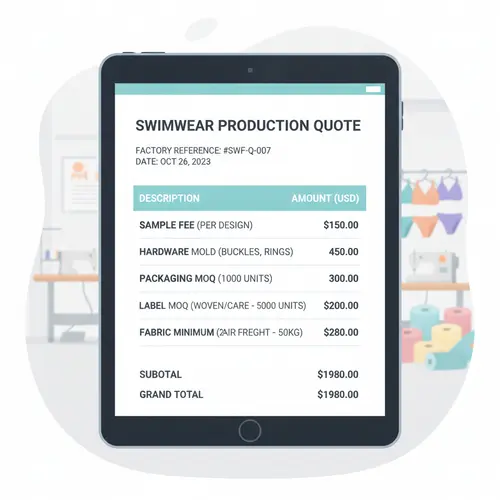
Ask for the full quote, not the headline price. A real swimwear quote runs into a dozen line items — sample fee, hardware mold, packaging MOQ, label MOQ, fabric minimum, shipping — each quoted separately. If a supplier gives you one number and nothing else, ask what it doesn't include.
Ask what happens to unused branding minimums. Hang tags, care labels, and packaging each carry their own minimums, separate from the garment MOQ, and some of them, like heat-transfer care labels, don't actually have one — a supplier who assumes you need the sewn version without asking your quantity first hasn't optimized the quote for your order size, just for the mold cost they're used to running.
This Isn't Swimwear-Specific — It's Sourcing 101, Applied Honestly
General supplier due diligence guides make the same basic point in different words: Global Sources' own sourcing knowledge base separates verifying that a company is legitimate from verifying that it can actually make your product, and treats both as necessary, not optional. A broader checklist for vetting manufacturers puts it plainly: if a supplier resists basic verification, treat that resistance itself as your answer. Swimwear doesn't change that logic. It just changes which specific claims are worth pressure-testing — MOQ mechanics, fabric function claims, and sample timing, rather than generic quality assurances.
Putting It Together
None of these four questions requires special sourcing knowledge. They just require asking for the specific thing, not the reassurance. A factory that can walk you through its own MOQ mechanics, name what it hasn't tested, give you a time range instead of a fixed promise, and admit a real gap is showing you how it actually operates. One that answers every question with an enthusiastic yes is showing you how it wants to be perceived.
For the fuller picture of what we do and don't offer, see our manufacturing feasibility guide and the budgeting guide for a real cost baseline to compare quotes against.
FAQ
Q: What's the single most useful question to ask a swimwear factory?
A: "What haven't you tested or verified about this specific claim?" It's the hardest question to fake a good answer to, and the most revealing one.
Q: Should I be suspicious of a factory that says "no problem" to everything?
A: It's worth a follow-up question, not an automatic red flag. Ask for the specific mechanism behind the "no problem" — why there's no MOQ, why the timeline is what it is. A real process has real detail behind it.
Q: How do I know if a quoted sample lead time is realistic?
A: Ask what it depends on. If the factory can name the variables — fabric, print method, custom parts, revision rounds — the number is grounded. If it's one flat number given before they've seen your design, treat it as a placeholder.
Q: Is it reasonable to ask a factory what it hasn't tested?
A: Yes, and a factory that gives you a specific, honest gap is more trustworthy than one that claims full certainty on every point.
Q: What should a full quote include beyond the per-piece price?
A: Sample fee, hardware and mold costs, packaging and label minimums and pricing, fabric minimums, and shipping, quoted as separate line items rather than folded into one number.
Planning Your First Order?
Send us your design or reference images, and we'll walk through our own MOQ logic, sample timeline, and what we have and haven't tested — line by line. Start with our no-MOQ guide if you're still comparing suppliers.