
The Real 2026 Sourcing Trend: Higher Minimums, Not Us
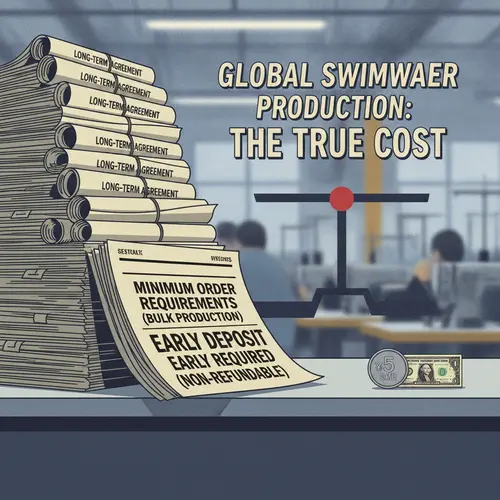
The dominant 2026 sourcing story in fashion trade press isn't really about tariff rates — it's about what factories are doing in response to them. Factories overbooked, requiring longer contracts, larger minimum orders, and early deposits, is the pattern multiple 2026 supply chain reports describe. It's one entry in the broader set of 2026 industry shifts worth tracking, and we looked at our own numbers before writing this, because a trend piece isn't worth publishing if it's not checked against what's actually happening on our own floor. Here's what we found: tariffs added a real but modest cost — about ¥5 RMB, under $1 USD, per garment. That's not what's straining our no-MOQ model. Something else entirely is, and it's worth being honest about it.
What the Broader Industry Is Actually Doing
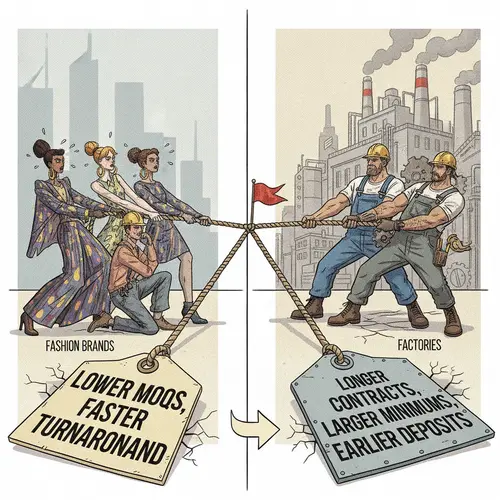
According to McKinsey's State of Fashion 2026 survey, sourcing costs are the single factor most fashion executives expect to pressure their economic models this year — more than any other. The response many factories are choosing isn't absorbing that pressure quietly; it's passing the risk downstream: longer contracts, larger minimum orders, and earlier deposits are becoming standard asks, even as brands simultaneously push suppliers for the opposite — lower MOQs, faster turnaround, more flexibility. Those two pressures are pulling most of the industry in opposite directions at once, and higher minimums are winning in a lot of factories right now.
What Tariffs Actually Cost Us
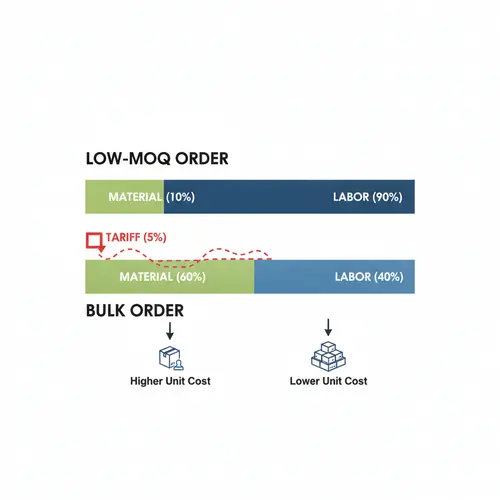
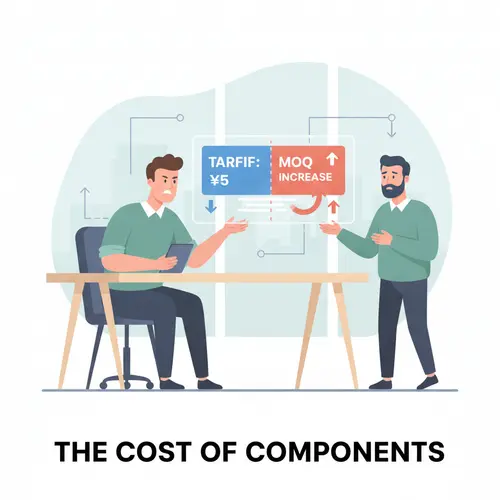
Here's our real number, not an estimate: tariff-driven cost increases worked out to roughly ¥5 RMB — under $1 USD — per garment. That's real, and we're not dismissing it. But it's genuinely too small a number to justify raising minimums or asking clients for bigger deposits, which is the standard industry response right now.
The reason it stayed that small has less to do with luck and more to do with our cost structure specifically. Under a low-MOQ model, fabric and trim cost is a small fraction of total cost — construction (labor) is what actually dominates the price of a small-batch garment. Tariffs mostly hit material costs directly. When material cost is already a minor line item relative to labor, a tariff-driven material price increase just doesn't move the total number very much. That's structurally different from a factory running large bulk orders, where material cost is a much bigger share of the total and a tariff increase on that material has real leverage on the final price.
Why No-MOQ Exists in the First Place — Reframed
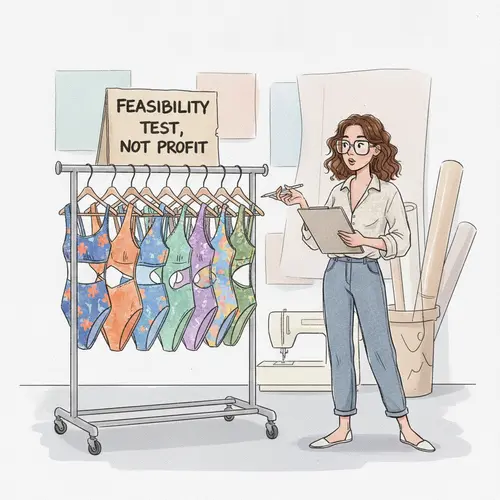
It's worth stating plainly why we run this model at all, because it explains why raising minimums in response to tariff pressure was never really on the table for us: clients coming to us for low or no-MOQ orders aren't trying to make money on that first order. Selling price on a test batch is often close to purchasing price — the actual goal is testing feasibility cheaply, not turning a profit on 20 units. Our fast response and low MOQ exist specifically to solve that problem. Raising the minimum to offset a sub-$1 tariff cost would have defeated the entire point of the model for the clients who actually need it.
The Real Strain — And It's Not Tariffs
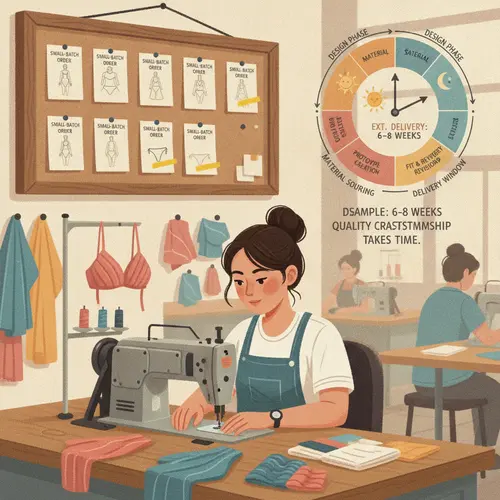
We want to be honest about where the actual pressure is, because it isn't where the industry narrative points. Running everything at low-MOQ — down to 5-10 pieces per size, sometimes as few as 3 — means every single order, not just formal samples, has to go through our skilled sample-maker workers rather than standard production-line staff. That's a real capacity constraint: sample-maker capacity doesn't scale the same way standard-line capacity does, and when 100% of orders route through that smaller pool of workers, real sample and small-batch delivery timelines can slip.
Our response has been two things, not one:
Proactive timeline communication — telling clients upfront, before they commit, what the realistic timeline actually looks like given current sample-maker capacity, rather than quoting an optimistic date and missing it.
Staffing expansion — actively growing our sample-maker team specifically to handle the volume of small-batch orders this model generates, rather than treating it as a fixed constraint we just manage around forever.
This connects directly to the real hidden costs behind low-MOQ orders we've written about before — fabric roll minimums, flat cutting fees, shipping weight brackets. Staffing capacity for sample-grade production is another real cost of this model, just one that shows up as a timeline constraint rather than a line-item price.
What This Means If You're Sourcing Right Now
If a factory is telling you tariffs are why your minimum order just went up, it's worth asking a direct follow-up: how much of that increase is actually the tariff, and how much is the factory using tariff pressure as cover to raise minimums for other reasons — capacity, margin, or just following what everyone else in the industry is doing right now. Our own honest answer, when we ran the numbers, was that tariffs alone didn't justify it. What we track from 2026 tariff and direct-sourcing shifts more broadly is a separate, real set of considerations — but it's not the same question as whether your MOQ needs to go up.
The no-MOQ model itself isn't free to run — it has real internal costs, just not the ones tariff headlines point to. Being honest about which pressure is real and which is being used as a convenient explanation is worth doing before accepting a higher minimum from any supplier in 2026.
FAQ
Q: Have tariffs actually increased your production costs?
A: Yes, genuinely — roughly ¥5 RMB, under $1 USD, per garment. We're not claiming zero impact. We're saying it's too small a number to justify raising minimums, which is the response a lot of the industry is choosing right now.
Q: Why didn't a real cost increase push you to raise your MOQ like other factories?
A: Partly because the increase was small relative to total cost, and partly because raising the minimum would undermine the actual reason clients use a no-MOQ model in the first place — testing feasibility cheaply, not maximizing margin on a first order.
Q: If not tariffs, what's the real pressure on your no-MOQ model right now?
A: Staffing capacity. Running orders as small as 3-10 pieces per size means every order routes through skilled sample-maker workers rather than standard production staff, and that's a real bottleneck we manage through upfront timeline communication and active staffing expansion.
Q: Why does fabric cost matter less to you than it might to other factories?
A: Under a low-MOQ model, labor (construction) cost dominates the total price far more than material cost does — the opposite of a large bulk order, where material cost is a bigger share of the total. That structural difference is a big part of why a material-focused tariff increase doesn't move our numbers much.
Q: Should I be skeptical if a supplier says tariffs are why my MOQ went up?
A: It's worth asking for specifics rather than accepting it at face value. Tariff impact is a real, checkable number — asking a supplier to break down exactly how much of a minimum-order increase is tariff-driven versus something else is a reasonable question, not an unreasonable one.
Wondering whether a real cost pressure or something else is behind a minimum-order increase you've been quoted? Tell us what you've been told — we can walk through what's actually driving it, honestly, even if the answer isn't flattering to whoever quoted you.