
Section 301 Replaces Section 122 Tariffs — Now What
Tariff policy on Chinese-origin goods has shifted repeatedly over the past two years, and it will keep shifting — that's now a confirmed pattern, not a prediction. Section 122's 10% global surcharge expired on schedule at 12:01 a.m. EDT on July 24, 2026, and USTR's Section 301 replacement took effect the same minute, with no gap: a two-tier 10%/12.5% duty on roughly 60 economies — broader than the 46-country proposal that had been on the table days earlier. The meaningful difference from Section 122: Section 301 carries no statutory sunset, so this layer isn't set to expire on a fixed date the way its predecessor was. For anyone sourcing from Asia, that makes it less a one-time shock to plan around and more a durable baseline to build sourcing structure against.
That's exactly the point. For any brand sourcing swimwear from Asia, the specific rate matters less than the structure of who you're buying from — because that structure is what determines how much any given tariff shift actually costs you, this time and the next time.
What's Actually Changing, and When
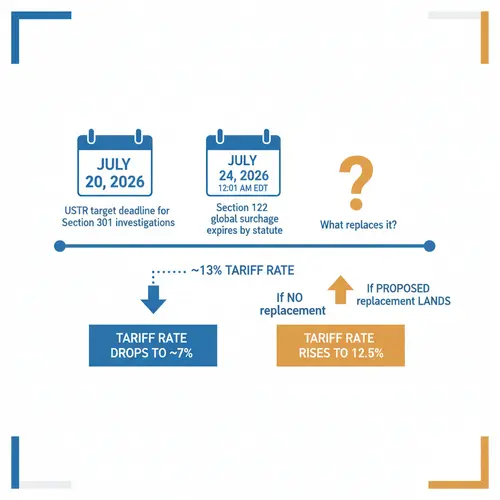
July 20, 2026: USTR's target deadline to complete Section 301 investigations covering 16 economies (structural excess manufacturing capacity) and a separate forced-labor enforcement track covering 60+ economies.
July 24, 2026, 12:01 a.m. EDT: Section 122's 10% global surcharge expires by statute — 150 days after taking effect on February 24, 2026, according to trade law analysis from Skadden, Arps, Slate, Meagher & Flom. The President cannot extend it unilaterally; Congress has shown no urgency to act.
The open question: if the Section 301 replacement isn't finalized in time, the average effective U.S. tariff rate could drop from roughly 13% to roughly 7% overnight — but if the proposed 12.5% replacement lands as described, rates could move in the opposite direction for many countries, including alternatives brands may have been shifting toward.
This is not a stable backdrop to make a one-time sourcing decision against, and it likely won't become one — tariff policy has been volatile for two years running, and there's no strong signal that volatility ends here. What this backdrop rewards, consistently, is a sourcing relationship structured to stay advantageous regardless of which specific rate is active at a given moment.
The Real Options Brands Are Weighing Right Now
Strategy | What It Actually Solves | The Catch |
|---|---|---|
**Diversify to Vietnam/Bangladesh** | Lower headline tariff rate on paper | MOQs typically run 500–1,000 units versus 100–300 for flexible China factories; both countries still import 60–80% of their own raw materials from China, so the tariff savings are partial, not total; less accumulated technical capability for complex knitwear like swimwear |
**Source through a trading company/middleman** | Simplicity — one point of contact | The tariff is calculated on the price you're charged, and a trading company's markup gets taxed along with the product — inflating your effective duty on top of their margin |
**Attempt transshipment through a third country** | Looks like a way to avoid China-origin tariffs entirely | Increasingly high-risk — see below. This is not a reliable strategy in 2026 |
**Source directly from an integrated China factory** | Tariff calculated on the lower factory-direct price, not a marked-up trader price; full retained technical capability and MOQ flexibility | Requires a factory relationship that can actually support low-volume, fast-turnaround orders — not every factory can |
Why Direct-Factory Sourcing Wins on the Math
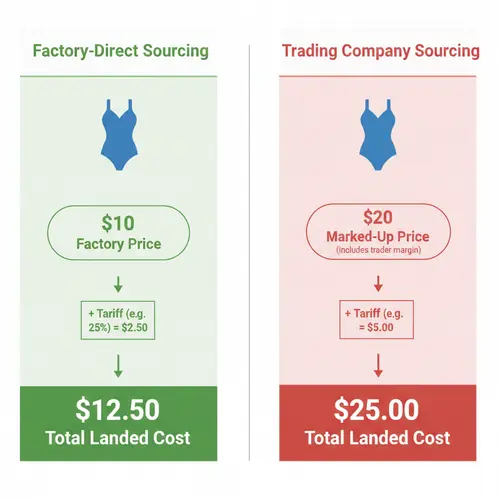
Tariffs are assessed on the price you pay, not some fixed "true value" of the product. That single fact is why routing through a trading company costs more than the tariff rate alone suggests: the trader's markup becomes part of the taxable value. A simplified example makes this concrete — at a hypothetical high tariff rate, a $10 factory-direct price carries a proportionally lower total landed cost than the same product marked up to $20 by a trader and then taxed on that higher number. The gap isn't the tariff rate — it's what base price that rate gets applied to. This is structurally why working directly with the actual manufacturer, rather than through an intermediary, matters more as tariffs rise, not less.
China's underlying production advantages also haven't gone away just because tariffs have gone up: it accounts for roughly 30% of global textile output, with fabric, trims, dye houses, and finishing typically available within a couple of hours of major manufacturing clusters — a level of supply chain completeness that alternative sourcing countries, still dependent on Chinese raw material imports themselves, haven't replicated. For a technically complex category like swimwear — stretch knits, structural components, multi-material construction — that accumulated capability is a real, measurable difference, not a marketing claim.
Is Transshipment a Real Option? The Policy Reality
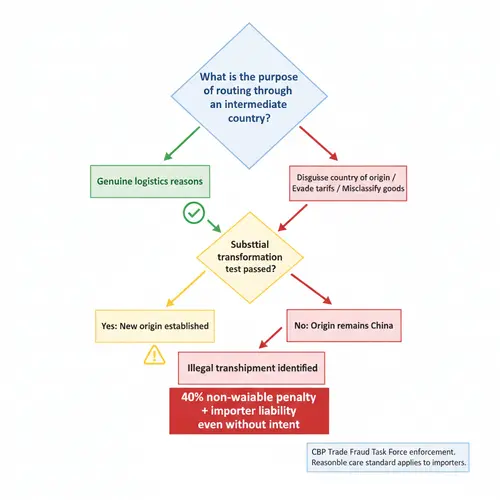
It's worth addressing directly, because it's the option that looks like a shortcut and isn't one anymore.
Transshipment itself — routing goods through an intermediate country for genuine logistics reasons — is completely legal and common. It becomes illegal the moment it's used to disguise a product's true country of origin in order to evade tariffs, misclassify goods, or falsely claim trade-agreement benefits. The legal test that matters here is "substantial transformation" — origin is determined by where a product acquires a genuinely new name, character, or use, not by where it was last repackaged or lightly assembled before shipping. Under the current U.S.-Vietnam framework, this has gotten stricter still: a product can be substantially transformed in Vietnam and still face a steep tariff if the percentage of Chinese-origin content is judged too high — effectively a "Chinese content test" layered on top of the origin question.
The enforcement environment has hardened accordingly. CBP has confirmed it applies a non-negotiable, non-waivable additional 40% tariff penalty on goods identified as illegally transshipped, and has stood up a dedicated Trade Fraud Task Force specifically targeting this. Critically, liability doesn't require intent — an importer who unknowingly relied on a supplier's false certificate of origin can still be held responsible if they didn't exercise "reasonable care": verifying origin claims, requesting supply chain documentation, and confirming that offshore processing genuinely met the substantial transformation threshold. In other words, even brands with no intention of evading tariffs can end up exposed if their supplier was cutting corners upstream. Between the severity of the penalty and the fact it can land on importers who didn't even know there was a problem, this isn't a strategy worth building a sourcing plan around in 2026.
Where This Leaves the No-MOQ, Full-Lifecycle Model
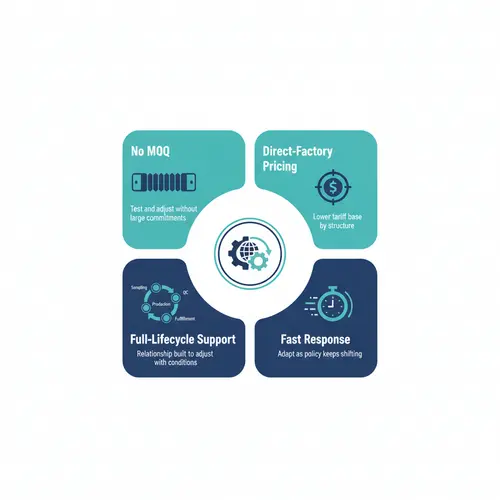
This is exactly the environment our model was built for, even though it wasn't designed with a specific tariff deadline in mind. A few pieces of it matter more right now than usual:
No MOQ means you're not locked into a large commitment while the rules are still moving — see how our no-MOQ model actually works. You can test, adjust, and re-evaluate sourcing volume without eating the cost of a large order placed under assumptions that might not hold in two weeks.
Direct-factory pricing keeps your tariff base lower by structure, not by strategy — no transshipment risk, no trader markup being taxed alongside your product.
Fast response matters more in a policy environment that keeps shifting — and it's exactly the trait worth verifying before you commit to a factory. Being able to move quickly on a sample, a fabric substitution, or a production timing decision is worth more when the underlying cost environment changes every few months rather than staying fixed for years at a time.
Full-lifecycle support — from sampling through production, quality checkpoints, and fulfillment — means this is a relationship built to adjust with you as conditions change, not a one-time transaction priced under conditions that may no longer apply by the time your order ships.
Tariffs also raise a separate question worth asking any supplier: how much of a minimum-order increase is actually tariff-driven, versus something else. See our own honest numbers on this.
FAQ
Q: Did tariffs go up or down after July 24, 2026?
A: Section 301 replaced Section 122 the same minute it expired, with a two-tier 10%/12.5% duty across roughly 60 economies — broader than the 46-country proposal on the table days earlier. Unlike Section 122, this layer has no statutory sunset, so it isn't set to expire on a fixed date.
Q: Is transshipping goods through another country to avoid China tariffs illegal?
A: It depends entirely on intent and substance. Transshipment for genuine logistics reasons is legal. Using it to disguise origin, evade duties, or falsely claim trade-agreement treatment is illegal, and CBP now applies a non-waivable additional 40% penalty when it's identified — with liability that can extend to importers who didn't personally arrange the scheme.
Q: Why does sourcing directly from a factory cost less than going through a trading company under tariffs?
A: Tariffs are assessed on the price you're actually charged. A trading company's markup becomes part of that taxable value, so their margin gets taxed along with your product. Buying direct from the manufacturer keeps that base price — and therefore the tariff calculated on it — lower.
Q: Do lower-tariff countries like Vietnam or Bangladesh actually avoid China's tariff exposure?
A: Only partially. Both countries import a majority of their own raw materials from China, so a portion of China's tariff exposure is embedded in their supply chains regardless of where final assembly happens. They also typically require higher minimum order quantities and have less accumulated technical capability for complex categories like swimwear.
Q: What should I actually do about sourcing strategy given how often tariff policy shifts?
A: Avoid locking into large, fixed-volume commitments based on any single moment's rate if you can help it, verify your supplier relationships can withstand scrutiny on origin claims, and work with a manufacturing partner flexible enough to adjust order size and timing as policy keeps shifting — because it will keep shifting, on its own timeline, regardless of any specific deadline.
This is one entry in our ongoing industry trends coverage — check there for the most current read on what's actually changing.
Trying to figure out how the current tariff situation affects your specific sourcing plan? Send us your product details — we'll walk through the real landed-cost math with you before you commit to a strategy.