
OYOYI Ready-Stock Catalog: Which of the 4 Paths Actually Fits You
OYOYI now offers four real starting points for getting a swimwear product to market, not just one. If you just need product, source an existing style as-is. If you want your name on it, keep the pattern and change the labels, packaging, and hardware. If you have your own artwork, print it onto a style confirmed as suitable. And if you're starting from an original idea, that's a design consultation, not a catalog browse. None of these replace full custom development — they're additional entry points for brands that aren't ready for a ground-up design process yet.
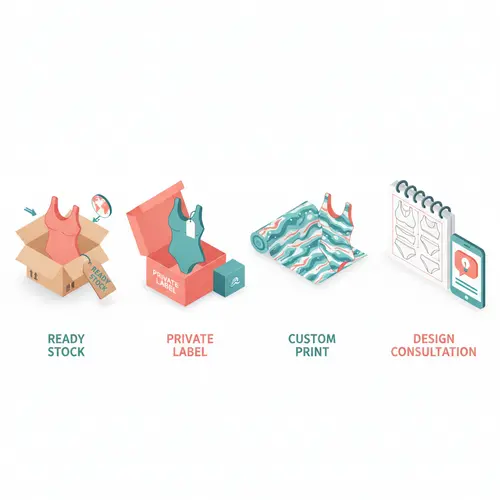
The Short Version
Path | What stays the same | What you change | Best for |
|---|---|---|---|
Ready Stock Sourcing | Everything — pattern, construction, labels, packaging | Nothing — shipped as-is | Testing a style on your sales channel, or a quick resale need |
Private Label & Packaging | Pattern, construction, base fit | Labels, branded hardware, packaging, sometimes color or print | Brands ready to put their name on a proven style |
Custom Print & POD | Pattern and silhouette | Surface artwork on an eligible style | Brands with their own print designs, no new pattern needed |
Design Consultation | Nothing — this starts a new development conversation | Everything, from scratch | Brands with an original design direction or existing tech pack |
Why Four Paths Instead of One Catalog
A catalog usually implies one thing: pick a product, buy it as shown. That's true for exactly one of these four paths — Ready Stock Sourcing. The other three are catalog-adjacent but structurally different, because each one changes a different layer of the product.
Private Label keeps the pattern and construction untouched and only changes what sits on the outside — labels, packaging, branded hardware. Custom Print keeps the pattern and construction untouched too, but changes the surface artwork instead of the branding. Neither one is "customization" in the sense of altering fit, silhouette, or construction — both are explicit about that boundary, and changes to structure require a separate assessment outside these paths.
Design Consultation is the odd one out on purpose: it isn't a catalog path at all. It's where a brand with an original idea, or an existing tech pack, moves into a real development conversation — the same kind of process behind why 90% of first samples succeed without needing a full tech pack.
Path 1: Ready Stock Sourcing
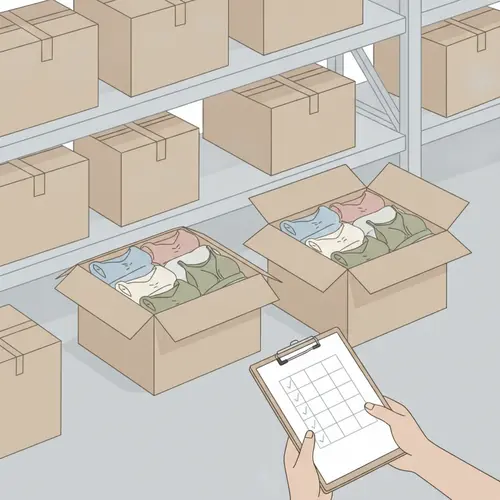
This is the simplest path: source an existing swimwear style, inspected and shipped as ordered, with no relabeling, packaging changes, or print changes involved. Availability is confirmed before ordering, and a single piece can be requested — the same low-barrier logic behind why there's no fixed MOQ applied to sourcing rather than production.
There's no blanket lowest-price promise here. Stock sourcing and branded production carry different costs, and neither is universally cheaper — the real comparison is the actual product quote, any service charges, and shipping, reviewed together rather than assumed, the same principle general supplier due-diligence guidance applies to sourcing decisions broadly.
This path fits a specific moment: testing whether a style performs on your sales channel, replenishing a boutique selection, or filling a resale need — without committing to a design or sampling cycle first.
Path 2: Private Label & Packaging
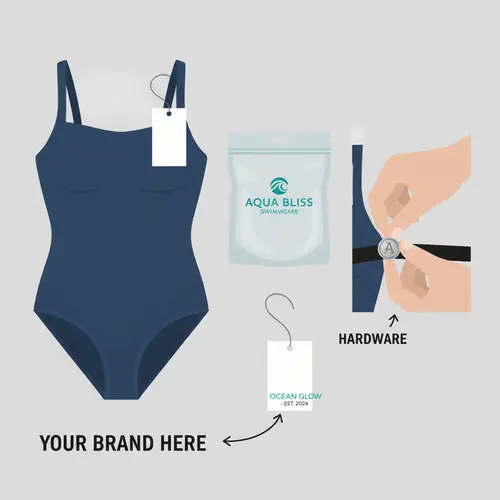
Here, the pattern, construction, seams, and base fit stay fixed — changes to structure require a separate assessment entirely. What you actually control is what sits on the surface: labels and hangtags, branded packaging bags, branded hardware, and in some cases print or color, if the specific style allows it.
Two real caveats are worth knowing upfront. First, a free sample under this path means an existing-stock sample, evaluated before you order — it's a different mechanism from the from-scratch sample fee structure that applies when you're developing a new design, and free samples here are limited and subject to approval. Second, garment, label, and packaging each carry their own minimums, confirmed separately for the selected style — there isn't one combined MOQ number that applies across the board.
If you're comparing this against your current supplier, the honest question isn't just price. An existing pattern can avoid new silhouette development entirely, but compare the complete quote — branding, any required proofs or samples, quantity, and freight — because savings from skipping design work aren't automatic.
Path 3: Custom Print & POD
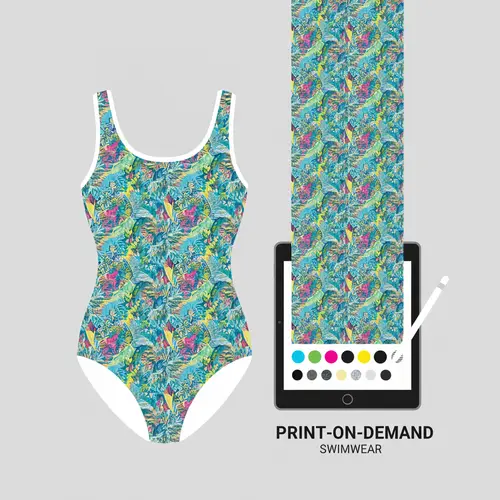
This path is for brands that already have artwork and want it on an existing, print-eligible style — not a new pattern. Eligibility is confirmed by the specific style, material, and print process, and a custom-printed product is produced to order, not immediately dispatchable the way original stock is.
Print feasibility comes before anything else. Stretch, base fabric color, and seam placement all change how an artwork actually looks once it's on a garment, and a screen proof doesn't guarantee an exact physical color match — a real production constraint, not a formality. Artwork rights are the customer's responsibility too: only artwork you own or have permission to use commercially should be submitted, and a factory reviewing feasibility isn't the same as clearing copyright. This is standard practice across custom print services generally — most print providers explicitly state they do not independently verify artwork ownership, placing that responsibility on the customer submitting the file.
Print and branding can be combined — a custom-printed style can also carry your labels and packaging — but each component keeps its own availability, quantity, and timing conditions rather than being bundled into one blanket minimum.
Path 4: Design Consultation
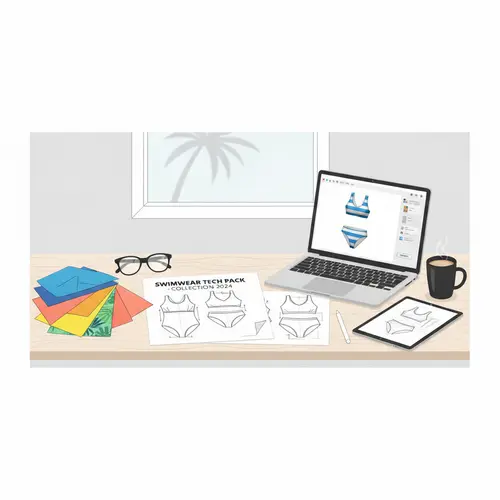
This isn't browsing a catalog — it's the entry point into an original development project, for a brand with a design direction of its own or an existing tech pack ready for review. It sits outside the ready-stock logic entirely and connects into OYOYI's core custom development process.
How to Actually Choose
Do you need the product to exist exactly as shown, with nothing changed? → Ready Stock Sourcing.
Do you have a style you like and just want your name and packaging on it? → Private Label & Packaging.
Do you have artwork ready and just need a suitable style to print it on? → Custom Print & POD.
Do you have an original idea, or a tech pack, and need real development? → Design Consultation.
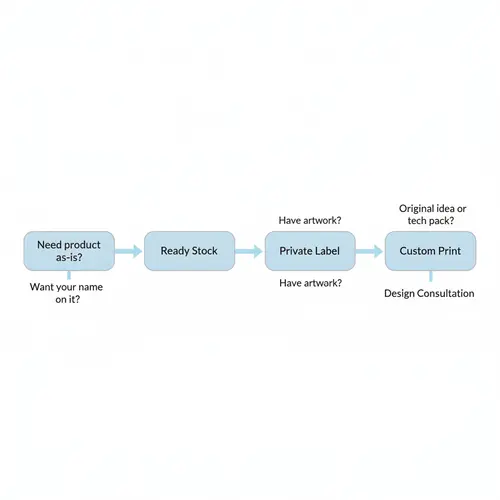
These aren't mutually exclusive over time. A brand might start with Ready Stock to test a category, move to Private Label once a style proves out, and eventually commission an original design once the brand itself is established — three different real starting points on the same spectrum, not three different suppliers to choose between.
For real reference material while you browse, see the hangtags and brand cards, custom packaging, and hardware and trims categories referenced across these paths, and our checklist for vetting any swimwear factory before you commit to any of them.
FAQ
Q: What's the difference between Ready Stock Sourcing and Private Label?
A: Ready Stock ships an existing product exactly as-is, with no changes. Private Label keeps the same pattern and construction but lets you add your own labels, packaging, and branded hardware.
Q: Can I get a custom print without changing the garment's pattern?
A: Yes — that's specifically what Custom Print & POD is for, on styles confirmed as print-eligible. The pattern and silhouette stay the same; only the surface artwork changes.
Q: Is there a minimum order for any of these paths?
A: It depends on the path and style. Ready Stock Sourcing can start at a single piece, subject to confirmed availability. Private Label and Custom Print each have their own garment, label, and packaging minimums, confirmed for the specific style.
Q: Are free samples available?
A: Under Private Label, a free sample from existing stock is available in limited cases, subject to approval. This is different from a from-scratch development sample, which carries its own sample fee.
Q: Do I need a finished design to use any of these paths?
A: No — three of the four paths (Ready Stock, Private Label, Custom Print) work from an existing style. Only Design Consultation is for an original idea or a tech pack that needs full development.
Q: Who is responsible for artwork rights on a custom print?
A: You are. Submit only artwork you own or are authorized to reproduce commercially — feasibility review confirms the artwork can be produced, not that you hold the rights to use it.
Ready to Find Your Starting Point?
Tell us where you are — testing a style, ready to brand one, holding artwork, or starting from scratch — and we'll point you to the right path. Start with our no-MOQ guide if you want the fuller picture of how OYOYI works with small and growing brands.