
Do DTC Swimwear Brands Actually Need a CPC/GCC Certificate?
CPSC eFiling became mandatory on July 8, 2026, and it made headlines across the apparel import world. For kids' swimwear brands specifically, though, the certification requirement itself isn't new — platforms like SHEIN were already requiring it roughly a year before eFiling took effect. The real question most independent brands actually need answered isn't "how do I comply with eFiling." It's simpler and more basic: do I need a CPC or GCC certificate for my kids' swim line at all? The honest answer depends entirely on where you sell, and it's a question we get asked often enough that it's worth laying out plainly, in the same spirit as where we've drawn honest compliance boundaries before.
The real split: marketplace sellers vs. independent brand sites
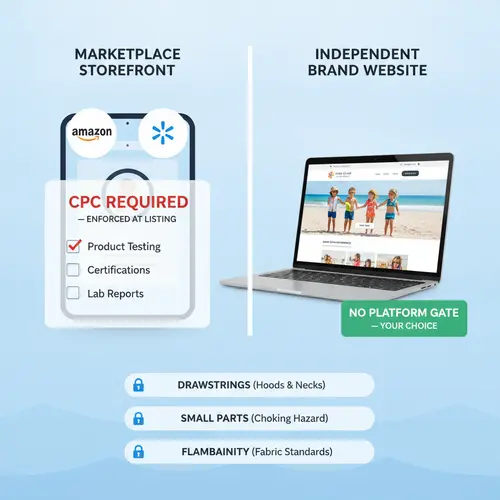
Marketplaces enforce this proactively. Amazon has required a Children's Product Certificate and third-party lab test report for children's product listings, and since September 2025 has been actively enforcing annual re-verification through approved testing and certification providers — flagged listings stay suppressed until documentation clears. Walmart's Marketplace policy is explicit too: sellers may only list children's products accompanied by a valid CPC and a corresponding third-party test report from a CPSC-accepted lab, produced on request.
Independent, DTC-only brand sites don't have that layer. No platform is checking your documentation before your product goes live, because there's no platform in the loop. That doesn't mean the underlying CPSIA safety rules disappear — the same federal requirements for drawstrings, small parts, and flammability apply regardless of sales channel, and we've written separately about what those construction requirements actually look like — but how the certificate gets enforced is completely different. On a marketplace, it's a listing gate: Amazon's own documentation lays out exactly which test reports and certificates it expects before a children's product ASIN goes live, and flagged listings simply don't sell until that clears. On your own site, there's no equivalent checkpoint — it becomes a business decision you make with your factory, not a technical requirement enforced by a third party.
This distinction matters more than it might seem, because it changes what "compliance" actually means for a brand. On a marketplace, compliance is binary — you either have the documentation on file or your listing gets suppressed. On an independent site, compliance is really two separate things stacked on top of each other: the physical construction has to meet the underlying safety rules no matter what, and the paperwork proving that formally is a separate, optional layer that a brand can choose to add or skip.
Labeling is a separate obligation from certificates; for the care-label side, including cost and MOQ by method, see swimwear care labels: heat transfer vs. sewn.
Certificates and lab reports are one part of what's worth verifying before you commit to any factory — see our full checklist for vetting a swimwear manufacturer.
What we actually do
For our brand clients, the starting point is always the same: we build to the real structural safety requirements regardless of whether a certificate is requested — the drawstring and small-parts constraints don't change based on your sales channel. Certification is a separate layer on top of that, and it's optional for independent-site clients specifically.
If a client wants the certificate:
We arrange standard third-party lab testing as part of the normal production process.
This requires 1-2 additional sample sets built specifically for lab testing — these are consumed in the testing process and aren't returned, so they add to the sample cost.
We tell the client clearly, upfront, that testing is happening and what it involves. If the client doesn't agree, we don't test. This isn't something we do quietly in the background.
Lab processing itself — separate from production or sampling time — typically adds 7-10 days.
If a client declines certification, we don't refuse the order. We proceed with the structurally safe construction, and we're explicit with the client about the risk they're accepting by skipping third-party verification, backed by a written disclaimer. That approach — build to the real safety standard regardless, then let the client make an informed choice about the paperwork layer on top — is the same honesty principle we try to apply across every manufacturing feasibility decision: we'd rather tell a brand plainly what's actually required versus optional than let them assume a stricter (or looser) standard than reality.
We also don't push certification on clients who haven't asked for it, and we don't quietly skip it for clients who have. Both directions of that mistake are easy to make when a factory is trying to move fast, and both end up costing a brand more — either in unnecessary sample costs and lead time for a marketplace-only brand that never needed it, or in real safety risk for a brand that assumed a certificate existed when it didn't.
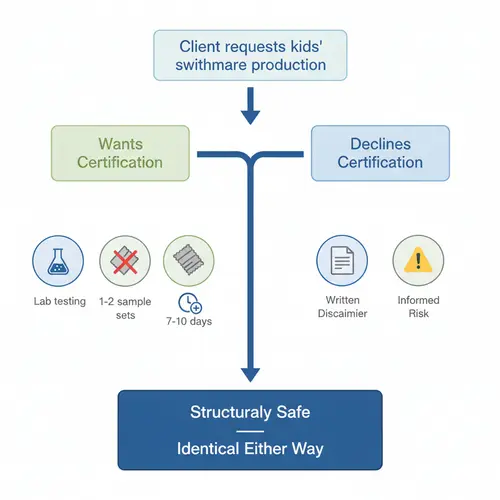
Marketplace vs. DTC: the real comparison
Marketplace sellers (Amazon, Walmart) | Independent DTC brand site | |
|---|---|---|
Certificate required to sell? | Yes — enforced at listing/account level | No platform enforcement |
Structural safety rules (drawstrings, small parts) | Apply regardless | Apply regardless |
Certificate decision | Not optional | Client's choice, with risk disclosed |
Extra cost if certified | Built into marketplace compliance cost | 1-2 extra sample sets, consumed in testing |
Extra lead time if certified | Factored into standard timeline | +7-10 days lab processing |
What CPSC eFiling actually changes — and what it doesn't
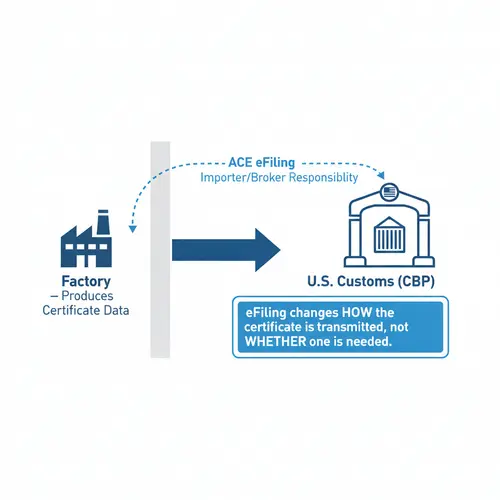
eFiling is an import-side administrative requirement: it changes how an existing certificate gets transmitted to U.S. Customs at the moment of entry, not whether a product needs one. That transmission — through CBP's Automated Commercial Environment system — is the importer's or their customs broker's responsibility, not the factory's. CPSC's own eFiling guidance is aimed squarely at import enforcement — catching noncompliant shipments at the border faster — not at expanding which products need certification in the first place. Our role stays the same either way: if a client wants a certificate, we make sure the underlying testing and documentation are accurate and complete. What the client's broker does with that data at customs is a separate step we're honest about not owning, the same way we're honest about the limits of what a factory can control on regulatory questions generally.
It's worth being clear about why this distinction matters practically: a brand that reads "eFiling is now mandatory" and assumes it needs to scramble for new certification is solving the wrong problem. If your kids' swimwear line already sells on a marketplace, you likely already have the certificate — eFiling just changes how your broker submits it. If you're DTC-only and never had a certificate, eFiling doesn't create that requirement out of nowhere; it's still the same optional layer it was before, subject to the same trade-off in cost and lead time described above.
FAQ
Q: Is a CPC or GCC certificate legally required for kids' swimwear?
A: The underlying CPSIA safety standards (drawstrings, small parts, flammability where applicable) apply to all children's products regardless of sales channel. Certification enforcement, in practice, is driven by where you sell — marketplaces check for it before you can list; independent sites don't have that gate.
Q: If I sell only on my own website, can I skip certification entirely?
A: You can, and many DTC brands do. We'll still build to the structural safety requirements either way, but we'll disclose the risk of skipping third-party verification and provide a written disclaimer so the decision is an informed one.
Q: What does certification actually cost in extra samples and time?
A: Typically 1-2 additional sample sets, built specifically for lab testing and not returned since they're consumed in the process, plus roughly 7-10 days of lab processing time on top of your normal sample lead time.
Q: Does CPSC eFiling mean I now need a certificate I didn't need before?
A: No. eFiling changes how an existing required certificate gets transmitted to customs at time of entry — it doesn't create a new certification requirement for products that weren't already subject to CPSC rules.
Q: Who is responsible for actually eFiling the certificate data with customs?
A: The importer of record, typically working through their customs broker, files the data through CBP's ACE system. That's separate from the manufacturing side — our responsibility is making sure the certificate itself is accurate if you choose to get one.
Q: Is this different for platforms like SHEIN or TikTok Shop?
A: Each marketplace sets its own enforcement timeline and requirements, and several major platforms started requiring documentation well before CPSC eFiling existed. If you sell on any third-party marketplace, check that platform's specific policy rather than assuming DTC rules apply.
Q: If I start DTC-only and later add a marketplace channel, what changes?
A: The certification decision flips from optional to required for that channel. It's worth telling us in advance if a marketplace launch is on your roadmap — testing and certification take 7-10 days of lab processing, and building that into your original sample timeline is far cheaper than retrofitting it later on an already-selling product.
Q: Does declining certification affect anything besides the paperwork?
A: No — the physical construction is identical either way. We build to the same drawstring, small-parts, and structural safety standards regardless of whether a client certifies. The certificate documents that the product meets those standards through third-party verification; it doesn't change how the product is actually made.
Not sure whether your kids' swimwear line needs certification for your specific sales channels? Tell us where you're planning to sell, and we'll walk through what's actually required versus optional before you commit to a sample run.