
Swimwear Seam Construction: What 'Seamless' Actually Means
"Seamless" is one of the most overused words in swimwear marketing, and it rarely means what it sounds like. In real production, swimwear seams come down to two fundamentally different approaches — sewn construction (flatlock and coverstitch) and bonded construction (heat or ultrasonic sealing) — and each one fails in a specific, predictable way when it's done wrong. Here's what actually separates them.
Sewn Construction: Flatlock and Coverstitch Aren't the Same Job
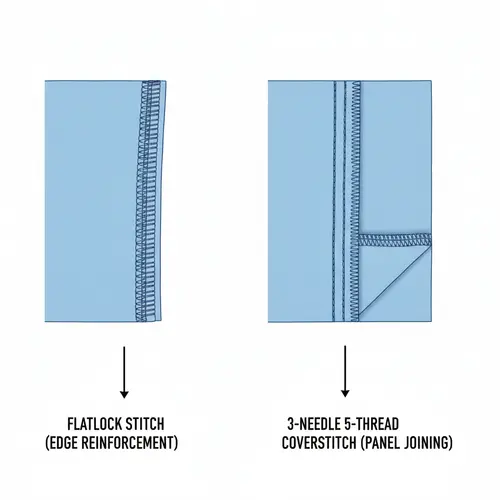
These two stitch types get used interchangeably in casual conversation, but they serve different structural roles in a swimwear garment:
Flatlock is mainly used for edge reinforcement — securing the raw edge of a seamed panel. The critical detail here is backstitching (打回针) at the start and end of the stitch line: without it, the stitching has no anchor point and unravels easily under stress, which is one of the most common, entirely avoidable defects in swimwear construction.
Coverstitch — specifically 3-needle, 5-thread coverstitch construction, which quality guidance from China Quality News recommends specifically for swimwear seams — is the main seaming method for side seams, shoulder seams, and other primary structural seams. It's built for stretch: the multi-thread, multi-needle structure flexes with high-elasticity fabric instead of resisting it, which is exactly what a seam running across a stretch panel needs to do.
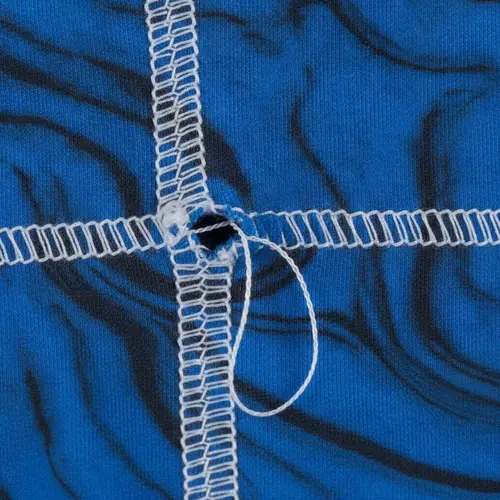
The real quality risk with coverstitch isn't strength in the way people assume — it's skipped stitches (跳针). Swimwear fabric is highly elastic and slippery, which makes consistent needle penetration and thread-loop formation harder to control than on a stable woven fabric; when the needle fails to catch the loop properly, it leaves a literal gap in the seam. A recent 2026 consumer quality guide from Hangzhou's official news portal specifically calls out checking seams for broken thread, skipped stitches, and loose thread ends — particularly at straps, waistbands, and panel joins — as a real, practical way to spot exactly this defect before it becomes a return.
Bonded Construction: What "Seamless" Usually Actually Means
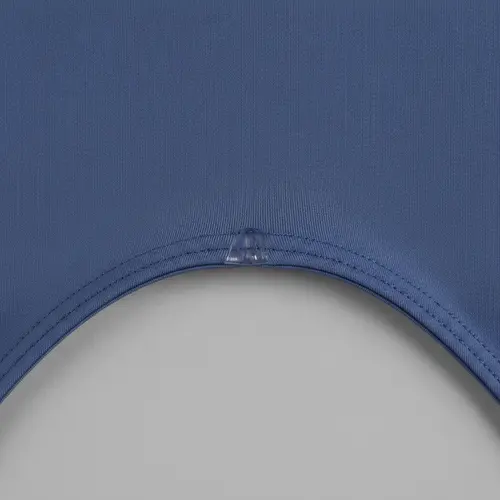
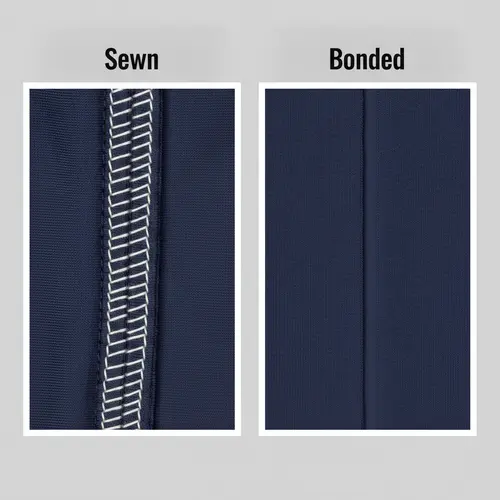
The other real approach doesn't use thread at all. Heat or ultrasonic bonding fuses fabric panels together directly, which is genuinely closer to what most people picture when they hear "seamless" — no visible stitch line, no thread to break.
We're able to produce both sewn and bonded construction, but it's worth being direct about how bonded construction actually works in practice: it typically relies on specialized processing facilities with the specific equipment this requires, rather than being a standard in-house sewing-line capability. This isn't unique to us — ultrasonic and heat-bonding equipment is a distinct capital investment from standard sewing machines, which is why this step is commonly handled through dedicated processing partners across the industry, not run as a default line alongside conventional stitching.
The process itself depends on tightly controlled parameters — the bonding temperature, contact time, applied pressure, and equipment speed all need to be dialed in precisely. In practice, this calibration typically comes from the bonding equipment manufacturer's own preset parameters rather than in-house custom tuning, which keeps the actual floor operation straightforward — but the real test of whether that calibration holds up isn't how the seam looks fresh off the line, it's whether it survives immersion and wash-durability testing. A bonded seam that looks clean on day one but wasn't processed at the right parameters is exactly the kind of defect that doesn't show up until a customer has already worn it in the water.
The Two Approaches, Side by Side
Factor | Sewn (Flatlock/Coverstitch) | Bonded (Heat/Ultrasonic) |
|---|---|---|
Visible seam line | Yes | No, or minimal |
Equipment | Standard sewing line | Specialized equipment, often outsourced to dedicated processors |
Main failure mode | Skipped stitches, unraveling without backstitch reinforcement | Incorrect bonding parameters, verified only through durability testing |
Best suited for | Standard seaming across most swimwear styles | Styles where a visible stitch line specifically needs to disappear |
What "Seamless" Actually Means When You See It on a Product Page
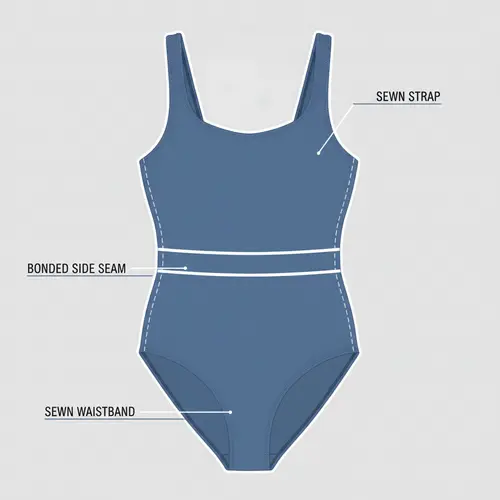
When a swimwear listing says "seamless," it's almost always describing bonded construction on some or all of the garment's seams — not the literal absence of any joining method. It's worth asking directly which seams are bonded and which are still sewn, since a garment can combine both (bonded side seams with a sewn waistband, for example) and still be marketed simply as "seamless." The distinction matters for fit and durability expectations, not just appearance.
This is the same kind of gap between a marketing term and the real construction underneath it that we've written about with why "compression" claims need a specific structural build behind them — a claim on a product page isn't the same thing as a verified construction choice. It's the same underlying question this entire construction-by-type guide is organized around: what a garment claims versus what's actually built into it.
We track seam construction and thread specifications as part of our real fabric and trims library, and thread type also affects how a seam holds up alongside the fabric's own stretch recovery performance — a seam that resists stretch fights against a fabric engineered to recover, which is its own source of premature wear at the seam line specifically.
Standard flatlock and coverstitch construction also handles a trickier-sounding join than it usually gets credit for — see why splicing mesh into a solid-fabric panel doesn't require a special technique.
FAQ
Q: Is coverstitch stronger than flatlock for swimwear seams?
A: They're not really comparable that way — they serve different jobs. Flatlock reinforces raw edges (and needs backstitching to hold), while coverstitch is the main seaming method for stretch panels like side seams. A well-built garment typically uses both, each where it's actually needed.
Q: What causes skipped stitches in swimwear seams?
A: Swimwear fabric's high stretch and slippery surface make it harder for the machine to consistently catch the thread loop compared to stable woven fabric, which is why skipped stitches show up more often in swimwear than in general apparel.
Q: Does "seamless" mean a garment has no seams at all?
A: Almost never literally. It usually means the visible seams are bonded (heat or ultrasonic) rather than sewn, which removes the visible stitch line — not that panels aren't joined at all. A garment can be partially bonded and partially sewn and still be marketed as "seamless."
Q: Can any factory produce bonded seamless construction?
A: Not without specific equipment. Ultrasonic and heat-bonding processing typically requires specialized machinery that's a separate capital investment from standard sewing lines, which is why this step is commonly outsourced to dedicated processing facilities across the industry rather than run in-house by default.
Q: How can I tell if a bonded seam was processed correctly before it fails?
A: Visual inspection alone isn't reliable — a seam can look clean immediately after bonding and still fail once it's been worn and washed. Immersion and wash-durability testing is the real way to confirm the bonding parameters were correct, not appearance at the sample stage.
Q: Should I ask my supplier which seams are actually bonded vs. sewn?
A: Yes, especially on anything marketed as "seamless" — knowing exactly which seams use which method tells you where the real durability and fit considerations sit, rather than assuming the whole garment was built one way.
Specifying seam construction for a new style, or want to know whether "seamless" on a spec sheet actually means what you think it does? Send us the details — we'll tell you honestly what's sewn, what's bonded, and what that means for durability.