
How Real Tummy-Control Swimwear Compression Is Built
Shaping and tummy-control has always been one of the most persistent themes in women's fashion — it sits at the intersection of body-image pressure and genuine aesthetic preference, and swimwear is where that pressure shows up most directly. Search interest in "shaping" and "tummy control" swimwear grew 96.6% between January and July 2025, and market data points to real, underserved demand across petite, tall, and adaptive sizing segments. The problem isn't demand. It's that most products marketed with these terms aren't actually engineered to deliver the function — they're using the keyword for search visibility, not describing a real construction.
Shapewear and waist-training as categories have already solved the core compression problem outside of swimwear. The real question is what happens when you try to bring those solutions into a category that also has to survive chlorine, salt water, and sun.
Two Proven Reference Models (From Outside Swimwear)
Standalone cinchers and waist trainers solve compression through adjustable multi-row hook-and-eye closures — typically three rows, spaced about an inch apart — combined with structural boning and a reinforced double-layer construction. The multiple rows exist specifically so compression can be adjusted incrementally as fit or body shape changes, rather than being fixed at one tightness.
Bandage-bodysuit construction takes a different approach: instead of a single compression panel, it uses elastic strips arranged to wrap the body directly, creating compression through strategic placement and tension rather than a single reinforced zone — and increasingly through zoned construction, where different areas of a garment carry different compression levels depending on what that area of the body needs (higher compression at the midsection, lighter compression where mobility matters more). A US construction patent for compression bands describes a similar approach: a supportive back panel joined to front panels with drawstring channels at the side seams, allowing adjustable tension rather than a fixed compression level.
The Constraint Neither Reference Model Has to Deal With
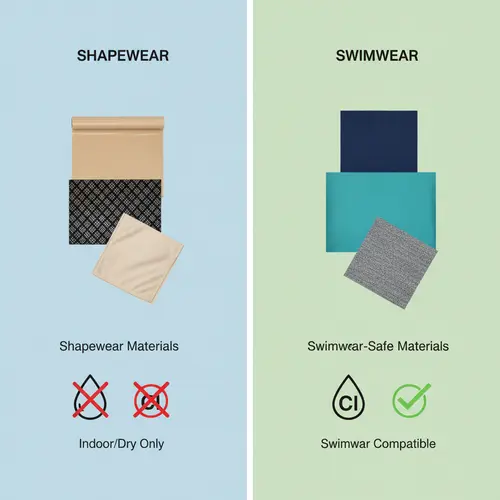
Standard shapewear and waist-trainer materials — latex, powernet, cotton-lined compression blends — are built for indoor, dry wear. None of them are built to survive chlorine, UV exposure, or repeated saltwater soaking. That's the real engineering problem in bringing shaping into swimwear: every fabric and component has to solve compression and chlorine/UV/quick-dry performance at the same time, which immediately rules out most off-the-shelf shapewear materials and mechanisms.
Five Real Ways We Build Shaping Into Swimwear
These are actual construction approaches, not marketing language — each solves the compression problem differently, with different cost and comfort trade-offs.
# | Method | How It Works |
|---|---|---|
1 | **Fabric combination (PBT panel + standard stretch)** | A PBT (polybutylene terephthalate) panel is used specifically at the belly — PBT fiber holds its shape and recovers from stretch better than standard nylon-spandex, giving real compression at the panel while the rest of the suit uses regular 4-way stretch fabric for comfort and flexibility |
2 | **Double-layer with outer ruffle/gather** | An outer layer of ruffled or gathered fabric visually conceals a structural inner layer underneath — the shaping comes from the inner layer; the outer layer's volume is what hides the construction rather than adding compression itself |
3 | **Seam-placement fullness** | Extra fabric volume is engineered into specific seam placements to create a visual camouflage effect at problem areas — this is a styling/pattern solution rather than a true compression solution, and it's worth knowing the difference when you're sourcing |
4 | **Cinch-belt panel with back adjustable closure** | Directly adapted from standalone waist trainers — a dedicated belt-like panel integrated into the suit, closed with an adjustable hook closure at the back, giving genuine, adjustable compression |
5 | **High-GSM heavy fabric** | A heavier-weight fabric trades some stretch for real compression — less flexible than standard swim fabric, but the added density itself creates a firmer hold, and it can be customized to a specific weight/compression balance |
The honest distinction worth remembering: methods 1, 4, and 5 create real compression. Methods 2 and 3 create visual camouflage. Both are legitimate design tools — but they solve different problems, and a listing that doesn't specify which one it's using is telling you it probably doesn't know either.
The Uncomfortable Truth About Most "Shaping" Swimwear Listings
Looking at how "tummy control" and "shaping" are actually used across Amazon and other marketplace listings, the pattern is consistent: based on the construction described (or the complete absence of construction detail) in most product descriptions, the vast majority cannot realistically deliver real compression. The terms are being used almost entirely as search-visibility keywords, not as an honest description of the garment's engineering — the same gap between a label and what it actually verifies shows up with fabric certification claims — which is exactly why the search demand keeps climbing while buyers keep reporting the same disappointment.
For a deeper look at one specific real compression method — neoprene lamination construction, the technique behind genuine graduated compression tiers — see our follow-up breakdown.
Tummy-control is one entry in a wider pattern — see the full real construction guide organized by swimwear type for how the same "claim vs. real build" question applies across bust support, compression, and other functional categories.
FAQ
Q: Does "tummy control" swimwear actually work?
A: It depends entirely on construction, not the label. Genuine compression comes from specific methods — a dedicated compression panel (like PBT fabric), a cinch-belt structure with adjustable closure, or heavier-weight fabric. If a listing doesn't describe one of these, it's very likely using the term for search visibility rather than describing real engineering.
Q: Can regular shapewear materials (latex, powernet) be used in swimwear?
A: Not directly — those materials aren't built for chlorine, UV, or extended water exposure. Any shaping solution for swimwear has to be built from chlorine-resistant, quick-dry fabric from the start, which rules out most off-the-shelf shapewear materials.
Q: What's the difference between "visual camouflage" and "real compression" in shaping swimwear?
A: Visual camouflage (like ruffled overlays or engineered seam fullness) disguises the silhouette without actually compressing anything underneath. Real compression comes from a structural element — a firm panel, an adjustable cinch closure, or denser fabric — that physically holds the area in.
Q: Does adding real shaping/compression affect comfort or dry time?
A: Yes, to some degree — heavier or denser fabric and structural panels add weight and reduce stretch compared to standard swimwear. It's a genuine trade-off between compression level and flexibility, which is why customizing the fabric weight and panel placement to the specific brief matters.
Q: Is this kind of construction available at low order quantities?
A: Yes — panel-based construction and fabric combinations like this fit within our standard custom development process, the same way any other customization does.
This kind of construction breakdown is part of our broader manufacturing feasibility coverage.
Building a shaping or tummy-control swim style and want to know which construction method actually fits your design and budget? Send us the concept — we'll tell you honestly whether it delivers real compression or just the visual effect.