
Low MOQ Swimwear Manufacturing Guide for New Brands
Starting a swimwear brand with low MOQ means more than finding a factory willing to accept a small order. You need a product that fits, materials that perform in water, and specifications that a manufacturer can follow consistently. The aim is to commit less inventory before you know what customers want—not to skip development work.
For a first-time founder, independent designer, or emerging DTC brand, a focused launch can make that work more manageable. Amazon FBA and white-label sellers face a similar decision: whether to develop an original swimsuit, adapt an existing design, or test demand with ready-stock products.
This guide explains how to move from a swimwear concept to an approved sample and a controlled first production run. It also shows where tools and services such as OYOYI’s free AI swimwear Tech Pack generator, sampling support, and low-MOQ supply chain can fit into the process.
Start with a Product Brief, Not a Large Collection
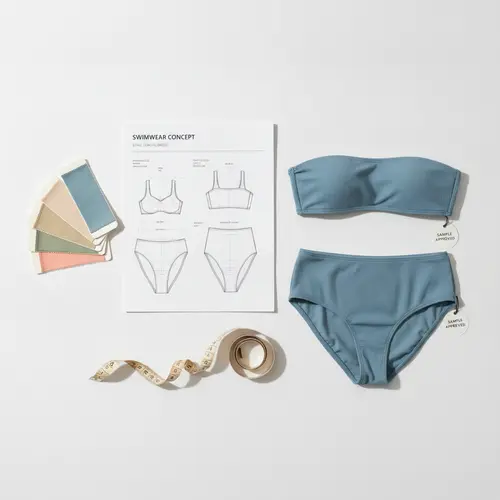
Before contacting a swimwear manufacturer, decide who the product is for and what it needs to do. A fashion bikini for occasional beach use has different requirements from a supportive one-piece intended for regular pool swimming.
Define the intended customer, coverage, support level, size range, and target retail price. Describe the fit in practical terms. “High-waisted with secure seat coverage” gives a development team more direction than “flattering and premium.” For a supportive top, specify whether you expect adjustable straps, removable cups, an underband, or underwire construction.
Keep the first collection focused. Every additional silhouette creates another pattern and fit decision. Each colour can introduce separate material sourcing, approval, and inventory requirements. Offering more options is not automatically a better launch strategy if the order becomes fragmented across sizes and colours.
A clear brief also helps you compare production routes. An independent designer may need original pattern development, while a marketplace seller may prefer an established shape with carefully defined branding changes.
Understand What Low MOQ Actually Covers
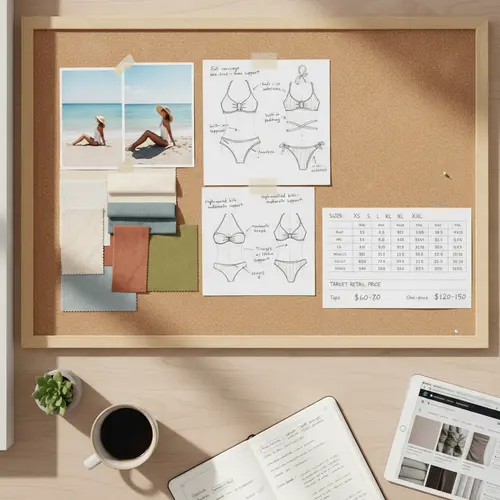
MOQ stands for minimum order quantity, but a supplier’s headline number does not tell you everything. The minimum may apply per style, per colour, per print, or across an entire order. Size splits may be allowed within that quantity—or subject to additional conditions.
Garment MOQ and fabric MOQ are separate issues. A factory might accept a small cut-and-sew order, while a mill requires a larger commitment for a custom-dyed colour. Printed fabrics, branded hardware, woven labels, and custom packaging can each introduce their own minimums or setup charges.
Before comparing quotes, get written answers to a few practical questions:
- Does the minimum apply per style, per colour, or to the total order?
- Can sizes be mixed, and are there minimum quantities per size?
- Is the fabric already available, or must it be produced or dyed?
- Do custom prints, trims, labels, or packaging change the minimum?
- Are samples, material purchases, and bulk production quoted separately?
Available stock fabric can make a small production run easier to arrange. However, stock fabric is not the same as ready-stock swimwear. The first is material used to manufacture your garments; the second is finished merchandise available from a catalog.
There is no universal low MOQ for swimwear. The useful number is the minimum attached to your actual design, material, colour, and branding requirements.
Build a Swimwear Tech Pack Before Requesting a Firm Quote
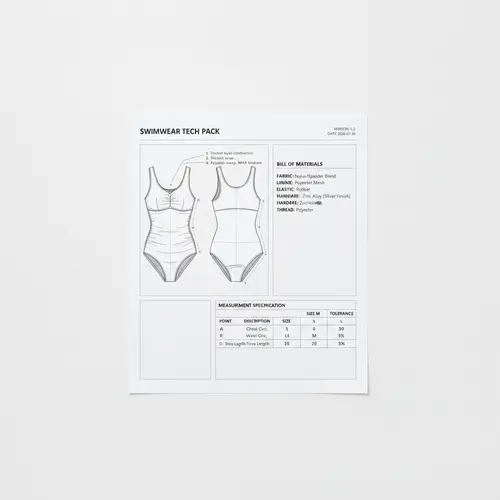
A swimwear Tech Pack is the specification document that connects your design intent to manufacturing instructions. A reference image can communicate a look, but it rarely explains the construction, measurements, or material choices needed for a reliable quote.
Your completed pack should include technical front and back views, a bill of materials, and construction notes. It also needs a base-size measurement specification, clearly defined measurement points, and agreed tolerances. Grading instructions explain how the measurements change between sizes.
Swimwear-specific details matter. Identify lining coverage, cup placement, strap adjusters, elastic width, seam construction, and the finish at leg openings. Describe the intended stretch direction and support requirements rather than leaving the factory to interpret them from a photograph.
Include label artwork, placement, and packaging instructions when they are relevant. Give the document a version number, and record sample revisions so the production team does not work from an outdated file.
OYOYI’s free AI swimwear Tech Pack generator can help you create a starting document for this conversation. Treat the output as a draft to review with the supplier, not a substitute for pattern development or fit testing. Measurements, materials, and construction details still need confirmation against the actual product.
A reviewed Tech Pack makes quotations easier to compare because suppliers are responding to the same requirements rather than making different assumptions.
Choose Fabric for the Intended Use
Nylon, also called polyamide, and polyester are common base fibres in stretch swimwear fabrics. Many constructions include elastane, also known as spandex, to provide stretch. Neither fibre name alone tells you how the finished swimsuit will perform.
Compare the actual fabric construction, weight, stretch, recovery, surface feel, and lining combination. Recovery describes how well the material returns toward its original dimensions after stretching. A fabric that stretches easily but recovers poorly can leave the garment feeling loose after wear.
Nylon blends are often considered for a smooth, soft hand feel. Polyester-based fabrics are commonly considered for sublimation prints and certain performance applications. These are starting points for sourcing, not universal quality rankings. Dyeing, finishing, knit structure, and elastane performance can change the result.
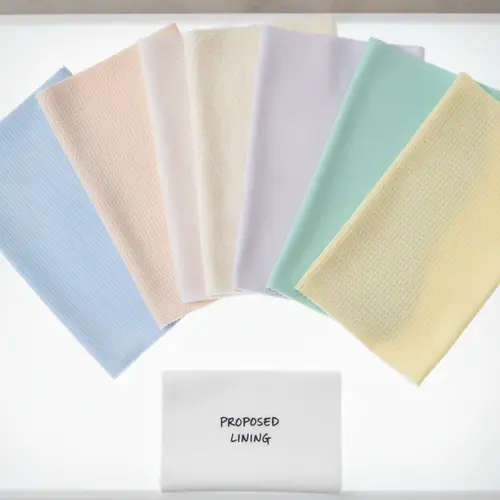
Request swatches before approving a material. Check them dry, wet, and stretched in the direction they will be used on the body. Pale colours and highly stretched areas deserve particular attention because a dry, flat swatch may not reveal an opacity problem. Evaluate the outer fabric together with the proposed lining.
For pool-focused products, request evidence supporting chlorine-resistance claims for the proposed material and colour. Colourfastness testing does not automatically prove that the elastic, seams, and entire garment will retain their performance indefinitely.
The same principle applies to recycled-content and sun-protection claims. Obtain documentation appropriate to the claim and the actual product. Do not assume that a general fabric description supports every statement you want to put on a listing.
Use Sampling to Resolve Fit and Construction
A sample is not just something to photograph. It is your opportunity to discover problems before repeating them across the order.
Agree on the purpose of each sample stage. An early prototype may establish shape and construction, while a fit sample addresses measurements, coverage, and support. A pre-production sample should represent the approved bulk materials and details as closely as agreed with the supplier.
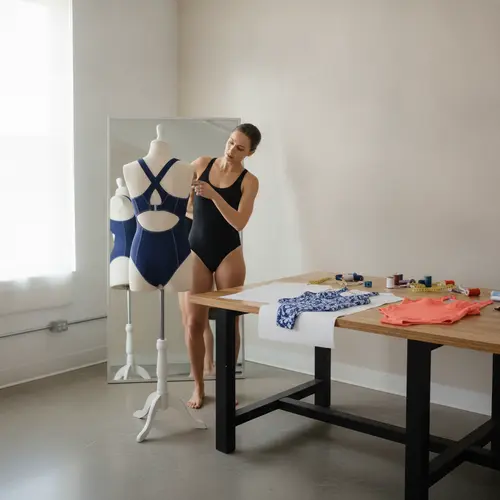
Assess the garment on a fit model whose measurements match your intended base size. Check it while standing, sitting, bending, and raising the arms. Look for strap movement, gaping, excessive pressure at leg openings, shifting cups, and changes in coverage.
Swimwear patterns often use negative ease, meaning the garment is smaller than the body measurements so the fabric stretches to fit. The correct amount depends on the fabric, construction, and support goal. Changing to a fabric with different stretch or recovery can therefore change the fit, even when the pattern stays the same.
Measure the sample using the method specified in the Tech Pack. Record corrections clearly: identify the measurement point or construction issue, explain the required change, and include annotated photos where helpful. “Make it more comfortable” is difficult to act on without identifying what causes the discomfort.
Before bulk approval, review wet opacity, lining coverage, seam stretch, and hardware comfort. Confirm the grading approach and whether representative sizes or a size set need checking. A good base-size sample does not prove that every size will fit correctly.
Keep a documented approval sample and the matching specification version. If the fabric, lining, elastic, or pattern changes afterward, decide whether another approval is needed.
Choose Between Custom Manufacturing, Private Label, and Ready Stock
The right sourcing route depends on how much product differentiation you need and how much development you are prepared to manage.
OEM commonly describes production to a buyer’s specifications. This can suit a designer with an original silhouette, a defined fit, and a detailed Tech Pack. Confirm who is responsible for patterns, material sourcing, and development work, because suppliers use the term differently.
ODM usually involves working from supplier-developed designs, sometimes with agreed modifications. It can reduce the amount of new development, but you still need to establish what can change and whether those changes require fresh samples or higher minimums.
Private-label swimwear generally means selling products under your own brand, often using an existing design. Do not assume it includes exclusive styling, unrestricted logo placement, or custom packaging. Those details belong in the quotation and agreement.
Ready-stock swimwear offers another way to test a sales channel without commissioning an entirely new product. It may suit a seller evaluating demand or building an initial assortment. Check current size and colour availability, sample quality, branding permissions, and whether the product can be replenished.
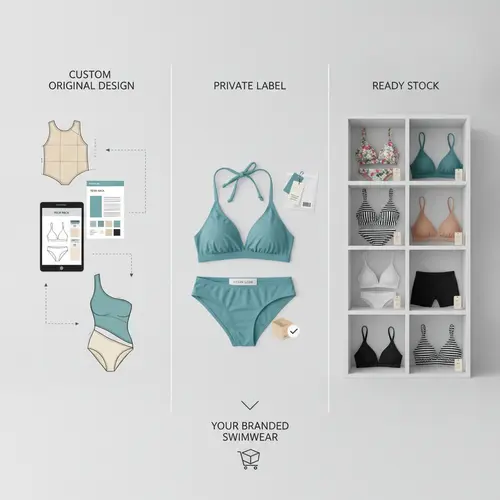
OYOYI offers custom production, OEM/ODM and private-label cooperation, as well as a ready-stock catalog. Compare these routes against your product brief rather than assuming that full customization is always the best first step. For original designs or significant adaptations, clarify pattern ownership, artwork rights, and exclusivity in writing.
Budget for Development and Landed Cost
A low-MOQ swimwear order can reduce the amount of inventory you commit to, but it does not necessarily produce the lowest unit price. Pattern work, cutting preparation, sample revisions, and production setup still require time and resources.
Build your budget around the full process. Include development and sampling, materials, garment production, labels, packaging, agreed testing, inspection, freight, and applicable import costs. Ask how unused custom materials will be handled and whether you are paying for a larger fabric commitment than the garment order requires.
For DTC sales, leave room for fulfilment, returns, and exchanges. For Amazon FBA, confirm the current preparation, barcode, packaging, and inbound requirements for your listing and destination. Marketplace requirements do not replace product compliance obligations.
Separate platform membership costs from product-development and manufacturing costs. OYOYI offers $0, $39, and $79 membership tiers. Review the current inclusions and billing terms before selecting a plan, and confirm which sampling, production, or other service charges are quoted separately.
Plan Quality Control Before Bulk Production
Quality control works best when the acceptance criteria are agreed before production begins. A final inspection can identify defects, but it cannot resolve an unclear fit standard or an unapproved material substitution.
For swimwear, define what will be checked against the approved sample and Tech Pack. Relevant checks include measurements, stitching, seam integrity, elastic application, lining coverage, hardware attachment, and colour consistency. Labels, size markings, packaging, and the quantity breakdown also need verification.
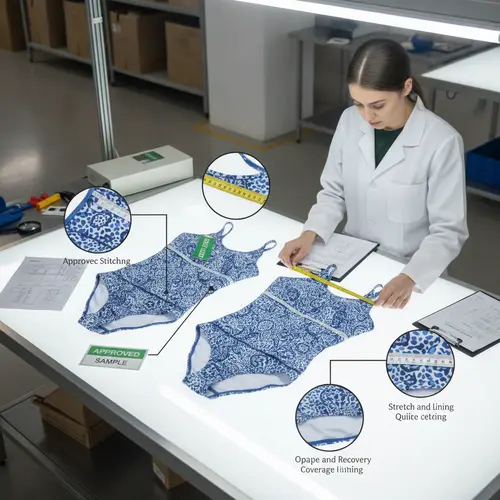
Agree on the inspection scope and how defects will be classified. Decide whether checks will cover selected units, a statistical sample, or every piece, and what happens when an order fails the agreed criteria. Do not assume that “QC included” means all units are inspected or every type of defect is covered.
OYOYI’s QC service can be part of the production arrangement. Establish the inspection stage, reporting format, and responsibility for corrections when discussing the order. Visual inspection and measurement checks should not be confused with laboratory testing for chemical restrictions or performance claims.
Confirm Labels and Compliance for Your Sales Market
Small orders are not automatically exempt from product requirements. Identify the destination markets before finalizing labels and packaging, especially if the same collection will be sold in more than one country.
In the United States, most textile apparel generally needs fibre-content information, country of origin, and identification of the manufacturer or another responsible business. Care instructions are also generally required for covered apparel. Confirm how the applicable rules affect your specific product.
For EU consumer sales, textile composition must use permitted fibre names, and label information must meet the relevant language requirements for the countries where the product is offered. A brand label by itself does not provide the required composition information.
Labels are only part of the work. Identify applicable product-safety, chemical-restriction, traceability, and documentation obligations with qualified support. Children's swimwear requires a separate assessment of relevant requirements; an adult product checklist is not enough.
Ask suppliers for records tied to the actual materials and production order. Keep approved specifications, label artwork, relevant test reports, and inspection records together. Avoid treating a generic supplier certificate as proof that every product is compliant in every market.
Make the First Order Something You Can Learn From
The purpose of a first production run is to create a sellable product while learning which fit, sizes, colours, and price points customers respond to. That information becomes more useful when the product itself is consistent.
Before authorizing bulk production, confirm the approved sample, final specification version, material availability, quantity breakdown, label artwork, inspection arrangement, and shipping responsibilities. Build the launch schedule around those approvals rather than relying on an estimated production time alone.
A reorder should use what you learned. Review fit-related returns, customer feedback, and sales by size and colour before adding more designs. If a material or construction detail needs changing, document and approve that revision instead of assuming the next batch will solve it.
Take the Next Step with OYOYI
If you are preparing your first swimwear launch, start with OYOYI’s free AI swimwear Tech Pack tool to develop a clearer product brief. Bring that draft into a discussion about sampling and small-batch custom production, or explore OEM/ODM and private-label cooperation if an existing design base better suits your business. You can also browse the ready-stock catalog to assess a more immediate product route. Share your target market, intended fit, size range, branding requirements, and expected order quantity so the conversation can focus on practical options and a clearly scoped quotation.
Frequently Asked Questions
What is a realistic MOQ for a new swimwear brand?
There is no single minimum that applies to every project. The requirement depends on the style, colour, fabric availability, print, trims, and supplier’s production setup. Ask for the MOQ for your actual specification and confirm whether sizes can be mixed. A small garment minimum may still come with a separate custom-fabric or branding minimum.
Do I need a Tech Pack if I only have a swimsuit reference image?
A reference image is useful for communicating appearance, but it usually leaves measurements, materials, lining, and construction undefined. A Tech Pack turns those decisions into instructions that can be quoted and reviewed. An AI-generated starting pack can help organize the brief, but its technical details should be checked with the supplier and confirmed through sampling.
Which fabric should I choose for my first swimwear collection?
Choose the specific fabric against the product’s intended use rather than relying on nylon or polyester as a quality label. Compare hand feel, stretch recovery, opacity, lining compatibility, and relevant performance evidence. Evaluate actual swatches and samples wet and stretched, especially for pale colours and areas under high tension.
Can I skip sampling when ordering a small quantity?
For a custom design, skipping sampling leaves fit and construction assumptions unresolved regardless of order size. Approve the relevant materials, measurements, and garment details before bulk production. For existing private-label or ready-stock products, reviewing a physical sample is still useful, and modifications may require a separate sample approval.
Is private-label or ready-stock swimwear better than custom manufacturing for a first launch?
It depends on your business model. Private label can suit a brand that wants its own identity on an established product, while ready stock can help evaluate a sales channel with limited development. Custom manufacturing makes more sense when original fit or construction is central to your offer. Compare sample quality, permitted changes, branding rights, minimums, and replenishment options before choosing.