
Why DTC Swimwear Returns Are So High — Not Just Fit
Swimwear has one of the highest return rates in apparel — 30 to 40% for DTC brands. The easy explanation is "bad fit, bad factory." The real picture is more honest than that, and more useful: return rate is shaped by at least six different factors, and manufacturing tolerance is only one of them. Treating it as a single problem with a single fix — usually "find a better factory" — misses most of what's actually driving returns.
Six Real Factors Behind Swimwear Returns
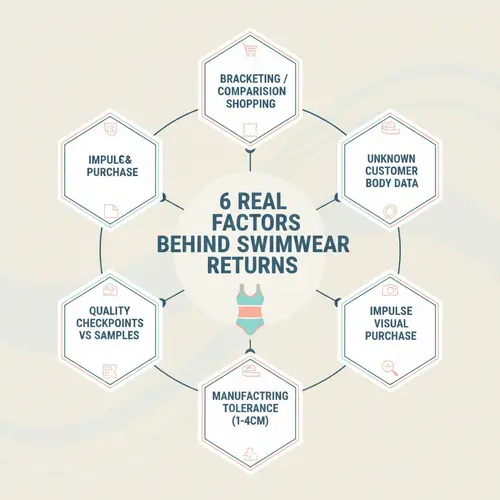
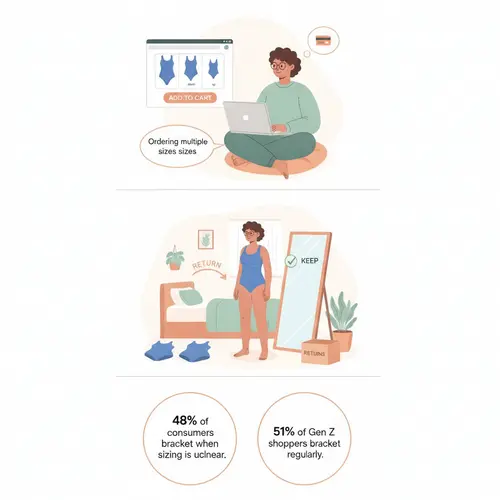
1. Comparison shopping is baked into how people buy swimwear — and it has a name: bracketing. Most shoppers order multiple sizes or styles at once, try everything on, and return whatever doesn't work — it's not a defect complaint, it's simply how online apparel gets shopped now. This isn't a fringe behavior: 48% of consumers report bracketing specifically when sizing is unclear, and 51% of Gen Z shoppers say they regularly bracket apparel and footwear purchases, compared to 36% of Gen X and 24% of Baby Boomers. Swimwear, with its size-sensitive fit and lack of a fitting-room equivalent online, sits squarely in the category where this behavior is most common.
2. Brands often don't actually know their real customer's body yet — and that's normal, not a failure. A founder's assumption about "the right fit for our customer" is a starting hypothesis, not a known fact. Most brands only discover who their real audience is, and what their actual body proportions look like, through return and fit-feedback data over time. This is a meaningful reason new brand success rates are low — the brands that become genuinely profitable are the ones that used that feedback loop to learn who they're actually fitting, rather than treating early returns purely as failure.
3. Some fabric and construction choices inherently limit who a style fits well — regardless of manufacturing quality. Swimwear fabric is mostly built around high stretch, but specific constructions (underwire, structured cups, certain pattern cuts) are, by design, only going to work well across a narrower range of body shapes. That's a design decision with real fit consequences, not a production error.
4. Swimwear is bought on impulse, and it's an intensely visual purchase. Product photography features models with idealized proportions in aspirational settings — and in that moment, "will this actually fit my body" is competing with "I want to feel like that." That gap between purchase motivation and fit reality shows up later, at the return stage.
5. Bulk production carries real, expected size tolerance — this isn't a defect, it's how manufacturing works. A sample represents a target, not a guarantee down to the millimeter across a full production run. Industry-normal tolerance is typically in the range of 1–4cm depending on the measurement point — for example, roughly ±1cm on cup height, and roughly ±3cm on bust or hip circumference are generally considered within acceptable range, not a manufacturing error. ASTM's body measurement standards for women's apparel exist precisely because body proportions vary continuously across a population — no single set of size charts, or a single "perfect" sample, can represent that variation without some tolerance built in.
6. Whether a factory "tests every size" is almost the wrong question. Even when a factory does produce test samples across a full size run, that testing is typically done by a single skilled worker producing something close to a best-case result — not representative of what an assembly line running at volume actually produces. So "did they test every size" doesn't really tell you much. The real question is whether quality control is checked in at every key production checkpoint — reviewing measurements and workmanship at each stage and course-correcting as the batch moves through production — rather than relying on one upfront "perfect" sample to guarantee consistency across an entire bulk order.
What Fit-Related Returns Actually Cost — In Real Numbers
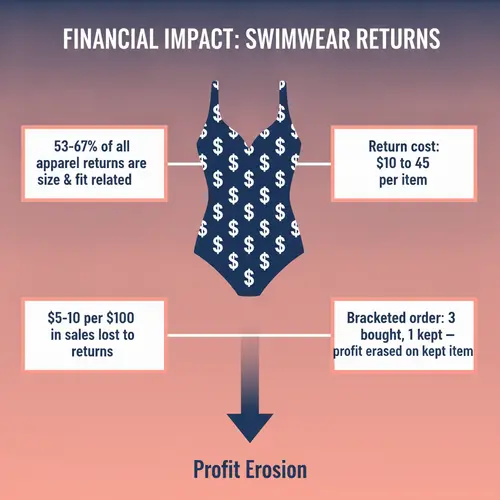
Here's a number worth sitting with: size and fit account for an estimated 53–67% of all apparel returns, meaning most of what falls under this article's factors 2, 3, 5, and 6 isn't a marginal issue — it's the majority driver, with comparison shopping and impulse buying (factors 1 and 4) contributing the rest.
The financial impact per return is bigger than most brands price in upfront. A single return typically costs a merchant $10 to $45 to process once reverse logistics, labor, and inventory depreciation are factored in, and NRF data puts the overall cost of apparel returns at roughly $5–10 for every $100 in sales. On a bracketed order — where a customer buys three sizes of the same style intending to keep one — the return costs on the two rejected pieces can fully erase the profit margin on the piece that was actually kept. This is why return rate isn't just a customer-experience metric; it's a direct line item eating into margin on every order it touches.
What This Actually Means If You're Trying to Reduce Returns
Some of this return rate is structural and not something any single brand or factory can eliminate — comparison shopping and impulse-driven purchasing aren't going away, and at roughly 50% of Gen Z shoppers bracketing as standard practice, that share of returns is a cost of doing business in this category, not a fixable defect. What is controllable — and what the 53–67% fit-related share above points to as the highest-leverage lever — is understanding realistic manufacturing tolerance upfront so you're not chasing an impossible zero-variance standard, working with a factory that checks quality at every production stage rather than only at initial sampling, and treating early return and fit-feedback data as information about your real customer rather than pure failure. For some brands, that data points toward a structural fix rather than a tolerance fix — sizing tops and bottoms separately measurably reduces returns for exactly this reason.
Certification is a separate lever some brands reach for to reduce return-driving quality concerns — worth knowing that for most independent DTC sites specifically, it's often optional rather than mandatory. See the real difference between marketplace-required and independent-site certification.
One specific, real return-dispute trigger worth knowing about directly: a compromised hygiene sticker on the gusset. See what it actually is, what it isn't, and where it commonly fails.
Another real, specific return trigger in supportive swimwear: underwire poking through the fabric. See why that's almost never actually a wire-quality problem, and what to ask a factory about instead.
FAQ
Q: What does a fit-related return actually cost a swimwear brand?
A: More than most brands account for. Processing a single return typically costs $10–45 once reverse logistics, labor, and inventory depreciation are included, and industry data puts overall apparel return costs at roughly $5–10 per $100 in sales. On a bracketed order — where a customer buys multiple sizes intending to keep one — the cost of the rejected pieces can wipe out the entire margin on the piece that's kept.
Q: Is a 30-40% return rate normal for swimwear, or a sign something's wrong?
A: It's within the normal range for the category — swimwear has structurally higher returns than most apparel, driven by comparison shopping, impulse buying, and the reality that most brands are still learning their true customer's fit needs. A rate well above that range, or returns concentrated on specific defects rather than general fit, is a more useful signal to investigate.
Q: What size tolerance should I expect from a bulk swimwear order versus the sample?
A: Roughly 1–4cm of variance depending on the measurement point is generally considered industry-normal — for example, around ±1cm on cup height and ±3cm on bust or hip circumference. This isn't a defect; it reflects the reality of producing at volume rather than one hand-finished sample.
Q: Does testing every size before bulk production guarantee consistent fit?
A: Not by itself. A single test sample per size is usually produced by a skilled individual worker under close to ideal conditions, which doesn't fully represent assembly-line output at volume. Ongoing quality checkpoints throughout production matter more than a single upfront test.
Q: How do I know if returns are a fit-design issue versus a manufacturing issue?
A: Look at where the returns cluster. If they're spread across sizes with no consistent pattern, it's more likely general fit/design or comparison-shopping behavior. If a specific size or measurement point is consistently off in the same direction, that points more clearly to a production tolerance or process issue worth raising with your factory directly.
Q: Should I expect my return rate to improve over time without changing anything?
A: Not without using the feedback. Return and fit data is genuinely useful information about who your real customer is — brands that treat it as a signal to refine sizing and fit tend to see real improvement; brands that treat every return purely as a failure often don't adjust anything and see the same rate persist.
This ties directly into the broader manufacturing feasibility questions worth understanding before production, not just after returns come in.
It also connects upstream to sampling: see how we keep first-sample accuracy high without ever requiring a client to write a technical spec.
Trying to figure out whether your return rate points to a design decision, a sizing assumption, or a production issue? Send us your size chart and current numbers — we'll help you figure out what's actually driving it.